Showing posts with label science. Show all posts

Wednesday, November 30, 2016

Learning with Pinecones

Learning with Pinecones
Today was drizzling. As I walk with preschoolers we listen to rain, step in puddles and admire raindrops cascading off a roof. We pass a couple of tall pine trees and check out the bundles of needles littered on the grass. Count the needles in each bundle: some have three, four, or five needles. The pines are Eastern White pines that have up to five needles in a bundle. We look for pinecones too. I have setup our class in a gazebo - where we continue to listen to the rain and can be sheltered.

Observation
A selection of pinecones to pass around, touch, lift and smell engages the young learners. The pinecones smell of resin, some are sticky, others prickly. The Coulter pinecone is huge, spiky and incredibly heavy and resiny. The sugar pinecone is light and long. The Jeffrey pinecone is also huge, and surprisingly strong yet light. For each pinecone we can see where the seeds grow and are protected - and have fallen out. Bring a pineapple and a dried sunflower flowerhead to highlight the similar fibonacci spiral patterns. I also bring in another different seedhead: one from a “bobbletree” - Liquidambar to compare and contrast with the pinecones patterns. This helps set the scene for an appreciation of patterns and diversity.


Coloring as prelude to journaling
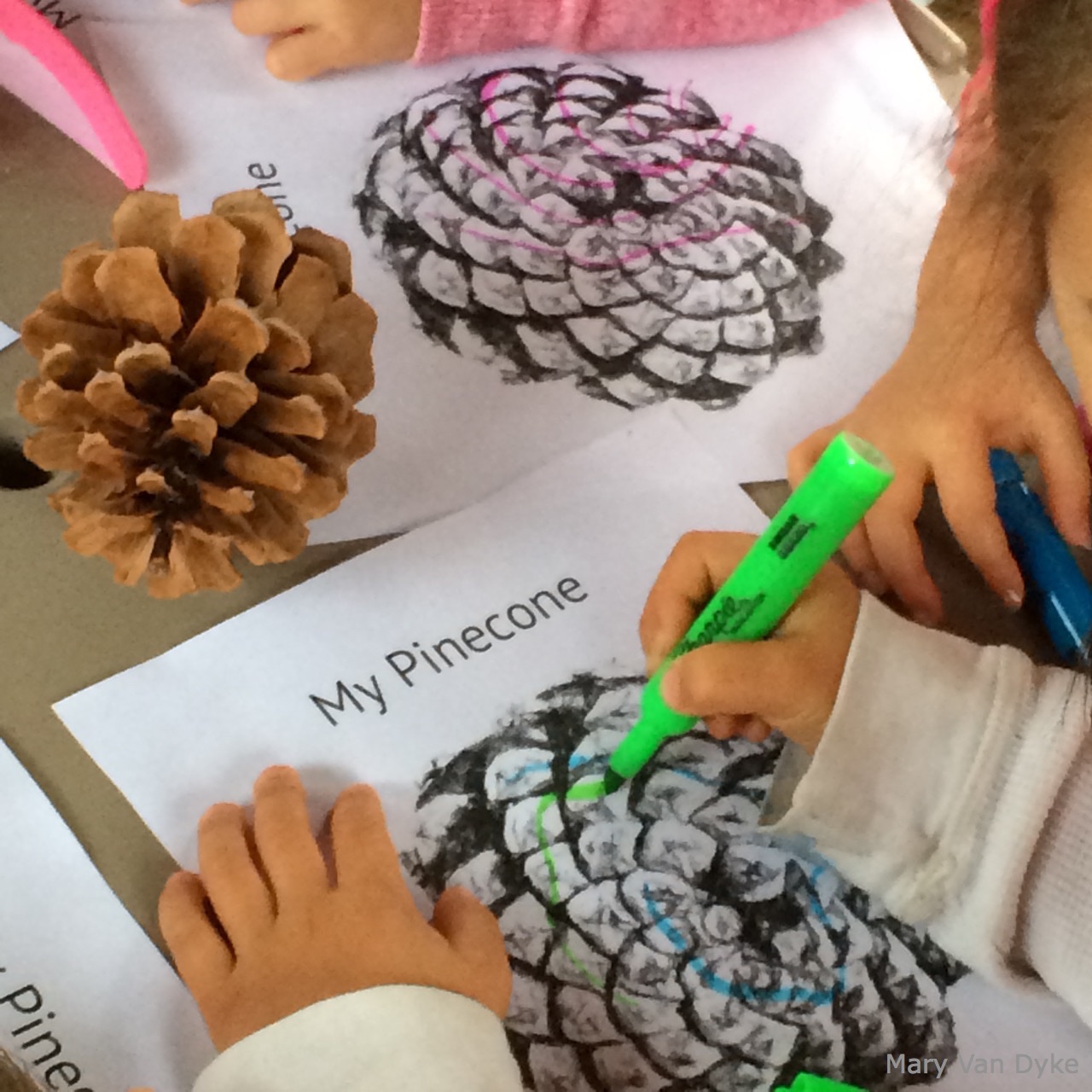
I leave a medium-sized pinecone in the table of the table and give students the My Pinecone coloring sheet.

Observe the spirals on the drawing sheet.
With highlighters I encourage the students to highlight the spirals in one direction. Then we pick a different color highlighter and try to find and color the spirals going in the opposite direction.
The preschoolers enjoy writing their names on the sheets too. Coloring can be trendy therapy, it is also a first step to future journaling.


Decorating pinecones to take home
I have collected small pinecones from a Virginia pine tree (the State Virginia pine tree) - that fell in a storm a few winters ago. Each year I collect a few more from other trees in the neighborhood.
Students decorate a small pinecone using glitter glue. Taking time with the brush and glue is fun and enhances the sensory experience. The pinecones take a day to dry. Students can take home as a gift from the garden to enjoy as a seasonal sparkly winter decoration, and reflect on the patterns they’ve experienced in nature!

We go back to class stomping in the puddles and looking at the clouds!

Resources

Pinecone coloring sheet - download, print and color http://www.slideshare.net/MaryVanDyke/my-pinecone-coloring-sheet-greenstem

Tuesday, June 9, 2015

Strawberries: Ripe for Inquiry

Do your "schoolgrown" strawberries taste good? Ours do!

Is that a fact or a hypothesis?  
Sounds like the time “is ripe” to do some inquiry and project-based science and art.

Strawberries are a wonderful and delicious teaching tool that cycles with the school year here in Virginia as you can observe them grow over the winter, flower, produce berries and harvest to eat in May and early June.
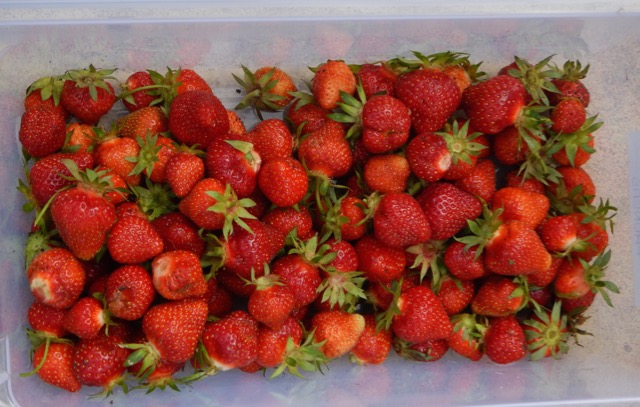
DSCN1301.jpg
Strawberries - May 2015, Jamestown Elementary School
May is Strawberry Month. If you missed it, put it on the calendar for next year and plan ahead to grow some and use strawberries to teach a lesson or two as they grow...


A few stats from the industry- as growing Strawberries is a billion-dollar business...
11262424_951528224892411_8530784529465069345_n.jpg
Where to grow strawberries?
Grow some strawberries in the ground - with or without netting


Here's some grown in the shade at Arlington Traditional School

Here’s plants in a sunny spot at Jamestown Elementary School.


Here are some container grown in EarthBoxes - with red plastic mulch with the Homeschool Club of Arlington.
The red plastic mulch speeds up the ripening compared to black mulch or straw. Do an experiment comparing mulches and see if you agree? And check your results with research from Penn State.


Here’s some commercially field grown strawberries with black mulch and irrigation system at Mackintosh Fruit Farms.

Here’s scientists growing strawberries in glasshouses and testing different cultivars in a gutter "sock" hydroponics system at Lynchburg Grows.

Strawberry Towers
Photo from DC School Garden Bike Tour Cultivate the City via Facebook
Or grow strawberries and pineberries in tower gardens or garden towers - and grow a business as at JO Wilson, DC Public schools.


Talking of art and strawberries
Notice the patterns of the seeds on the outside and the beauty of the cross-section

Notice the color and pattern


Make a clay brooch. here’s mine from pre-Sculpy days!


Or choose a technique to make signs for the school strawberry patch. Here above is a 5-year old's painting with acrylic on board, that I then sealed with acrylic spray sealer. The students nailed their own boards to the stakes for our kitchen garden signs. The stakes untreated last about a year, the painting longer.


Here are a couple of signs I made for school and community gardens. I designed the artwork on powerpoint or google presentation and laser printed onto Xerox Never Tear polyester paper and put into metal signholders. The ink lasts a couple of years or so.


What’s not a strawberry? The false strawberry!
Got those prolific little strawberries that taste dry and dusty in your home or school yard? Those plants with the yellow flowers are “false strawberries”.
False strawberry Duchesnia indica, has yellow flowers
Wild strawberries, and strawberries cultivated for fruit have white flowers.
Wild strawberry, Fragaria virginiana has white flowers
Cultural context
Wild strawberries are native to Virginia. 
  • Read the Cherokee Indian story about the First Strawberry.
937381


Ideas for experiments
  • Do a KWL diagram of what students already know before the project, want to learn, and have learned after your project.
  • Does mulching with red mulch, black mulch or straw help increase yield?
  • Test for shade and sun production?
  • How do different soil conditions affect our harvest?
  • Does a strawberry grow better in clay, silt or sandy soil?
  • What other factors are affecting results?
  • Do fertilizers (nutrients for the plant) affect production?
  • Grow strawberries indoors and measure runners (see NSTA article)
  • Extract Strawberry DNA (see resource links below)
  • For elementary students read The Strawberry by Jennifer Coldrey and George Bernard

Field Trip
Take the students to a berry or fruit farm near you to see technology and agri-business in action.
  • How is strawberry production affected by weather in your area? 
  • Are the farmers growing strawberries indoors or out? 
  • What’s the market? Who are they growing strawberries for? 
  • How much do they sell the strawberries for?  How much does it cost to produce each strawberry?
I was talking to some scientists last year who were designing a strawberry de-hulling machine and wanted to pilot it. They showed me pictures of the machine and how it was designed to hull strawberries - and was much safer than tools currently often used by workers in the fields for example in Florida.  I put the scientist team in contact with some of our local food distributors to set up a real world piloting experiment for the machine.  I wonder if they are piloting it now?
How Food Grows has some resources, including a time-lapse video of strawberries growing. I am also waiting for the How Does It Grow folks to produce film on strawberry production, if they do I will post it.  In the meantime, here below are some additional "strawberry-themed" resources.


Strawberry Resources
LINK to how to make signs using QR Codes and Xerox Never Tear paper technique
  • Strawberry Lifecycle Sign for schoolyard by Mary Van Dyke
  • Strawberry sign by Mary Van Dyke linked to QR Codes of stories for younger audience
Green STEM Learning Blog links:
Books
The First Strawberry retold by Joseph Bruchac, illustrated by Anna Vojtech
The Strawberry by Jennifer Coldrey and George Bernard

Films
How Strawberry Grows - timelapse


NGSS and VA SOL Standards Activities and Correlation Examples
Garden-based learning at Elementary School:
It’s just the Berries - NSTA Science and Children journal p 58.


NGSS 3rd Grade - Inheritance and Variation of Traits
http://www.nextgenscience.org/3ivt-inheritance-variation-traits-life-cycles-traits

VA SOL 3rd Grade Science - Plant Lifecycles


Middle Schoolers approx 7th Grade - Genetics
Extracting DNA from Strawberry

High Schoolers VA SOL Sample Lesson Life Sciences
Extracting DNA from Strawberry


Wednesday, October 1, 2014

Seeing Math Patterns in Nature - For Kids of All Ages

Here's a preview of my presentation for a workshop on Seeing Math Patterns in Nature for the National Science Teachers' Association, NSTA Conference in Richmond, VA, 16 - 18 October.  This is timely, as the October 2014 issue of the NSTAs Science and Children e-Journal is on "Patterns" too.

In my workshop, we'll take a look at plant growing patterns that you see in pinecones, pineapples, sunflowers and other plants that are easy to find in your garden, schoolyard and grocery store - and we check out Fibonacci and non-Fibonacci sequences.

Here's my powerpoint:


Seeing Math Patterns in Nature from MaryVanDyke

As Vi Hart might say,  "Are you still feeling spirally today?"
If so, give yourself 20 minutes and check out her YouTubes:
Doodling in Math: Spirals, Fibonacci, and Being a Plant Part 1: http://youtu.be/ahXIMUkSXX0

Part 2: http://youtu.be/lOIP_Z_-0Hs
Part 3: http://youtu.be/14-NdQwKz9w

And also spend a minute or two playing with Wolfram Mathematica's interactive models.
My favorites are:

Fibonacci Tree by Sandor Kabal

3D Spirals by Stephen Wolfram

On the Fundamental Theory of Phyllotaxis by Dmitry Weise


Enjoy the math.
It's as easy as one plus one...and then some.

Wednesday, September 3, 2014

Infographics - Talking Pictures

A picture speaks a thousand words, and catches your attention and appreciation.

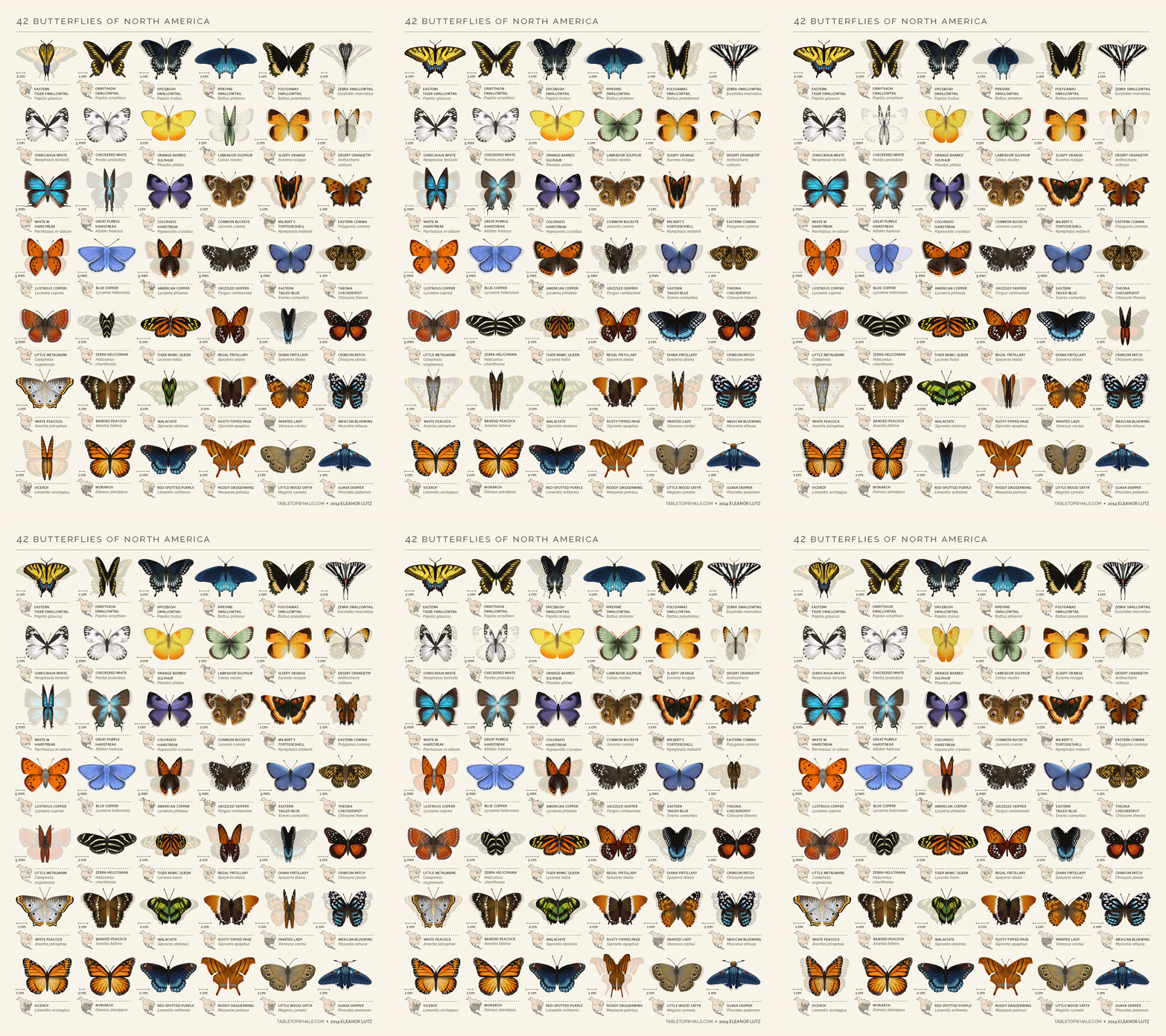
Wow your class with this fluttering butterflies infographic by Eleanor Lutz at Tabletop Whale.

http://tabletopwhale.com/2014/08/27/42-butterflies-of-north-america.html


Perhaps your students could also draw a couple of butterflies and animate them using simple gif-techniques?

Tabletop Whale publishes new infographics with science theme every two or three weeks. Check back frequently - or sign up to receive them.

Thursday, July 17, 2014

Explore Peep and the Big Wide World

Click and explore Peep and the Big Wide World http://www.peepandthebigwideworld.com/. You will find lots of ideas for pre-K and elementary-age kids.

Watch a few episodes and the short animations - and then do some experiments yourself!

"The Emmy-winning science and math series is set in and around a large urban park — a place of great wonder and mystery, a "big wide world" the characters are forever eager to explore...
...Peep narrator Joan Cusack, the mother of two young boys, marvels over the everyday science offered on the show and what it means to kids at home: “I’ve learned that just because you’re four or five years old and still using a sippy cup doesn’t mean you’re not a scientist… I love this show! It inspires kids and lets me see the world through their curious eyes.”


Sunday, April 6, 2014

Art and Science: Mural by Kyle Pierce at the Smithsonian Natural History Museum

Yesterday I was at the Smithsonian Natural History Museum for a free workshop to DNA barcode fish with 14 teens and scientist mentors.  I also visited Q?rius,  the Natural History Museum's beautiful 10,000 sq feet daylit "curiosity cabinet".  I enjoyed the new mural, and a chance to meet and talk with the artist, Kyle Pierce.


Here's more about the new mural on Kyle's blog: http://blog.kylepierceillustration.com/2013/12/12/mural-for-qrius-at-the-smithsonian/


Kyle and I talked about inspiration, science, walls, art, and mural techniques.
This mural for example is made by photographs printed on to vinyl, and works indoors.
Is there a technology to do this kind of work outdoors?
As quoted on the mural:

"The question is not what you look at, but what you see."  Henry Thoreau 

That goes for whether you are here to barcode fish, or to create buildings and art!


Sunday, August 18, 2013

Back to School: ideas for play, math, science and design with gourds, pumpkins and squash

Here for K- 5 educators - ideas for play, math, science and design with gourds, pumpkins and squash.


Gourd Math from MaryVanDyke

Check out planting, growing and harvesting details for gourd family plants in your zone.
Here in VA, gourds, pumpkins and squash are easy to plant in May and June.
The plants can then look after themselves over the summer vacation...and will be ready to harvest when kids go back to school in the fall.