Showing posts with label STEM. Show all posts

Thursday, December 29, 2016

Green STEM Learning ~ Review of 2016 and Next Steps 2017


Here's my review of Green STEM Learning for the year 2016.


Thank you to clients, individuals and organizations I've worked with this past year to bring outdoor programs to students. 


And here's to a healthy and inspirational new year 2017!


Wednesday, November 30, 2016

Learning with Pinecones

Learning with Pinecones
Today was drizzling. As I walk with preschoolers we listen to rain, step in puddles and admire raindrops cascading off a roof. We pass a couple of tall pine trees and check out the bundles of needles littered on the grass. Count the needles in each bundle: some have three, four, or five needles. The pines are Eastern White pines that have up to five needles in a bundle. We look for pinecones too. I have setup our class in a gazebo - where we continue to listen to the rain and can be sheltered.

Observation
A selection of pinecones to pass around, touch, lift and smell engages the young learners. The pinecones smell of resin, some are sticky, others prickly. The Coulter pinecone is huge, spiky and incredibly heavy and resiny. The sugar pinecone is light and long. The Jeffrey pinecone is also huge, and surprisingly strong yet light. For each pinecone we can see where the seeds grow and are protected - and have fallen out. Bring a pineapple and a dried sunflower flowerhead to highlight the similar fibonacci spiral patterns. I also bring in another different seedhead: one from a “bobbletree” - Liquidambar to compare and contrast with the pinecones patterns. This helps set the scene for an appreciation of patterns and diversity.


Coloring as prelude to journaling
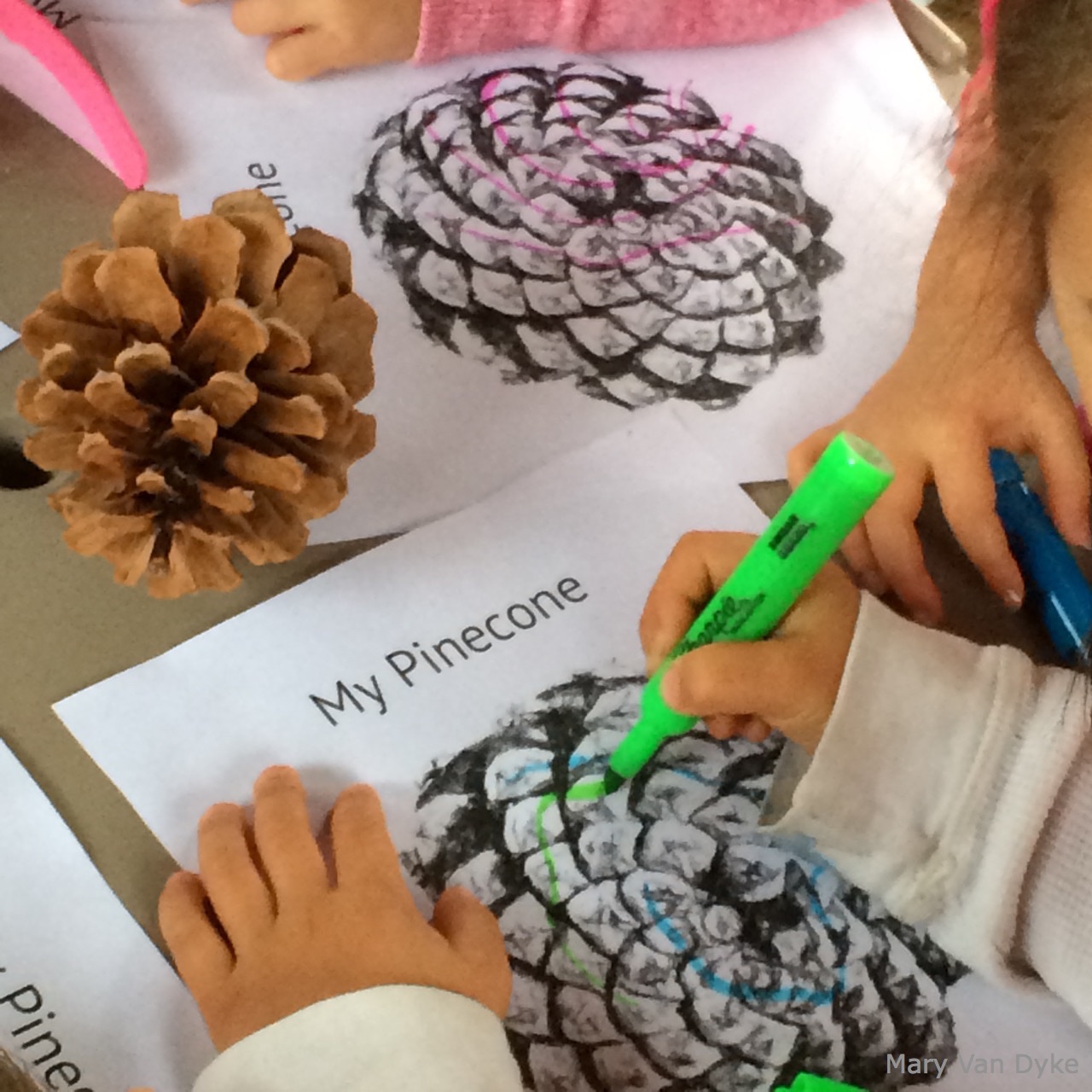
I leave a medium-sized pinecone in the table of the table and give students the My Pinecone coloring sheet.

Observe the spirals on the drawing sheet.
With highlighters I encourage the students to highlight the spirals in one direction. Then we pick a different color highlighter and try to find and color the spirals going in the opposite direction.
The preschoolers enjoy writing their names on the sheets too. Coloring can be trendy therapy, it is also a first step to future journaling.


Decorating pinecones to take home
I have collected small pinecones from a Virginia pine tree (the State Virginia pine tree) - that fell in a storm a few winters ago. Each year I collect a few more from other trees in the neighborhood.
Students decorate a small pinecone using glitter glue. Taking time with the brush and glue is fun and enhances the sensory experience. The pinecones take a day to dry. Students can take home as a gift from the garden to enjoy as a seasonal sparkly winter decoration, and reflect on the patterns they’ve experienced in nature!

We go back to class stomping in the puddles and looking at the clouds!

Resources

Pinecone coloring sheet - download, print and color http://www.slideshare.net/MaryVanDyke/my-pinecone-coloring-sheet-greenstem

Wednesday, February 18, 2015

Inspiration: The Love + Practice of STEAM

My teen daughter tells me this week that she wants to be a "neuroscientist who likes to practice music and play with clay". I listen and say, "YES!" aloud and in my heart. However, this week she had to choose between art and music at high school. Despite block scheduling and selecting options, I hope that she will continue to integrate her love of practicing the arts, sciences and languages.

On Valentine's Day I went to the Virginia Association of Science Teacher's conference on Inspiring a Love of Science with STEA*M (Science, Technology, Engineering, *the Arts and Mathematics). Keynote Speaker Margaret Hancock presented on "Thinking like Artists and Designers".  Her photos of the iconic Saarinen Womb chair and the Glasshouse by Mies Van der Rohe, reminded me of my architecture school days of thirty years ago! Then Margaret updated us to our digital ecologically-aware age with images from Patrick Dougherty's Stickwork and the architecture of Rural Studio.


Why S.T.E.A.M?
Observing and understanding nature is what Science is theoretically, but how and why? I never bought that "only observer" deal anyway. Did you? So the moment you acknowledge your active participation in systems: here comes integrating Engineering while gathering, hunting for and inventing the tools, the Technology, to help the observation, inquiry and the inevitable impetus to design and the iterative process. And whether you name it or not, you will add the Arts (and no doubt some aspects of religion or faith) to help with decision-making between various solutions and to acknowledge our basic need for symbolic references. Underlying patterns, economics and relations between all the variables there is a lot of Math, even if it is beyond your and my ability to solve for "x". So we have integrated STEAM in a nutshell. STEAM is more than just the sum of the parts:it shows emergence and synergy.

Talking of metaphors: I thought about calling this blog "Green STEAM Learning". But "Green STEAM" conjured up images of wilted lettuce and viridian clouds, so I went with the simpler "Green STEM Learning" to convey themes of integrated environmental education and sustainability.

STEAM at Home
Here is a simple example of "thinking like an artist and designer" and the synergy of STEAM in action at home.

My daughter and I spent some afternoons setting ourselves the task of making some jewelry together. We decided to go with a "cheap eats" theme and to collaborate. She decided to make Junk Food Jewelry while I made some Wearable Edible veggi brooches. And yes, we assessed plenty of social values and prejudices right there.
Junk Food Jewelry


We bought premixed polymer clay. And weighed the pros and cons and viability of alternatives such as homemade salt dough. Polymer clays are expensive, hence our decision to make small things. The color range can be enhanced by combining clays and adding pastel dust with a paintbrush. And you might experiment with some shaping tools in addition to fingers. Then you bake the objects in the oven for a few minutes to set.


Wearable Edibles


The engineering comes into play with questions such as:

  • How to create objects that work on necklaces, brooches, bracelets?
  • Do they balance well when you wear them?
  • Do they move successfully with the body, or fall off?
  • What kind of glue or fitting works best to fix a clay shape onto a metal armature?

It is a challenge to work within the budget, timeframe, technical capability and health and safety protocols that we have here at home -  or you might have in the classroom.

The creative and engineering processes are all about "having a go", experiments, analysis, feedback and iterative design. For example: the first peapod brooch toppled over on wearing. So I drew a cross-section and decided to hollow out the back and recess the brooch clip. This technique works well on the carrot and leek brooches too.


The peapods were easier to make if individual peas were baked first to harden, then clad with the pod layers and rebaked. The radish soft magenta color was achieved with pastel and water coloring - a more subtle shade than achieved by clay alone. We also used 3D modeling to good effect on the radish and chocolate chip cookies. The carrot and fronds were based on form of the pink cancer awareness ribbon brooch.


My daughter's Junk Food Jewelry and my Wearable Edibles selections both work on the symbolic artistic level, referencing well-known foods and vegetables at a miniature scale.

The result our collaborative, FUN, STEAM project-based learning.
We decided the plain chocolate chip pendant and earrings are a hit, and would sell like "hot cakes" with teens and other audiences.


Now two years on, my daughter still enjoys making and experimenting with polymer clay.  Her latest line is in "chibi" portraits as gifts to her classmates.
Emma's Chibi

Michelle's Chibi


She also takes classes at the community center to learn to throw pots, and she has chosen to study Ceramics at High School.

STEAM at Work
At this weekend's Love of Science and STEAM conference I went to other inspirational sessions. I heard George Mason Professor, Changwoo Ahn talk about his collaborative work:EcoScience + Art and current initiative: "The Rain Project - sustainable water management in an era of climate change" and his proposal for future efforts on food systems, soil and composting "The Dirt Project".

I enjoyed meeting Andrea Brothers from Micron Technology, and her multi-faceted presentation on life choices and career paths. She practices electron-microscopy to enhance yields of silicon memory products, plays violin and blends interests in art, science and technology. She played us her latest tunes, and shared her passion for innovation and design.
Andrea Brothers

STEAM at Play
I trained for many years as an architect. I also think like an architect unschooled. Here's one of my "early play dwellings", a Mouse House, or perhaps it is a model for a silicon chip?
On the Beach, Chios, April 1971

Here's to an integrated approach to education, creativity, experimenting and innovation, and to enabling holistic choices and designs. Whether or not you call it STEAM.


Thanks to Susan Bardenhagen for hosting VAST Region 8 PD Conferences, and being the VAST Region 8 Representative, and thank you to my daughter Maya, Andrea Brothers, Changwoo Ahn and Margaret Hancock for sharing their love and inspirations.


Friday, November 14, 2014

A Big STEM Project for 3 - 4 Year Olds and Up: Build Your Own Sandbox


Our vision is to make a sandbox for the kids. But what if perhaps we make the sandbox with the kids? After a one-minute conversation with teacher, aide and myself we decide to assemble the sandbox with the kids.
The result: I enjoy a wonderful afternoon building a sandbox with seventeen 3-4 year olds in the Montessori Program at Jamestown Elementary School.

The students do a great job. This is STEM (science, technology, engineering and math) and project and place-based learning at its best.
  • Let's have a go. We sit in a circle around the big box labeled "sandbox" and open it....  
  •  It's exciting! Let's see what's inside. What do we do?
  • We do lots of math. (The pieces are numbered.  How many corner pieces? How many side pieces? How many screws do we have?  And so on)
  • The students follow diagram directions
  • Everyone has a go and we use tools like Allen key, screwdriver and a hammer
  • We learn teamwork
This "Build Your Own Sandbox" is a great STEM project for tots and adults.

To do your "Build Your Own Sandbox" project you need:
People: Two to three adults and up to 16 kids (3- 4 years old - or older) optimum
Time to assemble: One hour
Time to fill: One hour - plus play time!
Sandbox Kit: We use a KidKraft Sandbox, 5 foot square, (cost about $150 from Amazon.com). Cost of sand, pebbles and earth not included.
Tools needed: An Allen key is in the box. You might like to have an extra Allen key(s) so kids can share, and a hammer, a few old nails, and screwdrivers (flat and Philips) just in case you need them.


Next week:  We'll put the sandbox outside in a quiet place in the playground, and fill it with sand, pebbles and earth for digging.

Thanks to staff Rachel Kipperman and Margaret MacLaughlin at Jamestown Elementary school for facilitating this project with students in the Montessori Program.

Sunday, November 9, 2014

Happy 4th Birthday to "How to SMILE" and Celebrating Their Free STEM Lessons

Looking for something STEM to do with kids?

Check out www.howtosmile.org for 1000's of STEM lessons - a collection built up over the last four years.

On your phone too...
Looking for something STEM and active?

...To promote hundreds of STEM activities that get learners moving, Howtosmile.org has partnered with the Let's Move! Museums & Gardens initiative of the federal Institute of Museum and Library Services."

"Howtosmile.org celebrates its 4th anniversary this month! Launched in 2010 at the Association of Science-Technology Centers (ASTC) annual conference in Honolulu, Hawaii, SMILE has grown to nearly 4,000 STEM activities from more than 150 source institutions, in 28 languages.... 
Photo: Project directors Darrell Porcello and Sherry Hsi were all smiles at their first NSDL conference after SMILE was funded.

....Howtosmile.org has been honored as an ALA Great Website for Kids, AASL Best Website for Teaching and Learning, and Homeschool.com top educational website. Initially funded by the National Science Foundation (NSF), SMILE has been a broad collaborative effort from its inception. Founding partners included Children's Museum of Houston, Exploratorium, New York Hall of Science, Science Museum of Minnesota, Lawrence Hall of Science, ASTC and the National Science Digital Library."

Reposted from: http://www.howtosmile.org/blog/posts/smile-turns-4-0

Friday, August 15, 2014

Earth Force Next Steps Institute Professional Development Program in DC includes Agriculture and STEM Pathway

See http://www.earthforce.org/NSI for details of this Earth Force professional development program: Next Steps Institute, NSI, for teachers in STEM education.

Are you interested in agriscience, food and sustainability?
One of the pathways you can choose at this year's NSI is Harnessing the Power of Agriculture with STEM.


The Next Steps Institute (NSI), powered by Earth Force, is the premier professional development program that promotes hands-on, minds-on learning in STEM education. Organized by pathways that take participants on an engaging journey into critical STEM learning arenas, the Institute offers the depth and breadth of content needed to enhance effectiveness in action and advocacy around STEM.
NSI offers participants:
• Inquiry-based professional development at an affordable cost;
• Tools for effective materials management; and
• Strategies for promotion of 21st century STEM skills using an educational partnership model.

2014 Next Steps Institute: Integrating STEM Learning in Communities
Georgetown University Hotel and Conference Center
3800 Reservoir Rd NW, Washington, DC 20007
Sept. 22-23, 2014
Registration closes September 16, 2014 at 11:59 p.m. EST.
Rooms are available for $149/night. Click here to reserve your room.

   Cost:
Individual - $360
Team of 3 or more people - $330 per person


NSI_website


See http://www.earthforce.org/NSI for further details of all the pathways.
Here below is the promo for the one focused on Agriculture and STEM. 

  • Harnessing the Power of Agriculture with STEM
Building an educated workforce with the skills and expertise necessary to sustain the world’s growing population is at the core of this pathway. Responsible for our food, water, shelter, and energy, agriscience provides a compelling and relevant context to address current issues and events on global and local scales. This pathway, facilitated by faculty from Murray State University and DelCastle Technical High School, takes an issues-based approach to understanding the ways agriscience deepens student understanding of STEM content using relevant, real-world examples.
Come share and generate best practices in teaching and learning that excite students and demonstrate the relevance of agriscience now and in the future. Problem-solving and inquiry-based activities provide a structure for learning crucial content, including: biofuels, crop management, biodiversity, conservation, nutrition, and genetics. 

Wednesday, May 28, 2014

Using GIS in High School: Arlington Washington-Lee HS Student and Teacher Attend White House Education Event


W-L's Catherine Dempsey at the White House Washington-Lee senior Catherine Dempsey and teacher Ryan Miller attended the ConnectED Science, Technology, Engineering and Mathematics (STEM) initiative at the White House yesterday. Dempsey and Miller were invited to attend by the Geographic Information System (GIS) company Esri and chosen by the White House to participate in the event where it was announced Esri will provide support to help strengthen STEM education through the ConnectED Initiative.

The event was held in concert with the Annual White House Science Fair.“The relationship that our Washington-Lee GIS class students have with Esri is a perfect example of a great school partnership. Esri has been very supportive of me as an instructional leader and of the learning endeavors of all of our students over the last several years,” said Miller. “This relationship has been exceptionally beneficial to our school. All partnerships are mutually beneficial, so my students and I were proud to support Esri today, knowing that technology and GIS education will continue to be a growing focus in our classrooms in the years ahead.”Esri, a corporate partner of Washington-Lee, responded to President Obama's call to the private sector to help out education. Esri's support will allow any school in the country to get a free ArcGIS Online Organization subscription account. ConnectED is a government education program developed to prepare K-12 students throughout the U.S. for digital learning opportunities and future employment.

Washington-Lee’s GIS class has been a part of an Esri pilot program and helped to demonstrate that the company's online software is useful and beneficial in the classroom setting.


ArcGIS Online Organization is at http://www.esri.com/software/arcgis/arcgisonline
The White House ConnectED Initiative is at  http://www.whitehouse.gov/issues/education/k-12/connected

Reposted from Arlington Public Schools APS School Talk 5/28/2014

Thursday, May 8, 2014

Do Something Cool! Plant a Soybean....Read and do STEM experiments


Here's a fun project for K-5 to learn about soybeans - one of our US staple crops.


First of all:
Buy Coolbean the Soybean book by Shawn Conley and read to your class.


I learned a lot about soybean production and products from the Coolbean book - and talking to agronomists, crop and soil scientists at the US Science and Engineering Festival last week.
What products do we get from soy? And where do soybeans grow?

I bought some soybeans at the grocery store, fresh green edamame.  The packet said they were from Indonesia.  The edamame beans tasted good and crunchy in my salad.  But I wondered why we imported them when we grow soybeans in Virginia and Maryland too? What are the reasons for the global soybean trade?


Do some soybean experiments
How about doing some cool soybean experiments?
Find ideas online at http://coolbeanthesoybean.org/


Here's a few experiments you could do with your students, 3-5 grade and some soybeans.

Test the strength of your seedlings
See Seed Lifting Power

Sample pods
Then when you harvest your beans, do a random sampling.  How many beans are usually in a pod?

Make soynut butter
Buy some soynuts (dried beans) - and blend to make soynut butter.
Do another experiment - taste it.  Do you like it?

Experiment Extensions:
See other experiments on the Coolbean website pages: http://coolbeanthesoybean.org/

Talk about staple crops - and design your own
 - read Weslandia by Paul Fleischman and design your own staple crops (see Junior Master Gardeners Literature in the Garden curriculum)

And look out for kudzu bugs on your beans!
If you find any - please report any sightings to your local Cooperative Extension office.
Click for details


Grow soybeans

I planted 8 soybean seeds outside today in a container.

I will watch the seedlings grow.
Maybe I will get some beans to make edamame salads later on in the summer?
I am also going to plant some soybeans indoors as that can be done anytime of year.