Showing posts with label strawberry. Show all posts

Tuesday, June 9, 2015

Strawberries: Ripe for Inquiry

Do your "schoolgrown" strawberries taste good? Ours do!

Is that a fact or a hypothesis?  
Sounds like the time “is ripe” to do some inquiry and project-based science and art.

Strawberries are a wonderful and delicious teaching tool that cycles with the school year here in Virginia as you can observe them grow over the winter, flower, produce berries and harvest to eat in May and early June.
DSCN1301.jpg
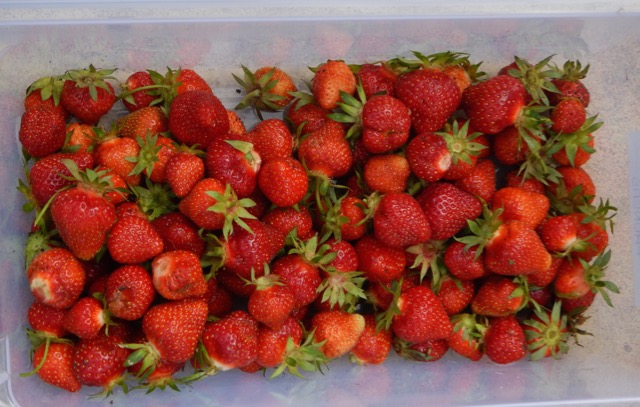
Strawberries - May 2015, Jamestown Elementary School
May is Strawberry Month. If you missed it, put it on the calendar for next year and plan ahead to grow some and use strawberries to teach a lesson or two as they grow...


A few stats from the industry- as growing Strawberries is a billion-dollar business...
11262424_951528224892411_8530784529465069345_n.jpg
Where to grow strawberries?
Grow some strawberries in the ground - with or without netting


Here's some grown in the shade at Arlington Traditional School

Here’s plants in a sunny spot at Jamestown Elementary School.


Here are some container grown in EarthBoxes - with red plastic mulch with the Homeschool Club of Arlington.
The red plastic mulch speeds up the ripening compared to black mulch or straw. Do an experiment comparing mulches and see if you agree? And check your results with research from Penn State.


Here’s some commercially field grown strawberries with black mulch and irrigation system at Mackintosh Fruit Farms.

Here’s scientists growing strawberries in glasshouses and testing different cultivars in a gutter "sock" hydroponics system at Lynchburg Grows.

Strawberry Towers
Photo from DC School Garden Bike Tour Cultivate the City via Facebook
Or grow strawberries and pineberries in tower gardens or garden towers - and grow a business as at JO Wilson, DC Public schools.


Talking of art and strawberries
Notice the patterns of the seeds on the outside and the beauty of the cross-section

Notice the color and pattern


Make a clay brooch. here’s mine from pre-Sculpy days!


Or choose a technique to make signs for the school strawberry patch. Here above is a 5-year old's painting with acrylic on board, that I then sealed with acrylic spray sealer. The students nailed their own boards to the stakes for our kitchen garden signs. The stakes untreated last about a year, the painting longer.


Here are a couple of signs I made for school and community gardens. I designed the artwork on powerpoint or google presentation and laser printed onto Xerox Never Tear polyester paper and put into metal signholders. The ink lasts a couple of years or so.


What’s not a strawberry? The false strawberry!
Got those prolific little strawberries that taste dry and dusty in your home or school yard? Those plants with the yellow flowers are “false strawberries”.
False strawberry Duchesnia indica, has yellow flowers
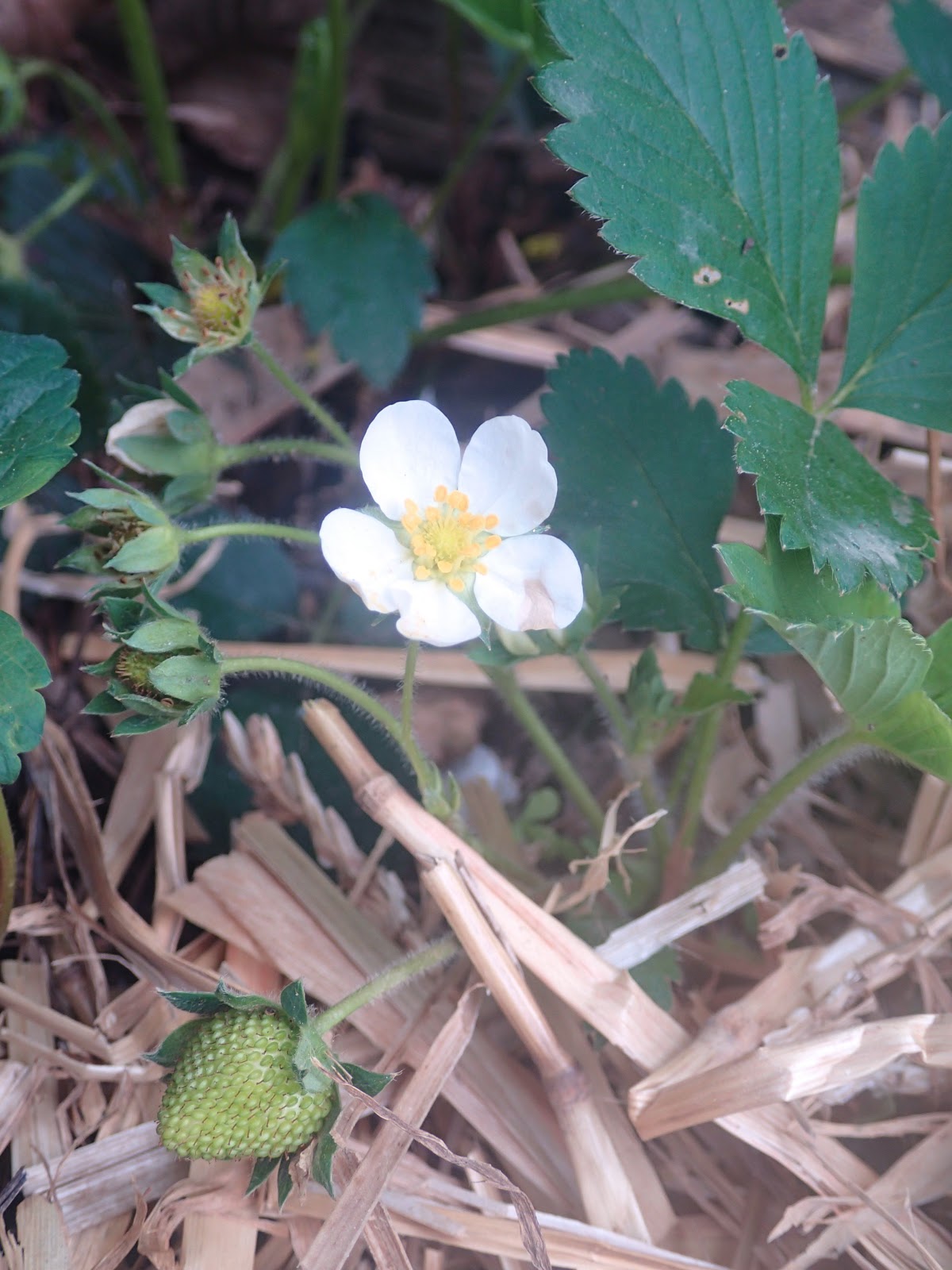
Wild strawberries, and strawberries cultivated for fruit have white flowers.
Wild strawberry, Fragaria virginiana has white flowers
Cultural context
Wild strawberries are native to Virginia. 
  • Read the Cherokee Indian story about the First Strawberry.
937381


Ideas for experiments
  • Do a KWL diagram of what students already know before the project, want to learn, and have learned after your project.
  • Does mulching with red mulch, black mulch or straw help increase yield?
  • Test for shade and sun production?
  • How do different soil conditions affect our harvest?
  • Does a strawberry grow better in clay, silt or sandy soil?
  • What other factors are affecting results?
  • Do fertilizers (nutrients for the plant) affect production?
  • Grow strawberries indoors and measure runners (see NSTA article)
  • Extract Strawberry DNA (see resource links below)
  • For elementary students read The Strawberry by Jennifer Coldrey and George Bernard

Field Trip
Take the students to a berry or fruit farm near you to see technology and agri-business in action.
  • How is strawberry production affected by weather in your area? 
  • Are the farmers growing strawberries indoors or out? 
  • What’s the market? Who are they growing strawberries for? 
  • How much do they sell the strawberries for?  How much does it cost to produce each strawberry?
I was talking to some scientists last year who were designing a strawberry de-hulling machine and wanted to pilot it. They showed me pictures of the machine and how it was designed to hull strawberries - and was much safer than tools currently often used by workers in the fields for example in Florida.  I put the scientist team in contact with some of our local food distributors to set up a real world piloting experiment for the machine.  I wonder if they are piloting it now?
How Food Grows has some resources, including a time-lapse video of strawberries growing. I am also waiting for the How Does It Grow folks to produce film on strawberry production, if they do I will post it.  In the meantime, here below are some additional "strawberry-themed" resources.


Strawberry Resources
LINK to how to make signs using QR Codes and Xerox Never Tear paper technique
  • Strawberry Lifecycle Sign for schoolyard by Mary Van Dyke
  • Strawberry sign by Mary Van Dyke linked to QR Codes of stories for younger audience
Green STEM Learning Blog links:
Books
The First Strawberry retold by Joseph Bruchac, illustrated by Anna Vojtech
The Strawberry by Jennifer Coldrey and George Bernard

Films
How Strawberry Grows - timelapse


NGSS and VA SOL Standards Activities and Correlation Examples
Garden-based learning at Elementary School:
It’s just the Berries - NSTA Science and Children journal p 58.


NGSS 3rd Grade - Inheritance and Variation of Traits
http://www.nextgenscience.org/3ivt-inheritance-variation-traits-life-cycles-traits

VA SOL 3rd Grade Science - Plant Lifecycles


Middle Schoolers approx 7th Grade - Genetics
Extracting DNA from Strawberry

High Schoolers VA SOL Sample Lesson Life Sciences
Extracting DNA from Strawberry


Wednesday, May 29, 2013

Strawberry Fields Forever...Strawberry Science

Want to read up on Strawberry Science for the 5 - 10 year-old age group?
Look for the book Strawberry by Jennifer Coldrey and George Bernard (1989).

Strawberry has beautiful pictures and easy to read-aloud text and will engage elementary-age children.


Read the Strawberry book while you grow your own strawberries.


Also use a microscope (e.g. a Magiscope) to observe your strawberry plants: flowers, roots, leaves and runners and of course the strawberry fruits in more detail over the weeks.


What do you notice?
  • Did you see bees or other pollinators pollinate the blossoms?
  • How many petals are there?
  • Can you see small strawberries forming from the pollinated flower?
  • Where do you think a strawberry seed is?
  • Cut a strawberry in half lengthwise, draw and discuss what you see?


  • What else happens to the strawberries you don't harvest?
  • How many strawberries do you harvest from each plant?
  • How are the strawberry plants reproducing (in addition to seeds)?
  • Count how many runners grow from one plant.  Can you see root hairs and small plants growing from the runner?


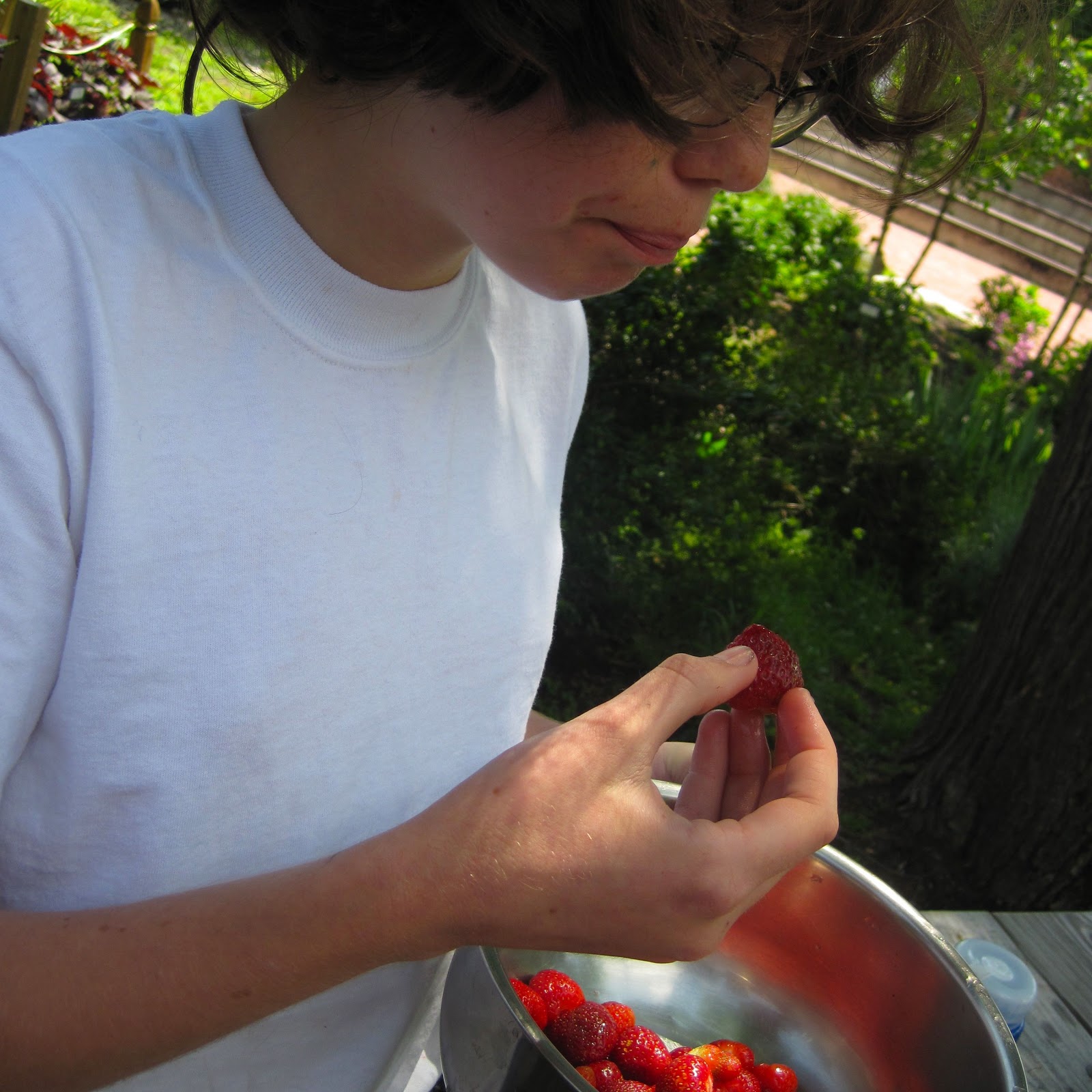
Triple wash your strawberries, and taste test them.

  • How would you describe the flavor?
  • Do you notice a difference if you planted different varieties?
  • If you were a chef - how would you recommend preparing and cooking with strawberries?
  • Do you like strawberries


I do!


References: 
Strawberry by Jennifer Coldrey, photographs by George Bernard, published 1989.

Strawberry recipe ideas from Virginia Dept of Agriculture and Consumer Services, thanks to Mackintosh Fruit Farm.
http://www.mackintoshfruitfarm.com/wp-content/uploads/2013/05/2013_06_03_15_24_50.pdf

See previous two blog posts on Green STEM Learning for strawberry planting and cultivation tips.


Saturday, May 11, 2013

Strawberry Fields Forever....Mulch, Observe and Journal

After a few weeks, the strawberries are growing in both beds and so are the weeds!  I note that in the bed that gets more sun - both weeds and strawberry plants are growing larger than in the shadier bed.

Already there are a few berries forming...

I notice a couple of half-ripe strawberries have been half-eaten by roly-poly's.  I decide to weed and then mulch the earth gaps between the strawberries: perhaps this will help keep down the weeds and keep the strawberry fruit off the earth so that they are less eaten by roly-poly's.  The bird netting is working to keep off the birds! 

"Do the strawberries need straw?"  I post the question to Master Gardeners and get plenty of responses: Some people advise straw in the fall, and then raking back the straw in the spring.  But now is the spring...
A colleague gives me a third of a bale of straw for free!
Another person recommends newspaper - it's cheap and works!
I decide to try - one bed with straw mulching...

and the other one with newspaper mulching.


Observe your own strawberry beds.  What's happening?
Here's some journal entries about strawberries from Arlington Traditional School students.  I'm observing and blogging..  


Next: let's harvest and look at the strawberries in more detail


Strawberry Fields Forever.... Plans, Planting, Protection

Strawberries are fun to grow.  The early varieties cycle with the school year, fruiting in May-June.  And you can bring lots of Green STEM Learning to the art of growing strawberries.

For a lesson on growing strawberries

Let's begin with the story of how the strawberry came to be

Here in Virginia - strawberries, Fragaria virginiana are a native plant, and grow well as a groundcover in part-shade.
Violets and Wild Strawberries - at the Museum of the American Indian DC
(photo Mary Van Dyke)
There is a Cherokee story about the origin of the First Strawberries.  In the Cherokee story, the first man and woman quarrel - and the woman leaves the man in anger.  The sun sends delicious, red juicy berries down to Earth to tempt the woman.  Do you think the strawberry has the power to quell the first woman's anger and make her stay on Earth with the first man?

Find the story of The First Strawberries as a book or as an audio download (References at end of this blog entry). 


Growing Strawberries

Strawberry cultivars are bred and selected for different qualities for human-eating.
Check them out at http://strawberryplants.org/. - and select some cultivars that suit your climate, ecology, timing  and taste...


Grow strawberry plants close together to crowd out weeds.  But if you're growing for prime fruits you may space your plants further apart.  Here comes the math, engineering, technology and science....


Plans
First considerations: What shape and how big is my planting bed?  How many berry plants can I fit in? Are you growing in the ground or in a pot? 
Here I'll show my design for 2 raised beds with internal dimension about 3' 4"  x 6'
Draw out a sketch plan roughly to scale at the recommended planting distance of about one foot per plant.

Or  work the other way round...

If I have 8 strawberry plants to plant in two rows of 4:
How big an area of ground will they need at a one-foot spacing apart?

Sketch it...and make your bed to suit...
How big a planting bed do you need if you space at the recommended distance of two-feet apart?


Planting

Buy strawberry plants.  Prepare soil and plant your strawberry plants following instructions on the pot or at strawberryplants.org


Protection
From experience I know that molds, pillbugs or roly-poly's, slugs, mice, chipmunks, and birds all like to feed on strawberry fruit...
The next step in the design process is how to keep off these predators and pests that (like me) also like to feast on strawberries?

One option might be to plant lots of plants and hope for the best?
But, if you have a small number of plants you're more likely to want to protect them from birds with bird netting, while a farmer with a large crop will not net and will factor in extra plants for bird loss.

If you choose to go with bird-netting - the choice is then "Does it need a support structure - or not?"

I have two beds this year and I am experimenting:
1) In one bed I lay the lightweight bird-proof netting straight over the plants.  And I pin it down the edges of the net with some wooden 2 x 3's.  That works well at the moment.

2) On the second bed, I build a frame out of PVC piping.  This is an easy project for 5th graders and up.  It's like a construction game.  The PVC tube connectors are available in two sorts: 90 degree L's and T's.  There are no 3 way corner connections.
Can you design a cheap and strong frame to fit your bed?  How many legs is it going to have? 
Have a go and see what structure you come up with.


For this example of the 3' 4" x 6 ' bed.
I decide the frame will be rectangular and stand on four legs, and that the maximum unsupported span of PVC piping will be about 3 or 4 feet. I decide the legs will be about 6 " in the ground and 18" above ground - i.e. 24 inch length.
Here's my cutting list of 1/2 " diameter PVC pipe that is available in 12 foot lengths:
10" #4
24" #4 (legs)
36" #2
48" #2

Can you count the connector pieces I need?  How many T's and L's do I need?

That's right - 4 T's and 4 L's

Next I assemble the frame - this takes about 10 minutes and is very easy as the connectors and tubes twist and push together - no glue is needed and the frame will be demountable at the end of the season.

Put the bird netting over the frame  and secure along bottom edge with loose laid 2 x 3 timbers.


Does this netting work? Does it need a frame to function well?  Time will tell....


Topic Extension
Why do you think this farmer uses hills, black plastic and underground irrigation?
What are the pros and cons of this method of growing that is now called "Plasticulture"
What do you think the standing-pipe sprayer is for?

Picking strawberries at Mackintosh Farm, Berryville VA (Photo by Mary Van Dyke)


Think of some other ways you might grow strawberry plants if you were a farmer?
What problems would you need to solve in each case?
What issues are eliminated or added to the problem of "growing strawberries" design if you hang the strawberries in hanging baskets?  Or grow strawberries in stacked boxes?


Next steps: we look at Strawberry Science close-up, mulching and harvesting...

References:

Native Virginia Strawberries: http://www.wildflower.org/plants/result.php?id_plant=FRVI
The First Strawberries, retold by Joseph Bruchac and illustrated by Anna Vojtech
The First Strawberries, free audiodownload from Storynory
Strawberryplants.org for information on growing strawberries