Showing posts with label math. Show all posts

Wednesday, November 30, 2016

Learning with Pinecones

Learning with Pinecones
Today was drizzling. As I walk with preschoolers we listen to rain, step in puddles and admire raindrops cascading off a roof. We pass a couple of tall pine trees and check out the bundles of needles littered on the grass. Count the needles in each bundle: some have three, four, or five needles. The pines are Eastern White pines that have up to five needles in a bundle. We look for pinecones too. I have setup our class in a gazebo - where we continue to listen to the rain and can be sheltered.

Observation
A selection of pinecones to pass around, touch, lift and smell engages the young learners. The pinecones smell of resin, some are sticky, others prickly. The Coulter pinecone is huge, spiky and incredibly heavy and resiny. The sugar pinecone is light and long. The Jeffrey pinecone is also huge, and surprisingly strong yet light. For each pinecone we can see where the seeds grow and are protected - and have fallen out. Bring a pineapple and a dried sunflower flowerhead to highlight the similar fibonacci spiral patterns. I also bring in another different seedhead: one from a “bobbletree” - Liquidambar to compare and contrast with the pinecones patterns. This helps set the scene for an appreciation of patterns and diversity.


Coloring as prelude to journaling
I leave a medium-sized pinecone in the table of the table and give students the My Pinecone coloring sheet.

Observe the spirals on the drawing sheet.
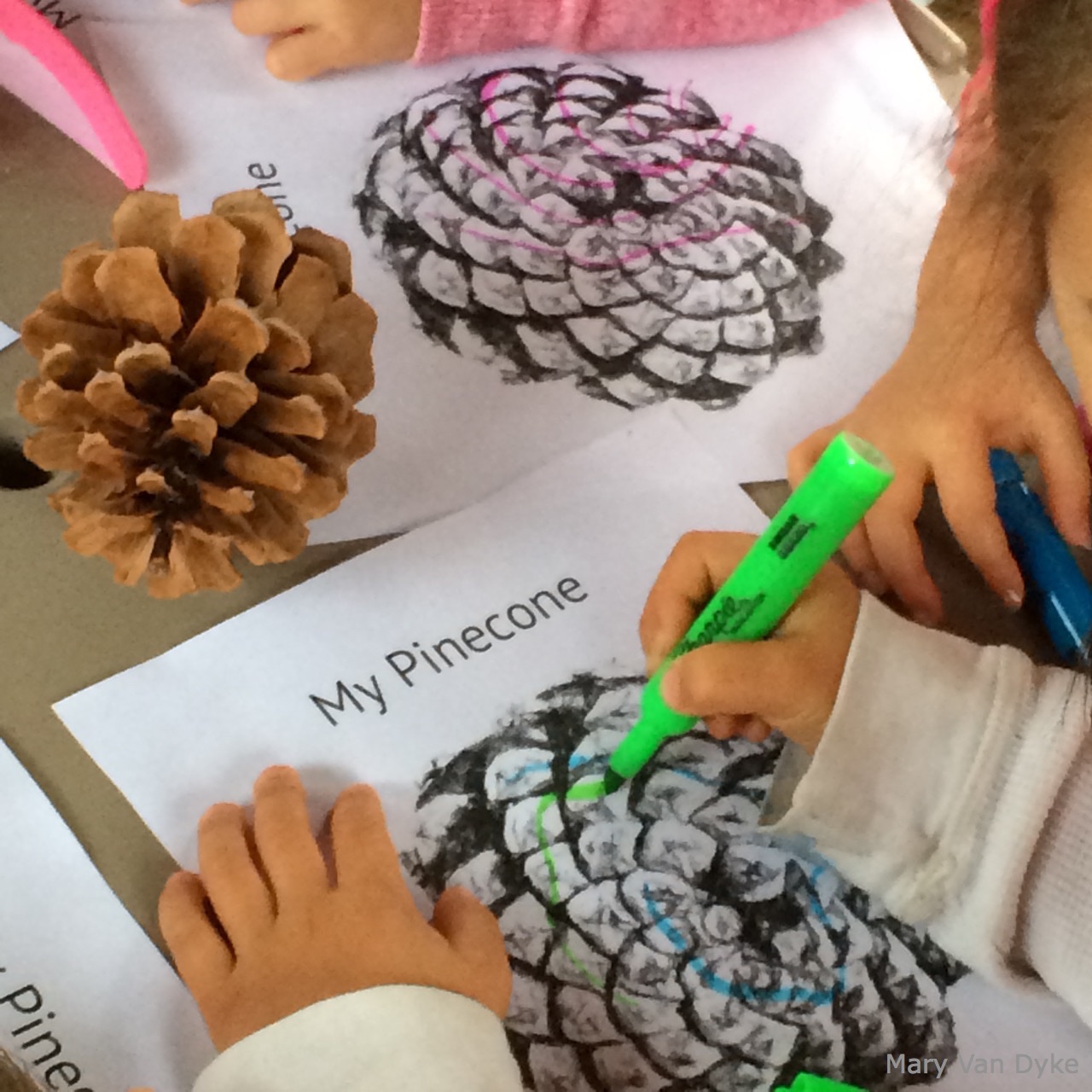
With highlighters I encourage the students to highlight the spirals in one direction. Then we pick a different color highlighter and try to find and color the spirals going in the opposite direction.
The preschoolers enjoy writing their names on the sheets too. Coloring can be trendy therapy, it is also a first step to future journaling.


Decorating pinecones to take home
I have collected small pinecones from a Virginia pine tree (the State Virginia pine tree) - that fell in a storm a few winters ago. Each year I collect a few more from other trees in the neighborhood.
Students decorate a small pinecone using glitter glue. Taking time with the brush and glue is fun and enhances the sensory experience. The pinecones take a day to dry. Students can take home as a gift from the garden to enjoy as a seasonal sparkly winter decoration, and reflect on the patterns they’ve experienced in nature!

We go back to class stomping in the puddles and looking at the clouds!

Resources

Pinecone coloring sheet - download, print and color http://www.slideshare.net/MaryVanDyke/my-pinecone-coloring-sheet-greenstem

Wednesday, February 18, 2015

Inspiration: The Love + Practice of STEAM

My teen daughter tells me this week that she wants to be a "neuroscientist who likes to practice music and play with clay". I listen and say, "YES!" aloud and in my heart. However, this week she had to choose between art and music at high school. Despite block scheduling and selecting options, I hope that she will continue to integrate her love of practicing the arts, sciences and languages.

On Valentine's Day I went to the Virginia Association of Science Teacher's conference on Inspiring a Love of Science with STEA*M (Science, Technology, Engineering, *the Arts and Mathematics). Keynote Speaker Margaret Hancock presented on "Thinking like Artists and Designers".  Her photos of the iconic Saarinen Womb chair and the Glasshouse by Mies Van der Rohe, reminded me of my architecture school days of thirty years ago! Then Margaret updated us to our digital ecologically-aware age with images from Patrick Dougherty's Stickwork and the architecture of Rural Studio.


Why S.T.E.A.M?
Observing and understanding nature is what Science is theoretically, but how and why? I never bought that "only observer" deal anyway. Did you? So the moment you acknowledge your active participation in systems: here comes integrating Engineering while gathering, hunting for and inventing the tools, the Technology, to help the observation, inquiry and the inevitable impetus to design and the iterative process. And whether you name it or not, you will add the Arts (and no doubt some aspects of religion or faith) to help with decision-making between various solutions and to acknowledge our basic need for symbolic references. Underlying patterns, economics and relations between all the variables there is a lot of Math, even if it is beyond your and my ability to solve for "x". So we have integrated STEAM in a nutshell. STEAM is more than just the sum of the parts:it shows emergence and synergy.

Talking of metaphors: I thought about calling this blog "Green STEAM Learning". But "Green STEAM" conjured up images of wilted lettuce and viridian clouds, so I went with the simpler "Green STEM Learning" to convey themes of integrated environmental education and sustainability.

STEAM at Home
Here is a simple example of "thinking like an artist and designer" and the synergy of STEAM in action at home.

My daughter and I spent some afternoons setting ourselves the task of making some jewelry together. We decided to go with a "cheap eats" theme and to collaborate. She decided to make Junk Food Jewelry while I made some Wearable Edible veggi brooches. And yes, we assessed plenty of social values and prejudices right there.
Junk Food Jewelry


We bought premixed polymer clay. And weighed the pros and cons and viability of alternatives such as homemade salt dough. Polymer clays are expensive, hence our decision to make small things. The color range can be enhanced by combining clays and adding pastel dust with a paintbrush. And you might experiment with some shaping tools in addition to fingers. Then you bake the objects in the oven for a few minutes to set.


Wearable Edibles


The engineering comes into play with questions such as:

  • How to create objects that work on necklaces, brooches, bracelets?
  • Do they balance well when you wear them?
  • Do they move successfully with the body, or fall off?
  • What kind of glue or fitting works best to fix a clay shape onto a metal armature?

It is a challenge to work within the budget, timeframe, technical capability and health and safety protocols that we have here at home -  or you might have in the classroom.

The creative and engineering processes are all about "having a go", experiments, analysis, feedback and iterative design. For example: the first peapod brooch toppled over on wearing. So I drew a cross-section and decided to hollow out the back and recess the brooch clip. This technique works well on the carrot and leek brooches too.


The peapods were easier to make if individual peas were baked first to harden, then clad with the pod layers and rebaked. The radish soft magenta color was achieved with pastel and water coloring - a more subtle shade than achieved by clay alone. We also used 3D modeling to good effect on the radish and chocolate chip cookies. The carrot and fronds were based on form of the pink cancer awareness ribbon brooch.


My daughter's Junk Food Jewelry and my Wearable Edibles selections both work on the symbolic artistic level, referencing well-known foods and vegetables at a miniature scale.

The result our collaborative, FUN, STEAM project-based learning.
We decided the plain chocolate chip pendant and earrings are a hit, and would sell like "hot cakes" with teens and other audiences.


Now two years on, my daughter still enjoys making and experimenting with polymer clay.  Her latest line is in "chibi" portraits as gifts to her classmates.
Emma's Chibi

Michelle's Chibi


She also takes classes at the community center to learn to throw pots, and she has chosen to study Ceramics at High School.

STEAM at Work
At this weekend's Love of Science and STEAM conference I went to other inspirational sessions. I heard George Mason Professor, Changwoo Ahn talk about his collaborative work:EcoScience + Art and current initiative: "The Rain Project - sustainable water management in an era of climate change" and his proposal for future efforts on food systems, soil and composting "The Dirt Project".

I enjoyed meeting Andrea Brothers from Micron Technology, and her multi-faceted presentation on life choices and career paths. She practices electron-microscopy to enhance yields of silicon memory products, plays violin and blends interests in art, science and technology. She played us her latest tunes, and shared her passion for innovation and design.
Andrea Brothers

STEAM at Play
I trained for many years as an architect. I also think like an architect unschooled. Here's one of my "early play dwellings", a Mouse House, or perhaps it is a model for a silicon chip?
On the Beach, Chios, April 1971

Here's to an integrated approach to education, creativity, experimenting and innovation, and to enabling holistic choices and designs. Whether or not you call it STEAM.


Thanks to Susan Bardenhagen for hosting VAST Region 8 PD Conferences, and being the VAST Region 8 Representative, and thank you to my daughter Maya, Andrea Brothers, Changwoo Ahn and Margaret Hancock for sharing their love and inspirations.


Saturday, October 18, 2014

Numbers in Nature at the Chicago Museum of Science and Industry


In Chicago with kids? Then take time to check out the Numbers in Nature exhibition at the Museum of Science and Industry.

"Your kids will never look at the world around them the same way after seeing the stunning new exhibit Numbers in Nature at the Museum of Science & Industry. This new permanent exhibit aims to make math fun and relevant for kids by illustrating how mathematical concepts are all around us in our everyday lives."

More at

Wednesday, October 1, 2014

Seeing Math Patterns in Nature - For Kids of All Ages

Here's a preview of my presentation for a workshop on Seeing Math Patterns in Nature for the National Science Teachers' Association, NSTA Conference in Richmond, VA, 16 - 18 October.  This is timely, as the October 2014 issue of the NSTAs Science and Children e-Journal is on "Patterns" too.

In my workshop, we'll take a look at plant growing patterns that you see in pinecones, pineapples, sunflowers and other plants that are easy to find in your garden, schoolyard and grocery store - and we check out Fibonacci and non-Fibonacci sequences.

Here's my powerpoint:


Seeing Math Patterns in Nature from MaryVanDyke

As Vi Hart might say,  "Are you still feeling spirally today?"
If so, give yourself 20 minutes and check out her YouTubes:
Doodling in Math: Spirals, Fibonacci, and Being a Plant Part 1: http://youtu.be/ahXIMUkSXX0

Part 2: http://youtu.be/lOIP_Z_-0Hs
Part 3: http://youtu.be/14-NdQwKz9w

And also spend a minute or two playing with Wolfram Mathematica's interactive models.
My favorites are:

Fibonacci Tree by Sandor Kabal

3D Spirals by Stephen Wolfram

On the Fundamental Theory of Phyllotaxis by Dmitry Weise


Enjoy the math.
It's as easy as one plus one...and then some.

Thursday, July 17, 2014

Explore Peep and the Big Wide World

Click and explore Peep and the Big Wide World http://www.peepandthebigwideworld.com/. You will find lots of ideas for pre-K and elementary-age kids.

Watch a few episodes and the short animations - and then do some experiments yourself!

"The Emmy-winning science and math series is set in and around a large urban park — a place of great wonder and mystery, a "big wide world" the characters are forever eager to explore...
...Peep narrator Joan Cusack, the mother of two young boys, marvels over the everyday science offered on the show and what it means to kids at home: “I’ve learned that just because you’re four or five years old and still using a sippy cup doesn’t mean you’re not a scientist… I love this show! It inspires kids and lets me see the world through their curious eyes.”


Saturday, November 30, 2013

See The Beauty of Math - Visualizing Math in the Everyday


Here's a video by artists Yann Pineill and Nicolas LeFaucheux visualizing the beauty of math in the everyday.

Click for article at Fast Company a blog for innovation by design,

Sunday, August 18, 2013

Back to School: ideas for play, math, science and design with gourds, pumpkins and squash

Here for K- 5 educators - ideas for play, math, science and design with gourds, pumpkins and squash.


Gourd Math from MaryVanDyke

Check out planting, growing and harvesting details for gourd family plants in your zone.
Here in VA, gourds, pumpkins and squash are easy to plant in May and June.
The plants can then look after themselves over the summer vacation...and will be ready to harvest when kids go back to school in the fall.