Showing posts with label fibonacci. Show all posts

Wednesday, November 30, 2016

Learning with Pinecones

Learning with Pinecones
Today was drizzling. As I walk with preschoolers we listen to rain, step in puddles and admire raindrops cascading off a roof. We pass a couple of tall pine trees and check out the bundles of needles littered on the grass. Count the needles in each bundle: some have three, four, or five needles. The pines are Eastern White pines that have up to five needles in a bundle. We look for pinecones too. I have setup our class in a gazebo - where we continue to listen to the rain and can be sheltered.

Observation
A selection of pinecones to pass around, touch, lift and smell engages the young learners. The pinecones smell of resin, some are sticky, others prickly. The Coulter pinecone is huge, spiky and incredibly heavy and resiny. The sugar pinecone is light and long. The Jeffrey pinecone is also huge, and surprisingly strong yet light. For each pinecone we can see where the seeds grow and are protected - and have fallen out. Bring a pineapple and a dried sunflower flowerhead to highlight the similar fibonacci spiral patterns. I also bring in another different seedhead: one from a “bobbletree” - Liquidambar to compare and contrast with the pinecones patterns. This helps set the scene for an appreciation of patterns and diversity.


Coloring as prelude to journaling
I leave a medium-sized pinecone in the table of the table and give students the My Pinecone coloring sheet.

Observe the spirals on the drawing sheet.
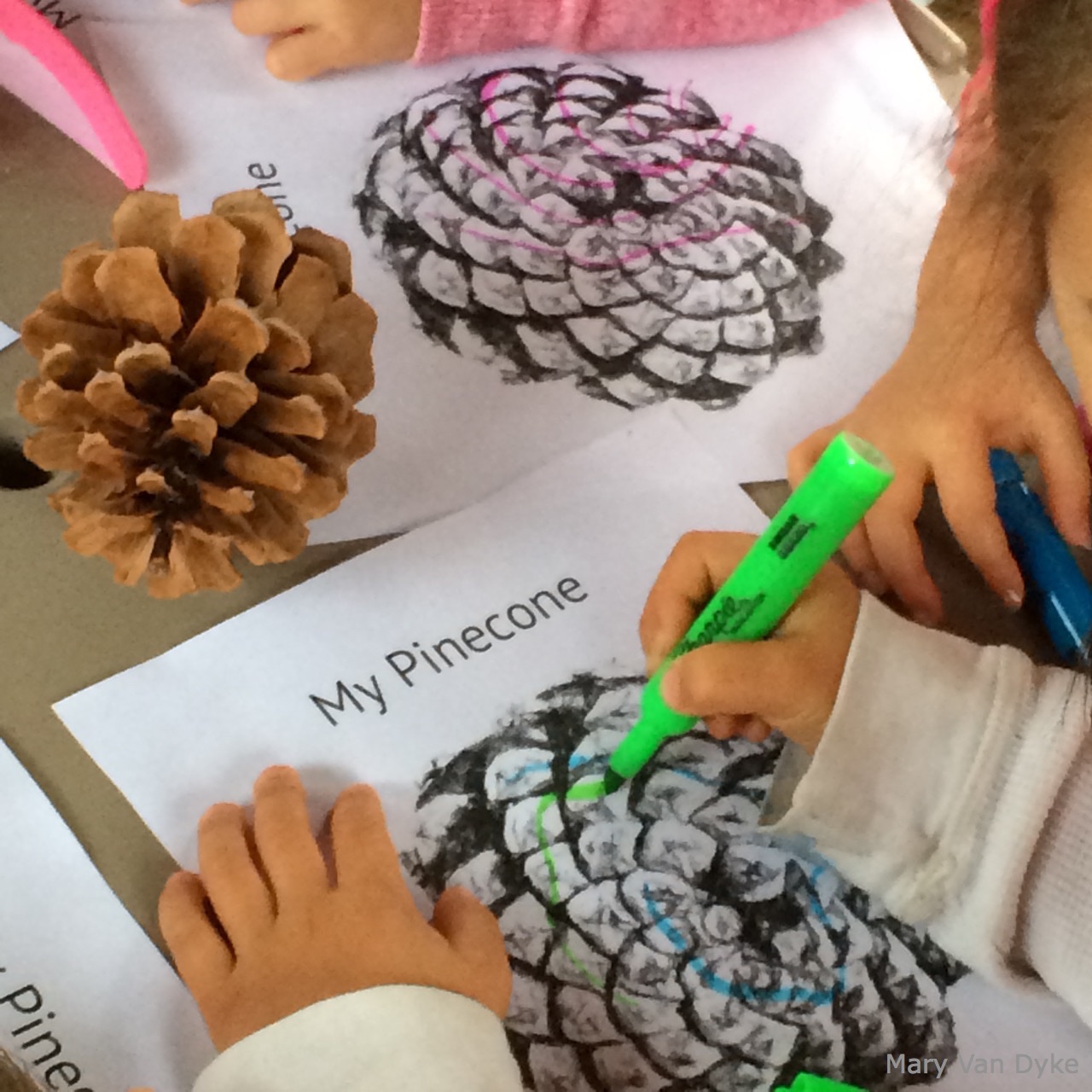
With highlighters I encourage the students to highlight the spirals in one direction. Then we pick a different color highlighter and try to find and color the spirals going in the opposite direction.
The preschoolers enjoy writing their names on the sheets too. Coloring can be trendy therapy, it is also a first step to future journaling.


Decorating pinecones to take home
I have collected small pinecones from a Virginia pine tree (the State Virginia pine tree) - that fell in a storm a few winters ago. Each year I collect a few more from other trees in the neighborhood.
Students decorate a small pinecone using glitter glue. Taking time with the brush and glue is fun and enhances the sensory experience. The pinecones take a day to dry. Students can take home as a gift from the garden to enjoy as a seasonal sparkly winter decoration, and reflect on the patterns they’ve experienced in nature!

We go back to class stomping in the puddles and looking at the clouds!

Resources

Pinecone coloring sheet - download, print and color http://www.slideshare.net/MaryVanDyke/my-pinecone-coloring-sheet-greenstem

Saturday, October 18, 2014

Numbers in Nature at the Chicago Museum of Science and Industry


In Chicago with kids? Then take time to check out the Numbers in Nature exhibition at the Museum of Science and Industry.

"Your kids will never look at the world around them the same way after seeing the stunning new exhibit Numbers in Nature at the Museum of Science & Industry. This new permanent exhibit aims to make math fun and relevant for kids by illustrating how mathematical concepts are all around us in our everyday lives."

More at

Wednesday, October 1, 2014

Seeing Math Patterns in Nature - For Kids of All Ages

Here's a preview of my presentation for a workshop on Seeing Math Patterns in Nature for the National Science Teachers' Association, NSTA Conference in Richmond, VA, 16 - 18 October.  This is timely, as the October 2014 issue of the NSTAs Science and Children e-Journal is on "Patterns" too.

In my workshop, we'll take a look at plant growing patterns that you see in pinecones, pineapples, sunflowers and other plants that are easy to find in your garden, schoolyard and grocery store - and we check out Fibonacci and non-Fibonacci sequences.

Here's my powerpoint:


Seeing Math Patterns in Nature from MaryVanDyke

As Vi Hart might say,  "Are you still feeling spirally today?"
If so, give yourself 20 minutes and check out her YouTubes:
Doodling in Math: Spirals, Fibonacci, and Being a Plant Part 1: http://youtu.be/ahXIMUkSXX0

Part 2: http://youtu.be/lOIP_Z_-0Hs
Part 3: http://youtu.be/14-NdQwKz9w

And also spend a minute or two playing with Wolfram Mathematica's interactive models.
My favorites are:

Fibonacci Tree by Sandor Kabal

3D Spirals by Stephen Wolfram

On the Fundamental Theory of Phyllotaxis by Dmitry Weise


Enjoy the math.
It's as easy as one plus one...and then some.

Friday, September 26, 2014

Count Your Sunflower Spirals - and Fibonacci and Lucas Sequences

I'm continuing research for a presentation on Seeing Math Patterns in Nature - and I am looking at growth patterns in sunflowers and other plants.

Sunflower - photo by Mary Van Dyke
Current estimates are that 90% of plants follow the Fibonacci sequence: (1 1 2 3 5 8 13 21 34 55 89... ) for optimum flow of auxin, the plant growth hormone, and evolutionary adaptation to maximize efficiency in packing seeds.

Here's Ron Knott's diagram of a 1000 seedhead sunflower with 89 and 55 spirals at the perimeter:


Some plant species, such as sunflowers, can follow both the Fibonacci and other sequences such as the Lucas sequence (1, 2 3 4 7 11...) - and other permutations of series too.

A big global citizen science experiment to study sunflowers and count their spirals has been running since 2012 in honor of mathematician Alan Turing's "enigma code breaker's" 100th anniversary of his birth - and the discovery of his unfinished work on the math of sunflowers.
See Turingsunflowers.com.


In 2012 people around the world planted sunflowers and counted their spirals - here's how from the Geeky Gardener - Anna Evangeli.


Fibonacci V Lucas: spot your sunflower's spiral › Science Features (ABC Science)

From the initial big data experiment of Turing's Sunflower Project - results came from 557 sunflowers from 7 countries as follows:
  • Fibonacci spiral sunflowers - 458
  • Lucas spiral sunflowers - 33
  • Double Fibonacci sequence numbers sunflowers - 26
  • Other spiral numbers - a small number of sunflowers with no apparent Fibonacci or Lucas number patterns
How about counting the spirals of the sunflower seedheads you planted in your garden this year?
Or do you plan to plant some sunflowers to count next year?


Collecting Sunflower Seeds - photo by Mary Van Dyke


Friday, August 22, 2014

Learning from Nature - Generative Design and Structural Tessellations

I am researching for my upcoming workshop on Fibonacci and Seeing Math Patterns in Nature.
I have been looking at sunflower, pinecone and branching patterns and the difference to hexagonal close-packing patterns such as in honeycombs and wasp nests.

In my google research I came across a fun blog from product designer Markus Kittner talking about "generative design and learning from nature" - and "structural tessellations and morphologies".

In the case of the Fibonacci sequence that we see in some growth patterns in nature we have a very simple input operation, that starts with the number one and simply is adding the previous number to it: i.e. the Fibonacci sequence is 1, 1+0 = 1, 1+1 = 2, 1+2 = 3, 2+3 = 5, 3+5 = 8, etc.

See more about generative design here:
http://74fdc.wordpress.com/2012/07/02/generative-design-learning-from-nature/


Find out more about the structure and economy of hexagonal honeycomb packing:

http://74fdc.wordpress.com/2012/02/10/structural-tessellations-and-morphologies/


Generative design and structural tessellations - such as seen in sunflowers, pinecones, branching patterns, and wasp nests and honeycombs, are fun applied math and design topics to explore with students K-12 both in the indoor and outdoor classroom.