Showing posts with label environmental literacy. Show all posts

Wednesday, November 30, 2016

Learning with Pinecones

Learning with Pinecones
Today was drizzling. As I walk with preschoolers we listen to rain, step in puddles and admire raindrops cascading off a roof. We pass a couple of tall pine trees and check out the bundles of needles littered on the grass. Count the needles in each bundle: some have three, four, or five needles. The pines are Eastern White pines that have up to five needles in a bundle. We look for pinecones too. I have setup our class in a gazebo - where we continue to listen to the rain and can be sheltered.

Observation
A selection of pinecones to pass around, touch, lift and smell engages the young learners. The pinecones smell of resin, some are sticky, others prickly. The Coulter pinecone is huge, spiky and incredibly heavy and resiny. The sugar pinecone is light and long. The Jeffrey pinecone is also huge, and surprisingly strong yet light. For each pinecone we can see where the seeds grow and are protected - and have fallen out. Bring a pineapple and a dried sunflower flowerhead to highlight the similar fibonacci spiral patterns. I also bring in another different seedhead: one from a “bobbletree” - Liquidambar to compare and contrast with the pinecones patterns. This helps set the scene for an appreciation of patterns and diversity.


Coloring as prelude to journaling
I leave a medium-sized pinecone in the table of the table and give students the My Pinecone coloring sheet.

Observe the spirals on the drawing sheet.
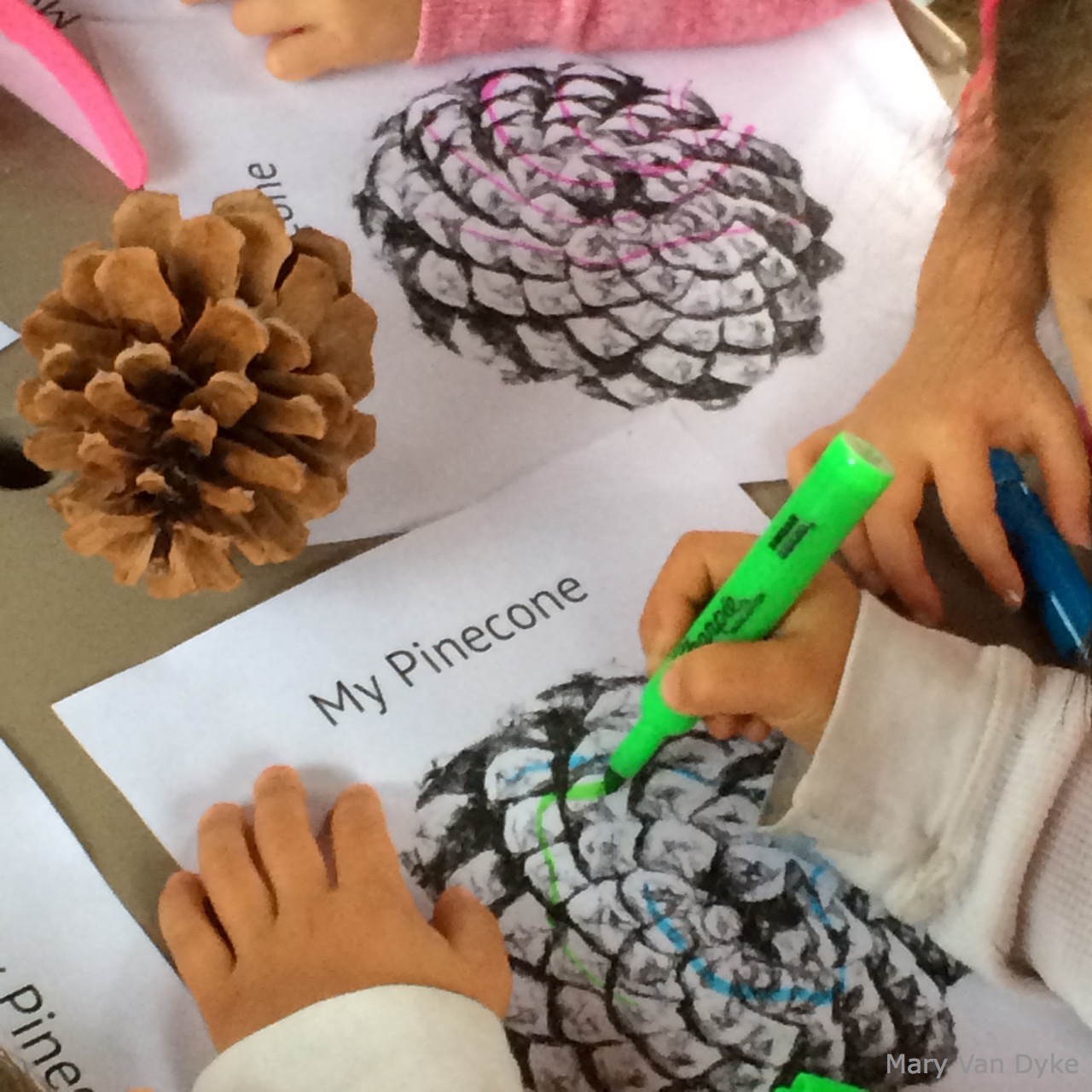
With highlighters I encourage the students to highlight the spirals in one direction. Then we pick a different color highlighter and try to find and color the spirals going in the opposite direction.
The preschoolers enjoy writing their names on the sheets too. Coloring can be trendy therapy, it is also a first step to future journaling.


Decorating pinecones to take home
I have collected small pinecones from a Virginia pine tree (the State Virginia pine tree) - that fell in a storm a few winters ago. Each year I collect a few more from other trees in the neighborhood.
Students decorate a small pinecone using glitter glue. Taking time with the brush and glue is fun and enhances the sensory experience. The pinecones take a day to dry. Students can take home as a gift from the garden to enjoy as a seasonal sparkly winter decoration, and reflect on the patterns they’ve experienced in nature!

We go back to class stomping in the puddles and looking at the clouds!

Resources

Pinecone coloring sheet - download, print and color http://www.slideshare.net/MaryVanDyke/my-pinecone-coloring-sheet-greenstem

Wednesday, January 27, 2016

Green STEM Learning 2015 and Vision for 2016 in Support of an Environmental Literacy Coordinator for APS

Here's the year end report for 2015 for my business Green STEM Learning, including work for clients Jamestown Elementary School PTA and Meridian Homeschool.

My cover photo shows Jamestown School yesterday. The Weeping Cherry Tree and Vegetable Beds are still under their blanket of snow! In the background, you see the big Willow Oak tree that is at the heart of the school's courtyard, and creates a wonderful shady place for classes to gather on hot summer days!


Green STEM Learning Report Year 2015 by Mary Van Dyke from Mary Van Dyke

This spring and summer at Jamestown School, I'll work on some of the projects highlighted in the report. While the snow is melting, it's a good time for me to meet with teachers to plan the vegetable gardens, native gardens and student outdoor projects.

And for Meridian Homeschool Club this spring, I'll continue working with the older students on their year-long Earth Force/Caring for Our Watershed civic engagement project. A couple of weeks ago, we went outside and measured the trees at the church where we meet. Then we calculated the ecosystem services the trees provide with i-Tree Design. We also identified the invasive plants on the property: there's lots of English Ivy and Bush Honeysuckle.  Next stage, the students are making a video for the church congregation and our partner schools in NM and PA.  I don't yet know what the students will come up with as a solution to the issues they are finding, as the project is student-directed and we have a few months to go!

Other projects for 2016, include my continued volunteer advocacy for enhancing sustainability and outdoor learning coordination within the Arlington Public Schools.

  • Why not invite the APS School Board to fund an Environmental Literacy Coordinator position?  I spent a couple of snow days this week making an aspirational pitch deck for the job - as if the School Board had funded the position. So stay tuned!  


Want to help with advocacy in the meantime?
  • Please do write to the APS School Board school.board@apsva.us with your comments in support of the APS Science Advisory Committee recommendations that include for cultivating integrative learning and also funding a Sustainability and Outdoor Learning Coordinator position.
  • A Sustainability and Outdoor Learning Coordinator (aka an Environmental Literacy Coordinator) as recommended by the Science Advisory Committee could help to more effectively evaluate programs, and share standards-aligned curricula and best practices through a collaborative and integrative approach that facilitates more creative problem-solving opportunities for students outdoors!
  • There's other priorities for the School Board, including the capacity issues and needing more seats for students.
     
  • So now's the time to ask for a balanced budget to include for this sustainability and outdoor learning coordinator position.

Mary Van Dyke, works part-time for Jamestown Elementary School PTA
as Visiting Horticulturalist, and as a volunteer she has interests in coordinating outdoor learning for schools in Arlington.
Mary serves on the APS Science Advisory Committee,
the APS Superintendent's Advisory Committee on Sustainability
and the Advisory Committee of NoVA Outside,
a regional alliance of environmental educators.
All opinions expressed in this article are the author's own.

Monday, August 3, 2015

Favorite Apps for Environmental Education and Outdoor Learning?

Time to take technology outdoors?
What are your favorite apps to enhance environmental literacy and outdoor learning?
Here's a list of my favorite Apps for Environmental Education/Outdoor Learning, optimized to include online guides for Virginia plants and wildlife see http://bit.ly/1KK4PnJ


Using app LikeThat Garden for flower identification
The list includes useful apps and links to identify plants, birds and animals and design gardens - wherever you have cellular connectivity!


Comments? Additions?

Wednesday, July 1, 2015

Thursday, February 12, 2015

Update on the No Child Left Inside Act


Here's an update from February 11, 2015 on the federal No Child Left Inside Act - that supports outdoor learning.
Reblogged from the Outdoors Alliance for Kids...

"Senators Jack Reed (RI-D) and Mark Kirk (IL-R) and Congressmen John Sarbanes (MD-R) and Mike Fitzpatrick (PA-R) introduced legislation aimed at improving environmental education in our nation’s public schools. Supported by the Outdoors Alliance for Kids (OAK), the No Child Left Inside Act would provide grants to school districts, support teacher training and promote the integration of outdoor learning into the regular school curriculum.
The legislation would enhance opportunities for school children and adolescents to learn about, and in, the great outdoors. Environmental education has been shown to increase academic performance across subject areas and has been linked to improvements in critical thinking skills, student motivation, civic engagement and environmental stewardship. Environmental education, particularly when practiced outdoors, can increase the amount of physical activity children and youth engage in during the school day.
“Today’s children will be asked to tackle tomorrow’s environmental challenges,” says Michael Brune, Sierra Club Executive Director. “It’s our responsibility to ensure our kids have opportunities to get outdoors and learn about the natural world. The No Child Left Inside Act will provide young people with the foundation they need to succeed and lead in a climate changing world.”
“We are hopeful that 2015 is the year that Congress acts to ensure that America’s youth have access to high-quality environmental education programs that we know help improve student achievement, connect young people to their communities, and build environmental literacy,” says Judy Braus, North American Association for Environmental Education Executive Director. “If we want our students to be competitive in a global economy, they need to be environmentally literate.”
Environmental Education

Saturday, November 22, 2014

Growing Outdoor Learning and Sustainability at Your School?

Are you trying to grow outdoor learning and sustainability in your school community?
Here's a presentation I gave a couple of weeks ago to the Jamestown Elementary School PTA on Growing Outdoor Learning and Sustainability at the school. 


We discussed our school community, vision, goals, wishlists, budget and funding sources - and several of the many environmental education and sustainability programs and projects for 2014 - 2015.


I am working part-time as "Visiting Horticulturalist" at the school and help to coordinate and facilitate outdoor learning. I appreciated this opportunity to meet with the PTA and discuss vision, goals and funding for the next year.