Showing posts with label agriculture. Show all posts

Thursday, May 19, 2016

Teaching Future Ranchers, Farmers and Decision Makers? Climate Change and the Water Cycle, USDA curriculum for 6th - 12th graders in the Southwest


Reposting from USDA Blog Posted by Albert Rango and Caiti Steele, Southwest Regional Climate Hub, on May 19, 2016 at 10:00 AM

Want to teach relevant, experiential projects on climate change and the water cycle to your teen future farmers, ranchers and decision makers?
Here is a new standards-aligned experiential learning curriculum for 10 hours of projects on climate change and the water cycle designed for 6th - 12th graders living in the Southwest.

"USDA has created a curriculum for teaching today’s students about climate change and educating tomorrow’s farmers, ranchers, and decision makers.  The Department’s Southwest Regional Climate Hub has partnered with the Asombro Institute for Science education to build “Climate Change and the Water Cycle,” a scientifically rigorous education unit for 6th -12th grade students.  Intended for both formal and informal educators, the unit includes 9 activities which can either stand alone or be taught over 10 instruction hours.  These hands-on activities are designed to help the students understand the scientific concepts behind different elements of the water cycle, climate change, and how to analyze data and communicate results. "


Tuesday, June 9, 2015

Strawberries: Ripe for Inquiry

Do your "schoolgrown" strawberries taste good? Ours do!

Is that a fact or a hypothesis?  
Sounds like the time “is ripe” to do some inquiry and project-based science and art.

Strawberries are a wonderful and delicious teaching tool that cycles with the school year here in Virginia as you can observe them grow over the winter, flower, produce berries and harvest to eat in May and early June.
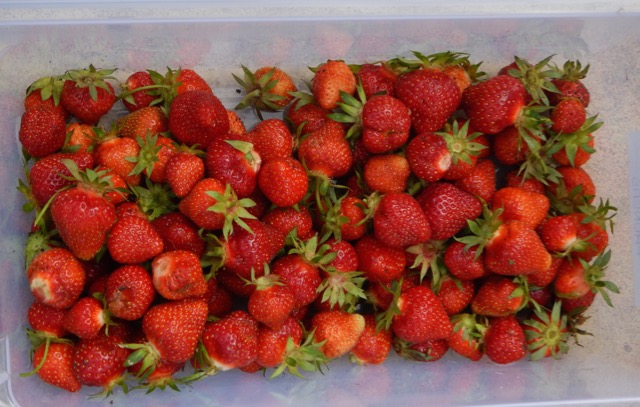
DSCN1301.jpg
Strawberries - May 2015, Jamestown Elementary School
May is Strawberry Month. If you missed it, put it on the calendar for next year and plan ahead to grow some and use strawberries to teach a lesson or two as they grow...


A few stats from the industry- as growing Strawberries is a billion-dollar business...
11262424_951528224892411_8530784529465069345_n.jpg
Where to grow strawberries?
Grow some strawberries in the ground - with or without netting


Here's some grown in the shade at Arlington Traditional School

Here’s plants in a sunny spot at Jamestown Elementary School.


Here are some container grown in EarthBoxes - with red plastic mulch with the Homeschool Club of Arlington.
The red plastic mulch speeds up the ripening compared to black mulch or straw. Do an experiment comparing mulches and see if you agree? And check your results with research from Penn State.


Here’s some commercially field grown strawberries with black mulch and irrigation system at Mackintosh Fruit Farms.

Here’s scientists growing strawberries in glasshouses and testing different cultivars in a gutter "sock" hydroponics system at Lynchburg Grows.

Strawberry Towers
Photo from DC School Garden Bike Tour Cultivate the City via Facebook
Or grow strawberries and pineberries in tower gardens or garden towers - and grow a business as at JO Wilson, DC Public schools.


Talking of art and strawberries
Notice the patterns of the seeds on the outside and the beauty of the cross-section

Notice the color and pattern


Make a clay brooch. here’s mine from pre-Sculpy days!


Or choose a technique to make signs for the school strawberry patch. Here above is a 5-year old's painting with acrylic on board, that I then sealed with acrylic spray sealer. The students nailed their own boards to the stakes for our kitchen garden signs. The stakes untreated last about a year, the painting longer.


Here are a couple of signs I made for school and community gardens. I designed the artwork on powerpoint or google presentation and laser printed onto Xerox Never Tear polyester paper and put into metal signholders. The ink lasts a couple of years or so.


What’s not a strawberry? The false strawberry!
Got those prolific little strawberries that taste dry and dusty in your home or school yard? Those plants with the yellow flowers are “false strawberries”.
False strawberry Duchesnia indica, has yellow flowers
Wild strawberries, and strawberries cultivated for fruit have white flowers.
Wild strawberry, Fragaria virginiana has white flowers
Cultural context
Wild strawberries are native to Virginia. 
  • Read the Cherokee Indian story about the First Strawberry.
937381


Ideas for experiments
  • Do a KWL diagram of what students already know before the project, want to learn, and have learned after your project.
  • Does mulching with red mulch, black mulch or straw help increase yield?
  • Test for shade and sun production?
  • How do different soil conditions affect our harvest?
  • Does a strawberry grow better in clay, silt or sandy soil?
  • What other factors are affecting results?
  • Do fertilizers (nutrients for the plant) affect production?
  • Grow strawberries indoors and measure runners (see NSTA article)
  • Extract Strawberry DNA (see resource links below)
  • For elementary students read The Strawberry by Jennifer Coldrey and George Bernard

Field Trip
Take the students to a berry or fruit farm near you to see technology and agri-business in action.
  • How is strawberry production affected by weather in your area? 
  • Are the farmers growing strawberries indoors or out? 
  • What’s the market? Who are they growing strawberries for? 
  • How much do they sell the strawberries for?  How much does it cost to produce each strawberry?
I was talking to some scientists last year who were designing a strawberry de-hulling machine and wanted to pilot it. They showed me pictures of the machine and how it was designed to hull strawberries - and was much safer than tools currently often used by workers in the fields for example in Florida.  I put the scientist team in contact with some of our local food distributors to set up a real world piloting experiment for the machine.  I wonder if they are piloting it now?
How Food Grows has some resources, including a time-lapse video of strawberries growing. I am also waiting for the How Does It Grow folks to produce film on strawberry production, if they do I will post it.  In the meantime, here below are some additional "strawberry-themed" resources.


Strawberry Resources
LINK to how to make signs using QR Codes and Xerox Never Tear paper technique
  • Strawberry Lifecycle Sign for schoolyard by Mary Van Dyke
  • Strawberry sign by Mary Van Dyke linked to QR Codes of stories for younger audience
Green STEM Learning Blog links:
Books
The First Strawberry retold by Joseph Bruchac, illustrated by Anna Vojtech
The Strawberry by Jennifer Coldrey and George Bernard

Films
How Strawberry Grows - timelapse


NGSS and VA SOL Standards Activities and Correlation Examples
Garden-based learning at Elementary School:
It’s just the Berries - NSTA Science and Children journal p 58.


NGSS 3rd Grade - Inheritance and Variation of Traits
http://www.nextgenscience.org/3ivt-inheritance-variation-traits-life-cycles-traits

VA SOL 3rd Grade Science - Plant Lifecycles


Middle Schoolers approx 7th Grade - Genetics
Extracting DNA from Strawberry

High Schoolers VA SOL Sample Lesson Life Sciences
Extracting DNA from Strawberry


Friday, August 15, 2014

Earth Force Next Steps Institute Professional Development Program in DC includes Agriculture and STEM Pathway

See http://www.earthforce.org/NSI for details of this Earth Force professional development program: Next Steps Institute, NSI, for teachers in STEM education.

Are you interested in agriscience, food and sustainability?
One of the pathways you can choose at this year's NSI is Harnessing the Power of Agriculture with STEM.


The Next Steps Institute (NSI), powered by Earth Force, is the premier professional development program that promotes hands-on, minds-on learning in STEM education. Organized by pathways that take participants on an engaging journey into critical STEM learning arenas, the Institute offers the depth and breadth of content needed to enhance effectiveness in action and advocacy around STEM.
NSI offers participants:
• Inquiry-based professional development at an affordable cost;
• Tools for effective materials management; and
• Strategies for promotion of 21st century STEM skills using an educational partnership model.

2014 Next Steps Institute: Integrating STEM Learning in Communities
Georgetown University Hotel and Conference Center
3800 Reservoir Rd NW, Washington, DC 20007
Sept. 22-23, 2014
Registration closes September 16, 2014 at 11:59 p.m. EST.
Rooms are available for $149/night. Click here to reserve your room.

   Cost:
Individual - $360
Team of 3 or more people - $330 per person


NSI_website


See http://www.earthforce.org/NSI for further details of all the pathways.
Here below is the promo for the one focused on Agriculture and STEM. 

  • Harnessing the Power of Agriculture with STEM
Building an educated workforce with the skills and expertise necessary to sustain the world’s growing population is at the core of this pathway. Responsible for our food, water, shelter, and energy, agriscience provides a compelling and relevant context to address current issues and events on global and local scales. This pathway, facilitated by faculty from Murray State University and DelCastle Technical High School, takes an issues-based approach to understanding the ways agriscience deepens student understanding of STEM content using relevant, real-world examples.
Come share and generate best practices in teaching and learning that excite students and demonstrate the relevance of agriscience now and in the future. Problem-solving and inquiry-based activities provide a structure for learning crucial content, including: biofuels, crop management, biodiversity, conservation, nutrition, and genetics. 

Friday, May 30, 2014

Food Tech: Got computer skills, and want to use them to solve real world food issues? Here's a free event this weekend in MD to go to...

Full details at... 
https://www.eventbrite.com/e/montgomery-county-food-data-jam-part-of-the-national-day-of-civic-hacking-tickets-11494435165

Discover a side of the DC region you never knew at the Food Data Jam!

Food Data Jam

What is a Food Data Jam? It’s a hackathon that will generate solutions to local food and farm challenges. Developers, students and non-profits will work together for 24 hours on three specific tasks. The team with the best solution gets $1,000! Second place gets $500! This event, organized as part of the National Day of Civic Hacking, will be held in Poolesville, the heart of the Agricultural Reserve in Montgomery County. Located just 30 minutes from the White House, the Agricultural Reserve provides 93,000 acres of specially zoned farm and open space, is home to 560 farms, employs 10,000 residents and generates $245M annually.
As a participant in this event you’ll work on a team addressing one of three challenges related to food and agriculture:
  • Food Recovery: The County estimates that 19% of our local waste stream is food waste, which includes 28,769 tons from restaurants, 14,014 tons from supermarkets, and 5,301 tons from schools.  Participants in this challenge will build solutions that link supply (those with excess perishable food) to demand (shelters, food pantries, etc.).
  • Farming and Agriculture:  You will be given access to a wealth of data from the Montgomery County Agriculture Services division and USDA. Your ideas will help our small and mid-sized farmers meet the growing demand for locally grown products, and will increase customers’ access to healthful food.
  • School Food and Nutrition: Using real and sample data from the Montgomery County Public Schools Food and Nutrition Services Division, explore what applications can help educate parents and students about options for healthy eating and increase access and options to healthy food for students.

What does it mean to participate? As a participant of the Food Data Jam you’ll join or form a team to work on the challenge of your choice. You’ll brainstorm a solution and then build it! What you build can be as elaborate or advanced as your skills allow. You can build a functioning prototype or just mock-up a concept. You’ll have about 24 hours to do it with plenty of stimulating talks and breaks along the way with subject matter experts. On the second day your team will present your ideas and solutions to a panel of judges.
Who can participate? Everyone is welcome, whether you are a food system expert, an experienced developer, or a student. We are especially looking for participants with solid technical skills. We will be asking you to build something, so be ready for a marathon!
Never been out to Poolesville? Don’t have a car? No problem! Get on the bus! Poolesville is a short ride from DC and we’ve made special arrangements to bus folks from Bethesda to the Food Data Jam. For our technical particpants we'll even stop along the way to give you a tour of a working farm. Our general and student participants should join us for lunch at Poolesville High School at Noon!
How much does this cost? What else do I need to know? It’s free! Registered participants will get free meals courtesy of our sponsors. Just bring your laptop and get ready to roll up your sleeves. You’ll be able to stay in Poolesville High School overnight as your team works through the night. Do you have to stay overnight? No, but you're free to if you like!
To register for this free event:

Friday, September 27, 2013

Garden Adventures - Grow Eat and Learn in your Schoolyard - presentations at two upcoming conferences

Here is Garden Adventures, a ten-week after-school schoolyard gardening program focused on growing food and healthy eating that I co-facilitated at Arlington Traditional School Garden in 2011.

Here below is the powerpoint on Garden Adventures  I am presenting at two upcoming conferences:
Virginia Association of Environmental Educators (October 16-18)
and Virginia Association of Science Teachers (November 14-16).


Garden Adventures Grow Eat and Learn in your Schoolyard VAEE VAST 2013 reduced file size from MaryVanDyke


I based the Garden Adventures program on the session framework from Project PLANTS (from University of Kansas, fall and spring after-school food and nutrition programs) and activities from the Junior Master Gardeners curriculum.

See details on the Garden Adventures spring program at my archive blog:  ATS Gardening, March - May 2011.

Project PLANTS will soon be online!