Showing posts with label harvest. Show all posts

Saturday, August 22, 2015

Need to Claim and Tame Your Schoolyard Garden?

by Mary Van Dyke, August 22 2015
Gone away for a few weeks and come home to find your garden has turned into a jungle? Weeds are thigh-high, the herbs and flowers in pots have shriveled, and the tomatoes and pumpkins are rampant. This is the scenario when I return to my home garden after a summer vacation, and it can play out in your schoolyard garden too.


So how to "claim and tame" your schoolyard garden after the summer?
  • Do you already have parent volunteers set up a family summer-watering and weeding schedule?
  • Can you outreach to volunteers such as Master Gardeners and Master Naturalists to help “adopt a plot”?
  • Have you set up a community garden in your schoolyard?


This year at Jamestown Elementary School, we do not have family community buy-in to water or weed during the summer months. The schoolyard maintenance crew continues to visit every two weeks to mow and trim the grassy areas. The custodians in their spare time, water and harvest the vegetables: including beans, pumpkins, kale and lettuce. In late August, the PTA will hire a contractor to trim and mulch the week before school begins. The rest of the gardens will need to be reclaimed and tamed again when school begins in September.  I am planning a couple of community schoolyard maintenance sessions with Master Naturalists and the PTA for early October and in the spring. Maybe a Master Naturalist will take on to maintain a native plant meadow? These Saturday sessions will help engage some families to help on other garden learning projects too, and be part of our strategy this year to involve more staff and students in learning outdoors.


I “claim and tame” my home garden after summer vacation by: 
  1. Weeding: i.e. remove the fastest growing, most dangerous, or most prolific weeds
  2. Watering
  3. Harvesting
In a couple of hours I remove:
Poison ivy (Toxicodendron radicans) seedling

    • A dozen poison ivy seedlings
    • A dozen mulberry seedlings
    • A dozen wild grape vine seedlings
    • Several kinds of weeds, prioritizing those in the garden with lots of seeds: including lambs quarters (you can eat this one), pigweed, kochia, sow thistle, horseweed, white heath aster and crabgrass.
    • Less disruptive weeds I leave for next time!
    Mulberry seedling
    Wild grape seedling
    While in the garden, I take time to enjoy the outdoors and sunshine, and I pick green and red tomatoes to ripen indoors on a window cill.  


     I water the pots of strawberries, herbs and basil, and harvest potatoes and gourds.


    Then I pick a bunch of beautiful native flowers for the table. 


    While working I listen to the birds, see a tiger swallowtail butterfly, and get stung by a wasp!
    But now I know where wasps are nesting. I cook the potatoes with basil for supper.


    Next week I’ll start to reclaim and tame the schoolyard. 
    • What will be the main "weeds" this year?
    • What will be in flower?
    • What vegetables, fruit and herbs will be ready to harvest?
    • What animals and birds will be there?
    • Who will be interested to learn in the schoolyard?
    Reference:
    Weed Identification for Schools by Mary Van Dyke

    Next blog:
    A Guide to Nature Through the Seasons

    Friday, March 20, 2015

    The Potato Project: Planting Potatoes with Montessori

    It is time (and later in the season than usual) to think "potatoes". It is snowing a little, although we are already past St Patrick's Day and today is the spring equinox.


    This spring, the Montessori class are taking on potato planting, care, harvest and cooking as their outdoor learning project.

    In the fall, I  identified a raised bed for planting close to the students' classroom. The bed is sunny and has water nearby. I enrich the soil with compost.


    I initiate "The Potato Project" with two 45-minute class sessions over two weeks, and describe here how to run for a class of twenty, 3 - 5 year olds.
    Please note that this activity can be adapted easily for other groups and ages.
    • Click on resources for printable version of these two sessions and higher grade VA SOL or NGSS-linked materials.
    Session One: 45 mins: Indoors (can be end of March, around St Patrick's Day)

    Introduction and Planning
    "One Potato, Two Potatoes, Three Potatoes, Four..."
    How many of the students have eaten potatoes?  How were they prepared and cooked?


    We look at different kinds of "seed potatoes" and identify eyes, tubers, sprouts. Some of the potatoes are red, others yellow, some are purple.
    We discuss that "seed potatoes" are not seeds from flowers, but small potatoes that are living with stored food in the tuber and will sprout to make another plant.
    Potatoes are native to Mexico and South American mountain areas.
    Potatoes in a market in La Paz, Bolivia
    from Vegetables, p. 135 by Roger Phillips and Martyn Rix

    Rock-ledge habitat of wild potato in Mexico
    from Vegetables, p. 134 by Roger Phillips and Martyn Rix

    And grow well in cooler parts of North America in Maine and Idaho - and around the world.
    Potatoes growing in Maine
    from Vegetables, p. 141 by Roger Phillips and Martyn Rix

    The students put the "seed potatoes" on the window cill to sprout.
    We'll leave the seed potatoes on the window cill to sprout more, and will plant them in the garden next week - on Day 7.
    I ask the teacher Ms Kipperman, if she and the students can cut the seed potatoes in half on Day 6 and leave the potatoes to "heal", to air dry for the planting session next week.

    We then read Two Old Potatoes and Me by John Coy. This beautiful book sets the scene for our expectations, the "hypothesis", for our potato cultivation and celebration.

    Activity: Potato Printing
    Preparation:It takes about an hour for me to cut 5 lbs of potatoes into various simple designs.
    I do this in the morning before the class.


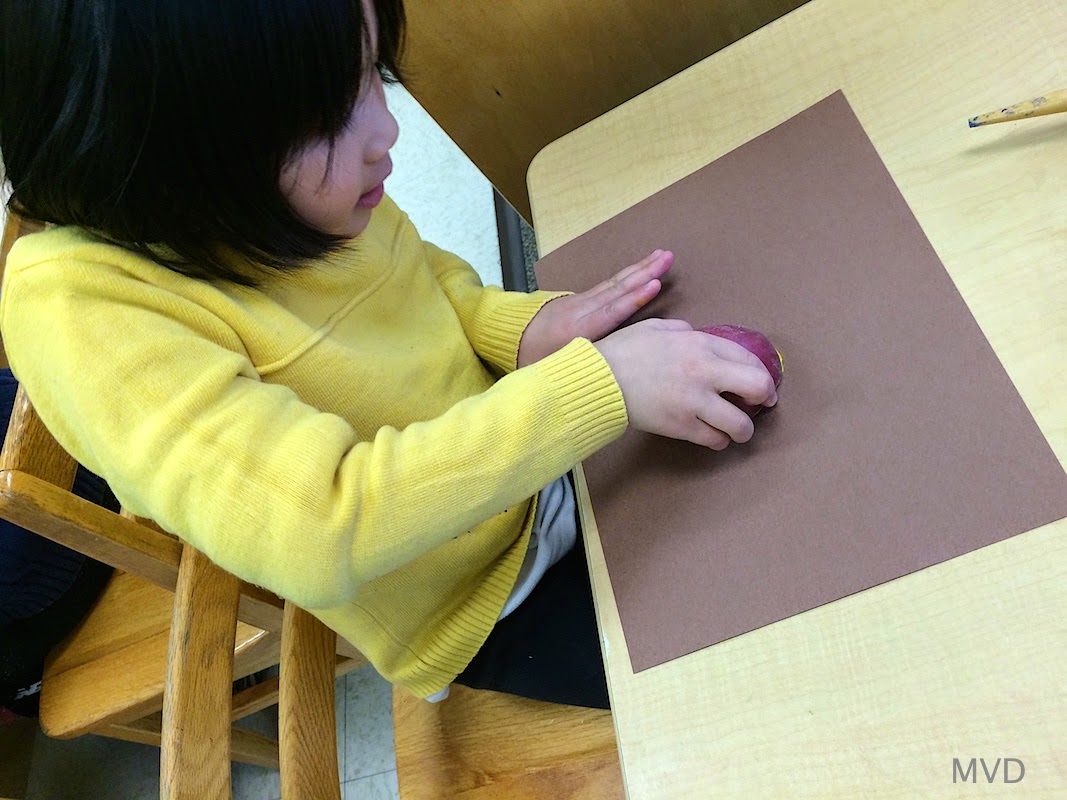
    In the class, the teacher demonstrates to the students how to apply the paint thinly on the paint surface with a brush, or to dunk the potato in the paint and print. The printing with washable acrylic paints works well on ordinary construction paper.
    The potato printing is a quick and fun activity for the students at the end of their school day.


    This ends the Day 1, 45-minute session introducing The Potato Project.


    Day 6: 
    Teacher and students will take the "seed potatoes" that have been on the window sill and cut each potato in half (each half to have two or more eyes) and will leave the potatoes to dry "heal".

    Next Week, Day 7,  Session Two: 45 mins: We will be mainly outdoors and
    planting before spring break.

    Then after spring break there will be class weekly care sessions until June:
    • Go out to potato bed, observe, journal and draw, look out for insects, and water well. 
    • Mound up earth around potato plants leaving some leaves visible. You may need to do this once a month during the growing season.
    • Adults may add compost (or fertilizer) to potatoes once or twice during growing season.
    Harvest and Prepare Mashed Potatoes (June and/or September)
    • Class can harvest some or all of the potatoes in June, wash, prepare and serve "microwaved mashed potatoes" as a class celebration.
    • Or you can leave some potato plants to grow until school returns to harvest in September (as a "Legacy Garden" for next  year's class of Montessori students to harvest and enjoy!).

    Resources: Link to detailed planning documents for the The Potato Project


    Saturday, July 5, 2014

    Return on Investment - Growing Garlic

    Last fall, I bought $15 worth of organic hardneck Siberian Red Chesnok garlic bulbs from the http://www.thegarlicstore.com/. Today, I harvested my entire garlic crop.  About 30 garlic bulbs have grown from the initial two bulbs. This is a healthy ROI, return on investment!
    Red Chesnok garlic
    Red Chesnok garlic
    Garlic is easy to grow in your garden. It likes sun, well-drained soil and regular watering.
    October/November: plantingPlan ahead and you can plant some garlic cloves around Thanksgiving-time.
    Split the bulbs into cloves and plant the cloves about 3 inches deep and 10 inches apart.
    In the spring, the garlic sprouts leaves.
    Garlic shoot
    Garlic shoot
    June: harvest and eat the ‘scapes’In June, you can harvest the flowerbuds: the ‘scapes’ of this hardneck variety.
    Harvesting the ‘scapes’ ensures the food-energy from the leaves goes into forming the garlic bulb, rather than producing flowers.
    Add washed and chopped ‘scapes’ to salads, omelettes and other dishes for flavor.
    Garlic 'scapes'
    Garlic ‘scapes’
    July: dig up and store garlic bulbsToday, the garlic leaves are turning yellow.  And I dug up the garlic bulbs and hung them  in shady place. I will leave the bulbs to dry for 3 or 4 weeks, and then braid them and bring indoors.
    OLYMPUS DIGITAL CAMERA
    Drying garlic
    Garlic culinary and medicinal uses
    Garlic has been a staple of Mediterranean, African and Asian cuisines for thousands of years, and is famous for its medicinal properties.  Today I made a stirfry flavored with our homegrown garlic and checked out garlic’s health benefits on wikipedia
    October/November: replanting
    In the fall, I can either replant some of these Red Chesnok garlic cloves – or I might try my luck and invest in growing another variety.

    Sunday, August 18, 2013

    Back to School: ideas for play, math, science and design with gourds, pumpkins and squash

    Here for K- 5 educators - ideas for play, math, science and design with gourds, pumpkins and squash.


    Gourd Math from MaryVanDyke

    Check out planting, growing and harvesting details for gourd family plants in your zone.
    Here in VA, gourds, pumpkins and squash are easy to plant in May and June.
    The plants can then look after themselves over the summer vacation...and will be ready to harvest when kids go back to school in the fall.