Showing posts with label environmental education. Show all posts

Wednesday, November 30, 2016

Learning with Pinecones

Learning with Pinecones
Today was drizzling. As I walk with preschoolers we listen to rain, step in puddles and admire raindrops cascading off a roof. We pass a couple of tall pine trees and check out the bundles of needles littered on the grass. Count the needles in each bundle: some have three, four, or five needles. The pines are Eastern White pines that have up to five needles in a bundle. We look for pinecones too. I have setup our class in a gazebo - where we continue to listen to the rain and can be sheltered.

Observation
A selection of pinecones to pass around, touch, lift and smell engages the young learners. The pinecones smell of resin, some are sticky, others prickly. The Coulter pinecone is huge, spiky and incredibly heavy and resiny. The sugar pinecone is light and long. The Jeffrey pinecone is also huge, and surprisingly strong yet light. For each pinecone we can see where the seeds grow and are protected - and have fallen out. Bring a pineapple and a dried sunflower flowerhead to highlight the similar fibonacci spiral patterns. I also bring in another different seedhead: one from a “bobbletree” - Liquidambar to compare and contrast with the pinecones patterns. This helps set the scene for an appreciation of patterns and diversity.


Coloring as prelude to journaling
I leave a medium-sized pinecone in the table of the table and give students the My Pinecone coloring sheet.

Observe the spirals on the drawing sheet.
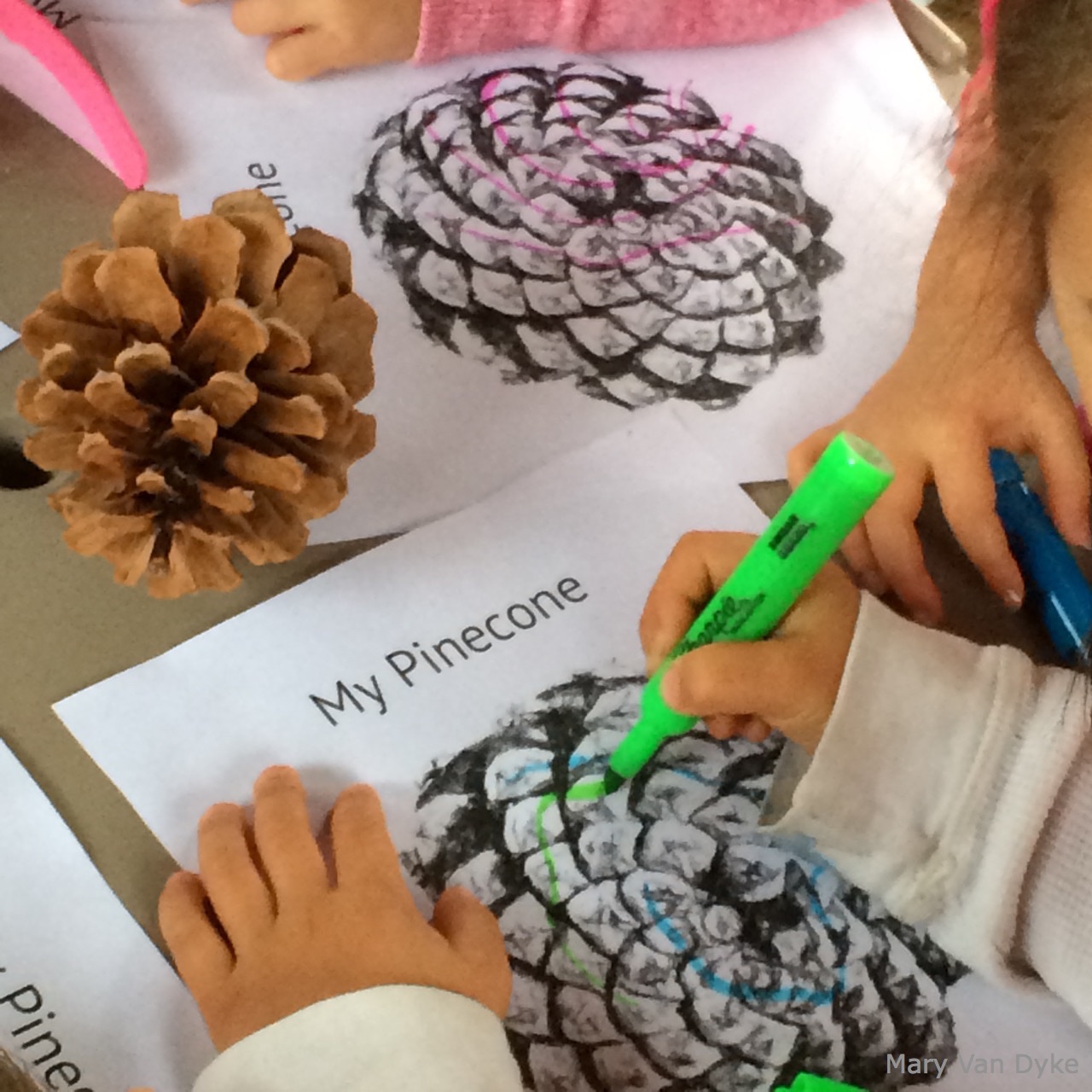
With highlighters I encourage the students to highlight the spirals in one direction. Then we pick a different color highlighter and try to find and color the spirals going in the opposite direction.
The preschoolers enjoy writing their names on the sheets too. Coloring can be trendy therapy, it is also a first step to future journaling.


Decorating pinecones to take home
I have collected small pinecones from a Virginia pine tree (the State Virginia pine tree) - that fell in a storm a few winters ago. Each year I collect a few more from other trees in the neighborhood.
Students decorate a small pinecone using glitter glue. Taking time with the brush and glue is fun and enhances the sensory experience. The pinecones take a day to dry. Students can take home as a gift from the garden to enjoy as a seasonal sparkly winter decoration, and reflect on the patterns they’ve experienced in nature!

We go back to class stomping in the puddles and looking at the clouds!

Resources

Pinecone coloring sheet - download, print and color http://www.slideshare.net/MaryVanDyke/my-pinecone-coloring-sheet-greenstem

Wednesday, January 27, 2016

Green STEM Learning 2015 and Vision for 2016 in Support of an Environmental Literacy Coordinator for APS

Here's the year end report for 2015 for my business Green STEM Learning, including work for clients Jamestown Elementary School PTA and Meridian Homeschool.

My cover photo shows Jamestown School yesterday. The Weeping Cherry Tree and Vegetable Beds are still under their blanket of snow! In the background, you see the big Willow Oak tree that is at the heart of the school's courtyard, and creates a wonderful shady place for classes to gather on hot summer days!


Green STEM Learning Report Year 2015 by Mary Van Dyke from Mary Van Dyke

This spring and summer at Jamestown School, I'll work on some of the projects highlighted in the report. While the snow is melting, it's a good time for me to meet with teachers to plan the vegetable gardens, native gardens and student outdoor projects.

And for Meridian Homeschool Club this spring, I'll continue working with the older students on their year-long Earth Force/Caring for Our Watershed civic engagement project. A couple of weeks ago, we went outside and measured the trees at the church where we meet. Then we calculated the ecosystem services the trees provide with i-Tree Design. We also identified the invasive plants on the property: there's lots of English Ivy and Bush Honeysuckle.  Next stage, the students are making a video for the church congregation and our partner schools in NM and PA.  I don't yet know what the students will come up with as a solution to the issues they are finding, as the project is student-directed and we have a few months to go!

Other projects for 2016, include my continued volunteer advocacy for enhancing sustainability and outdoor learning coordination within the Arlington Public Schools.

  • Why not invite the APS School Board to fund an Environmental Literacy Coordinator position?  I spent a couple of snow days this week making an aspirational pitch deck for the job - as if the School Board had funded the position. So stay tuned!  


Want to help with advocacy in the meantime?
  • Please do write to the APS School Board school.board@apsva.us with your comments in support of the APS Science Advisory Committee recommendations that include for cultivating integrative learning and also funding a Sustainability and Outdoor Learning Coordinator position.
  • A Sustainability and Outdoor Learning Coordinator (aka an Environmental Literacy Coordinator) as recommended by the Science Advisory Committee could help to more effectively evaluate programs, and share standards-aligned curricula and best practices through a collaborative and integrative approach that facilitates more creative problem-solving opportunities for students outdoors!
  • There's other priorities for the School Board, including the capacity issues and needing more seats for students.
     
  • So now's the time to ask for a balanced budget to include for this sustainability and outdoor learning coordinator position.

Mary Van Dyke, works part-time for Jamestown Elementary School PTA
as Visiting Horticulturalist, and as a volunteer she has interests in coordinating outdoor learning for schools in Arlington.
Mary serves on the APS Science Advisory Committee,
the APS Superintendent's Advisory Committee on Sustainability
and the Advisory Committee of NoVA Outside,
a regional alliance of environmental educators.
All opinions expressed in this article are the author's own.

Monday, August 3, 2015

Favorite Apps for Environmental Education and Outdoor Learning?

Time to take technology outdoors?
What are your favorite apps to enhance environmental literacy and outdoor learning?
Here's a list of my favorite Apps for Environmental Education/Outdoor Learning, optimized to include online guides for Virginia plants and wildlife see http://bit.ly/1KK4PnJ


Using app LikeThat Garden for flower identification
The list includes useful apps and links to identify plants, birds and animals and design gardens - wherever you have cellular connectivity!


Comments? Additions?

Wednesday, July 1, 2015

Sunday, April 12, 2015

Arlington's Growing Green Schools and the NoVA regional Schools Environmental Action Showcase

This week the Arlington County Healthy Community Action Team and the Arlington County Superintendent's Advisory Committee on Sustainability co-hosted a Growing Green Schools networking and resource-sharing event to recognize schools greening efforts.

The event is blogged by Jessica Haney at Mindful Healthy Life. 

The Growing Green Schools event helped catalyze and foster networks, partnerships and collaborative information sharing on health, food and nutrition and outdoor learning between local Arlington schools, community and providers of environmental and sustainability education.


Two days later, NoVA Outside, the Northern Virginia regional alliance for environmental educators partnered with Earth Force, George Mason University and many others to host the annual Schools Environmental Action Showcase.

Participating schools came to the Schools Environmental Action Showcase from all over the Northern Virginia region for an exciting day of activities including student project presentations, school displays and a competition for a school mascot made from recycled materials. Visiting VIPs included Senator Tim Kaine's representative Joe Montano, and a representative from Dominion Power.

The day was exciting and inspirational for all.  There was many people to talk to and ask questions such as:

  • Did you see the Dolphin mascot made of recycled trash? 
  • Did you check out the Dragon? 
  • How about the high school students presentation of Radicle Radishes: their project growing Daikon radishes to help with an erosion issue in a schoolyard?
  • Do you compost food waste at your school yet?
  • Do you find the Eco-Schools USA framework helpful?
  • How did the blades on your wind turbine work out?
  • Are you tracking your school's power usage?


I was impressed by the increase in focus on sustainability in our area schools.
Many thanks to Eco-Schools USA for providing an easily adoptable framework that is followed by many schools already in Fairfax County.

Thank you also to the SEAS organizers: to Elaine Tholen (FCPS Get2Green Coordinator), Kurt Moser (Earth Force), Cindy Smith (GMU PEREC) and the Advisory Committee of NoVA Outside, and also to many many others for hosting and participating in this Schools Environmental Action Showcase - that is the premier regional event for youth-focussed environmental education!

I helped to organize both Arlington's Growing Green Schools and the NoVA Schools Environmental Action Showcase and I also learned from talking with students, parents, teachers and partner organizations.

During the week, I also taught several classes of outdoor learning at Jamestown Elementary School and started a Garden Adventures program for the Homeschool Club of Arlington. I put into practice the basics for students learning outdoors: observation and journalling. Students discussed healthy ecosystems, soil and planted native plants. We planted vegetables and weeded.  I developed signage linked to QR Codes to highlight "evidence of learning" in the schoolyard. I trained Middle School teachers on Seeing Math Patterns in Nature. And I continued negotiations with school staff and the community for building capacity to adopt an Eco-Schools framework at a local school.

For me it was a beautiful week for learning and teaching about sustainability both indoors and outdoors.

I look forward to more students and their mentors being able to join in these local and regional showcase events next year to share the energy, inspiration and knowledge!


Resources:


Thursday, February 12, 2015

Update on the No Child Left Inside Act


Here's an update from February 11, 2015 on the federal No Child Left Inside Act - that supports outdoor learning.
Reblogged from the Outdoors Alliance for Kids...

"Senators Jack Reed (RI-D) and Mark Kirk (IL-R) and Congressmen John Sarbanes (MD-R) and Mike Fitzpatrick (PA-R) introduced legislation aimed at improving environmental education in our nation’s public schools. Supported by the Outdoors Alliance for Kids (OAK), the No Child Left Inside Act would provide grants to school districts, support teacher training and promote the integration of outdoor learning into the regular school curriculum.
The legislation would enhance opportunities for school children and adolescents to learn about, and in, the great outdoors. Environmental education has been shown to increase academic performance across subject areas and has been linked to improvements in critical thinking skills, student motivation, civic engagement and environmental stewardship. Environmental education, particularly when practiced outdoors, can increase the amount of physical activity children and youth engage in during the school day.
“Today’s children will be asked to tackle tomorrow’s environmental challenges,” says Michael Brune, Sierra Club Executive Director. “It’s our responsibility to ensure our kids have opportunities to get outdoors and learn about the natural world. The No Child Left Inside Act will provide young people with the foundation they need to succeed and lead in a climate changing world.”
“We are hopeful that 2015 is the year that Congress acts to ensure that America’s youth have access to high-quality environmental education programs that we know help improve student achievement, connect young people to their communities, and build environmental literacy,” says Judy Braus, North American Association for Environmental Education Executive Director. “If we want our students to be competitive in a global economy, they need to be environmentally literate.”
Environmental Education

Thursday, December 11, 2014

UL Innovative Education Awards for Non-Profits in US and Canada - apply now!


THE UL INNOVATIVE EDUCATION AWARD IS GRANTING $250,000 TO NONPROFITS. HELP US SPREAD THE WORD!
Dear NAAEE (North American Association for Environmental Education) Members:

If you attended our annual conference this year, you may have heard about NAAEE’s exciting new collaboration with Underwriters Laboratories (UL, the global safety science leader), the UL Innovative Education Award! The program, open now for submissions, supports the development of our future leaders by awarding nonprofits for their work in environmental and STEM education for children.

This is a first-of its-kind opportunity and a total of $250,000 will be awarded in addition to professional mentorship opportunities and more! But to find the most deserving organizations, we have to let them know that this opportunity exists. 

We need your help to spread the word about the program far and wide!  If you are involved with or know of an educational nonprofit that fits within the guidelines below, please let them know! By driving interest and enthusiasm for the award, you can help support the great work of non-profits across the U.S. and Canada as well as elevate the visibility of environmental education as a driver of STEM and curiosity.

Award Overview
The UL Innovative Education Award aims to recognize and support the critical work of U.S. and Canadian nonprofits that embrace E-STEM to inspire school-aged children to be the next generation of game-changing scientists, business leaders, researchers, inventors, and engineers.   The program supports E-STEM work with school-aged children (K-12) that is:
  • Advancing STEM learning through research and investigation
  • Promoting social responsibility and citizenship
  • Tackling environmental problems

Recognition Grants and Support
One $100,000 grant, two $50,000 grants, and two $25,000 grants will be awarded in the final program. In addition to recognition grants, UL employees, including science, engineering and technical experts, will work directly with the selected organizations to provide expertise, resources, and volunteer hours to help further their efforts in E-STEM education.  

Eligibility
Participants must:
  • Be a US 501c3 not-for-profit corporation or be registered with the Canada Revenue Agency as a non-profit organization (NPO) or be a program run by a US 501c3 not-for-profit corporation or Canadian equivalent NPO.  
  • Utilize E-STEM principles in innovative ways to teach school-aged (K-12) children in the US or Canada
  • Have an organization or program operating budget no greater than $2 million.

The UL Innovative Education Award website address is: http://naaee.org/ulinnovativeeducation. Pass it on today!

Please feel free to contact me directly with additional questions. Furthermore, if you would like to join the mailing list for the UL Innovative Education Award, you can sign up here: http://ulinnovationeducation.naaee.net/mailinglist

Thank you for your help!

Sincerely,
Christiane Maertens
Deputy Director
North American Association for Environmental Education
Christiane.Maertens@gmail.com

Saturday, November 22, 2014

Growing Outdoor Learning and Sustainability at Your School?

Are you trying to grow outdoor learning and sustainability in your school community?
Here's a presentation I gave a couple of weeks ago to the Jamestown Elementary School PTA on Growing Outdoor Learning and Sustainability at the school. 


We discussed our school community, vision, goals, wishlists, budget and funding sources - and several of the many environmental education and sustainability programs and projects for 2014 - 2015.


I am working part-time as "Visiting Horticulturalist" at the school and help to coordinate and facilitate outdoor learning. I appreciated this opportunity to meet with the PTA and discuss vision, goals and funding for the next year.

Friday, July 11, 2014

Gardening With and For Kids: Use All the Senses

What do you see, hear, smell, touch and taste in the garden?


This is a presentation to go with a Garden Talk held at Arlington Central Library this week.


Handout is at 
http://goo.gl/cqIjV  with ideas of projects to do and books to read.

Tuesday, June 17, 2014

What is Urban Environmental Education? And Why?

"Great article by The Nature of Cities around the goals and practices of urban environmental education. http://bit.ly/1qkvm2V"


Reposted from Earth Force's Facebook Page, June 17 2014

Wouldn't you love to see an Environmental Educators Leadership pathway in Virginia for Urban Environmental Educators?

See http://www.deq.virginia.gov/ConnectWithDEQ/EnvironmentalInformation/EnvironmentalEducatorsLeadershipProgram.aspx for the current list of educator pathways...


Using Technology in Environmental Education - Free Online Summer Course

This eight-week (self-paced) online course is designed to get you up and running with technologies you can use immediately in your organization and environmental programs. Choose the technologies you want to learn. You can focus on mobile and non-mobile tools to enhance your education programs, or focus on social media apps for marketing your programs. Or you can focus on both!

The course is free, funded by the EPA, Environmental Protection Agency.
Registration open until 07/01/2014


Click on the link for details and to register:  

Tuesday, April 15, 2014

Greening STEM - Environmental Education Week

This week April 13 - 19 is Environmental Education Week.
Time to think and plan!

What are you going to do to focus on "EEE" - that is Environmental Education & Engineering and Greening STEM?

http://eeweek.org/learning-center

Need more ideas? Check out my pieces on:
And the EE Engineering Educator Toolkit


Friday, March 21, 2014

Webinar: Want to learn more about Next Generation Science Standards and Environmental Education?

Download a webinar on the Next Generation Science Standards and Environmental Education (http://www.seer.org/Webinars/3-17-14NWF.wmv)
Note: The webinar is approximately 2 hours lon
g, so the file may take several minutes to download to your computer.
The Next Generation Science Standards (NGSS) represent an unprecedented opportunity for the environmental and sustainability education communities. Time to get up to speed on these important issues!
Reposted from the Green Schools National Network Facebook page 3/21/14

Thursday, January 23, 2014

Growing Stories: Literature in the Garden

It's time to register for this year's NSTA National Science Teachers Association Conference http://www.nsta.org/conferences/national.aspx that will be in Boston in April.

One of the four conference strands will be focused on Science and Literacy: A Symbiotic Relationship.

Today I wrote a conference proposal for our regional NSTA and VA Office of Environmental Educators conference that will be held in Richmond VA in October 16 - 18 2014.
My conference proposal theme is 
Growing Stories: Literature in the Garden.


Do you want to talk with elementary-age students about utopias, languages and designing your own culture and staple crop?
Read Paul Fleishman's inspirational Weslandia
Thumbnail for version as of 04:42, 21 April 2011
And check out associated activities in Junior Master Gardener's Literature in the Garden curriculum.
Here's a second grader's design for a staple crop...

Interested in teaching Native American culture, ecology and biodiversity with your class of 8-year olds?
Read Susan Jeffer's Brother Eagle Sister Sky.
And weave a Web of Life with your class using the activity plan from Junior Master Gardeners Literature in the Garden.


Examples of these classes are blogged on:
Arlington Traditional School's Gardening Blog:

Read Weslandia and Design New Staple Crops Second Grade 11/22/2011
Brother Eagle, Sister Sky  Second Grade 3/27/12

For further suggestions on environmental-themed literature for children:
Check out award-winning books from the Junior Master Gardeners and American Horticultural Society's "Growing Good Kids Book Awards"...

Cultivate reading in your garden!