Showing posts with label eco-schools USA. Show all posts

Sunday, April 12, 2015

Arlington's Growing Green Schools and the NoVA regional Schools Environmental Action Showcase

This week the Arlington County Healthy Community Action Team and the Arlington County Superintendent's Advisory Committee on Sustainability co-hosted a Growing Green Schools networking and resource-sharing event to recognize schools greening efforts.

The event is blogged by Jessica Haney at Mindful Healthy Life. 

The Growing Green Schools event helped catalyze and foster networks, partnerships and collaborative information sharing on health, food and nutrition and outdoor learning between local Arlington schools, community and providers of environmental and sustainability education.


Two days later, NoVA Outside, the Northern Virginia regional alliance for environmental educators partnered with Earth Force, George Mason University and many others to host the annual Schools Environmental Action Showcase.

Participating schools came to the Schools Environmental Action Showcase from all over the Northern Virginia region for an exciting day of activities including student project presentations, school displays and a competition for a school mascot made from recycled materials. Visiting VIPs included Senator Tim Kaine's representative Joe Montano, and a representative from Dominion Power.

The day was exciting and inspirational for all.  There was many people to talk to and ask questions such as:

  • Did you see the Dolphin mascot made of recycled trash? 
  • Did you check out the Dragon? 
  • How about the high school students presentation of Radicle Radishes: their project growing Daikon radishes to help with an erosion issue in a schoolyard?
  • Do you compost food waste at your school yet?
  • Do you find the Eco-Schools USA framework helpful?
  • How did the blades on your wind turbine work out?
  • Are you tracking your school's power usage?


I was impressed by the increase in focus on sustainability in our area schools.
Many thanks to Eco-Schools USA for providing an easily adoptable framework that is followed by many schools already in Fairfax County.

Thank you also to the SEAS organizers: to Elaine Tholen (FCPS Get2Green Coordinator), Kurt Moser (Earth Force), Cindy Smith (GMU PEREC) and the Advisory Committee of NoVA Outside, and also to many many others for hosting and participating in this Schools Environmental Action Showcase - that is the premier regional event for youth-focussed environmental education!

I helped to organize both Arlington's Growing Green Schools and the NoVA Schools Environmental Action Showcase and I also learned from talking with students, parents, teachers and partner organizations.

During the week, I also taught several classes of outdoor learning at Jamestown Elementary School and started a Garden Adventures program for the Homeschool Club of Arlington. I put into practice the basics for students learning outdoors: observation and journalling. Students discussed healthy ecosystems, soil and planted native plants. We planted vegetables and weeded.  I developed signage linked to QR Codes to highlight "evidence of learning" in the schoolyard. I trained Middle School teachers on Seeing Math Patterns in Nature. And I continued negotiations with school staff and the community for building capacity to adopt an Eco-Schools framework at a local school.

For me it was a beautiful week for learning and teaching about sustainability both indoors and outdoors.

I look forward to more students and their mentors being able to join in these local and regional showcase events next year to share the energy, inspiration and knowledge!


Resources:


Wednesday, April 1, 2015

One Small Square in the Outdoor Classroom

Ms Rascoe’s fourth grade science classes come out to the Jamestown Courtyard "outdoor classroom" to work collaboratively in teams of four students and to practice scientific method while observing a “one-meter square plot”: a One Small Square.


  • We frame our inquiry in terms of “health”.
    • How can we begin to assess the health of the small square?
    • What is the health of the one small square plot?
    • What would we do to improve the health of this plot?
  • The lesson guides students experientially to an understanding of improving health of an ecosystem through increasing biodiversity


Click for lesson plan details.

Also note: although students mark out a meter square area, we will consider what is underground and also in the air above the soil surface.
See Donald Silver's book One Small Square - Backyard for inspiration.


Each team of four students builds a one-meter square with ½ inch plastic pipes.


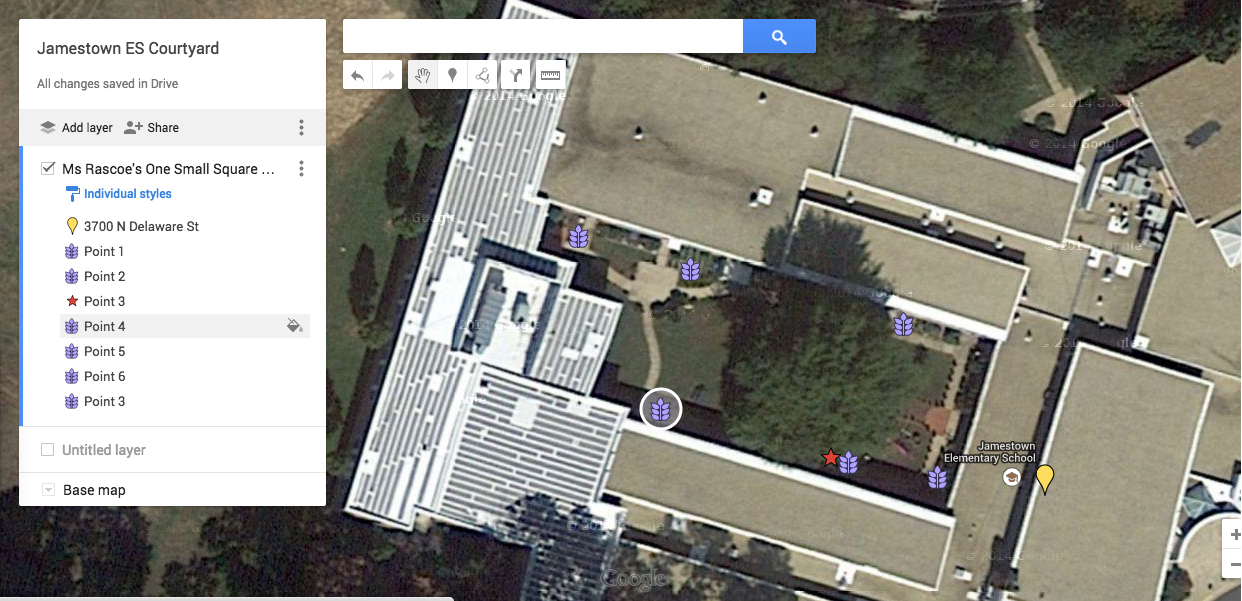
Each student team locates their meter square within a general area of the courtyard garden. Here are the 6 areas identified on a googlemap
JES One Small Square 0330115.jpg

The students observe their plots using senses: look closely, listen, smell and feel too...(We're not tasting things in the garden today though!)
  • Can you draw a bird's eye view of your one-meter plot?
  • What would a cross-section look like?
  • What do you consider to be factors influencing the "health" of your plot?
    • Factors include: sun, light, soil, rock, water, air, human interactions, wildlife, plants (abiotic and biotic factors)
  • Can you find and identify the plants in the plot?
  • Are there any insects and wildlife in your plot today?
    • Can you name them?
    • Observe the insects and wildlife and describe what they are doing.
  • Can you make a hypothesis or an inference about what might be under the soil surface using some of the information on the surface or by exploring carefully?


The students discuss together and diagram and write notes in their science journals, using pencil and colors.


After making observations, students begin to formulate a "health assessment" of the plot and propose design improvements.
  • What do we mean by “health” of the garden? We discuss ecosystems, biodiversity, wellness...
  • What would you do to measure and improve the health your plot? Consider potential signs of health.
  • The students begin to think about introducing plants or other ways they could increase the biodiversity and improve the health of their plot.

Here are some results and ideas for improvement:


Plot
Name of Plot
Observations of Plot
Ideas for Improvement
of "Health" of Plot
1
Sensory Garden
  • Not much growing yet
  • Daffodils are out
  • Sage (smells) silvery leaves
  • Thyme (smells)
  • Strawberries
  • Sign saying second grade are going to be planting a garden here with a QR Code links to a planting list
  • Could add many more plants with different textures, feel and smell to appeal to the senses and for students to study
  • Needs pathway
2

End Wall
  • Name of this area is not very poetic!
  • Smells of drains from toilet inside
  • Looks like a plant died and left a big “gap”
  • After rain hear rainwater in the downpipe
  • Crocuses in flower but behind big shrubs so you can’t see them
  • Need to report potential drain leak to Principal and Custodians - it smells unhealthy in this area
  • Need to select and plant a shrub to fill the “gap”
  • Can anyone think of better name for this area?
  • Could dig up and replant crocuses in front of the big bushes so they are visible and we can enjoy them in the spring
3

Weather Station
  • Christmas Rose, Hellebore in flower just outside the plot
  • The weather station has a thermometer that might work, a rain gauge and an anemometer to measure wind speed. The anemometer is broken.
  • There is a birdhouse
  • Some plants here are Coneflowers, Echinacea that have seeds that provide food for birds such as goldfinches
  • A weather station is an asset to the student’s use of the courtyard. But this one is broken. Perhaps it’s time to think about getting a new one?
  • There is also room to plant more plants here
3

Pyramidal Frame
  • Decide the frame is for a climbing plant
  • there’s a label but no plant in sight
  • There might be a plant waiting to come up?
  • Plant a climbing plant here if one doesn’t regrow in the spring?
4

K Tulip/Milkweed Garden
  • Several students remember planting tulips here when they were in Kindergarten and see lots of tulip leaves
  • In addition to tulips there are crocuses and lots of other plants identified as wild garlic, mugwort, chickweed
  • It might be a good idea to weed this bed of wild garlic and mugwort so that the plants intended to be here such as the tulips and milkweed can thrive more.
  • Also the milkweed likely will overcome some of the smaller plants here.
  • If milkweed is to be here - it might be more healthy for the plot to move the other plants to where they can more easily thrive?
5

Second Grade Garden
  • This garden lacks a poetic name!
  • Last week it was called the bed of the “decomposing pumpkin”
  • There are a lot of plants here that look interesting including lambs ear, asters, honeysuckle, buddleia and boxwoods
  • We discuss relative impacts of the various plants.
  • Buddleia although a nectar provider for insects can now be invasive in this area, perhaps it should be taken out and replaced with native plant?
  • The students like the lambs ears - it could also be divided to plant in the Sensory Garden. It needs to be managed to not overgrow its plot.
6

3 B’s Bird, Bees and Butterflies, Pollinators and Milkweed Garden
  • This garden has a name - although it is long.
  • Students find a rhizome of milkweed
  • There are a lot of hairy bittercress in flower, mugwort and other plants such as mint and lavender growing here
  • May need to move lavender
    out of this bed as it will be overcome by mint
  • Could weed out
  • Could plant other plants to increase biodiversity and increase flowers from spring to summer for pollinators
This lesson was 45 minutes long and gave students a quick overview and idea of what they could do for stewardship projects to help create a more healthy environment in the courtyard: to increase biodiversity.

The students are excited today by observing their selected small square plots, and feel empowered by suggesting ways they could contribute to the overall well-being of the courtyard. Students offer to be included in the stewardship and maintenance process of the courtyard, and I note proposals include: to plant seeds and plants, and to weed and water. Students begin to discuss health of the ecosystem in terms of increasing biodiversity.

Credits and Resources
One Small Square is inspired by "Magic Spots" in The Growing Classroom, p. 238.


Donald Silver: One Small Square - Backyard

One Small Square adaptations
The One Small Square lesson can be adapted for working over several class periods, and for elementary, middle school and high school students to assess for example: the health of a tree and an ecosystem, and to form an introduction to more extensive civic engagement stewardship projects.
For example:
  • At Gunston Middle School, I developed materials in Spanish and English for 6th grade students to observe tree health, do site assessments and catalyze stewardship projects.
  • At Arlington Traditional School, second grade and fifth grade classes observed their Small Squares over a year (Sept/Oct 2011) and implemented design projects.
  • The iSchool for the Future blogs One Small Square as a family activity.
  • Use the One Small Square lesson as an introduction for more extensive site assessments and audits of your schoolyard and school such as required for the Eco-Schools USA program.