Showing posts with label green schools. Show all posts

Sunday, April 12, 2015

Arlington's Growing Green Schools and the NoVA regional Schools Environmental Action Showcase

This week the Arlington County Healthy Community Action Team and the Arlington County Superintendent's Advisory Committee on Sustainability co-hosted a Growing Green Schools networking and resource-sharing event to recognize schools greening efforts.

The event is blogged by Jessica Haney at Mindful Healthy Life. 

The Growing Green Schools event helped catalyze and foster networks, partnerships and collaborative information sharing on health, food and nutrition and outdoor learning between local Arlington schools, community and providers of environmental and sustainability education.


Two days later, NoVA Outside, the Northern Virginia regional alliance for environmental educators partnered with Earth Force, George Mason University and many others to host the annual Schools Environmental Action Showcase.

Participating schools came to the Schools Environmental Action Showcase from all over the Northern Virginia region for an exciting day of activities including student project presentations, school displays and a competition for a school mascot made from recycled materials. Visiting VIPs included Senator Tim Kaine's representative Joe Montano, and a representative from Dominion Power.

The day was exciting and inspirational for all.  There was many people to talk to and ask questions such as:

  • Did you see the Dolphin mascot made of recycled trash? 
  • Did you check out the Dragon? 
  • How about the high school students presentation of Radicle Radishes: their project growing Daikon radishes to help with an erosion issue in a schoolyard?
  • Do you compost food waste at your school yet?
  • Do you find the Eco-Schools USA framework helpful?
  • How did the blades on your wind turbine work out?
  • Are you tracking your school's power usage?


I was impressed by the increase in focus on sustainability in our area schools.
Many thanks to Eco-Schools USA for providing an easily adoptable framework that is followed by many schools already in Fairfax County.

Thank you also to the SEAS organizers: to Elaine Tholen (FCPS Get2Green Coordinator), Kurt Moser (Earth Force), Cindy Smith (GMU PEREC) and the Advisory Committee of NoVA Outside, and also to many many others for hosting and participating in this Schools Environmental Action Showcase - that is the premier regional event for youth-focussed environmental education!

I helped to organize both Arlington's Growing Green Schools and the NoVA Schools Environmental Action Showcase and I also learned from talking with students, parents, teachers and partner organizations.

During the week, I also taught several classes of outdoor learning at Jamestown Elementary School and started a Garden Adventures program for the Homeschool Club of Arlington. I put into practice the basics for students learning outdoors: observation and journalling. Students discussed healthy ecosystems, soil and planted native plants. We planted vegetables and weeded.  I developed signage linked to QR Codes to highlight "evidence of learning" in the schoolyard. I trained Middle School teachers on Seeing Math Patterns in Nature. And I continued negotiations with school staff and the community for building capacity to adopt an Eco-Schools framework at a local school.

For me it was a beautiful week for learning and teaching about sustainability both indoors and outdoors.

I look forward to more students and their mentors being able to join in these local and regional showcase events next year to share the energy, inspiration and knowledge!


Resources:


Wednesday, March 18, 2015

Think Spring! Plan to Sustain a Teachable Schoolyard

I am the "Visiting Horticulturalist" at Jamestown Elementary School in Arlington and help the school community (staff, parents, students) plan and maintain the courtyard garden and grounds for outdoor learning.

Here's the school Courtyard in October 2014
Jamestown Elementary School, Courtyard
October 2014

Outcomes
What are the short-term outcomes that the community expects by the end of June 2015?
  • A beautiful and useful garden
  • Flowers in bloom
  • Vegetables to harvest and taste
  • To attract and sustain insects and birds while minimizing rodents
  • To increase parent and teacher interest and involvement
  • To increase the number of students learning outdoors
  • To increase use of volunteers, such as Eagle Scouts
  • To demonstrate "evidence of learning" in the garden and on various media
  • Integrated "green STEM" curriculum-linked learning

I have lots of questions to work through myself and with the community.
How can we start from where the community is - and build capacity for those goals over the next few weeks?
What are projects and community-building to put on the to-do list for next year or the distant future?
How do we build time for schoolyard-based curriculum-linked gardening into the already-packed school schedule?
What resources do we have or need in terms of funding and expertise?

In the fall various projects began. The principal, lead science teacher and I met and discussed and surveyed the grounds several times. I made an inventory and site assessment. I met three key parents interested in supporting outdoor learning and I built connections to the PTA, presented to the PTA on growing sustainability and outdoor learning. The PTA had already budgeted for an annual clean up by a landscape contractor, and also funding for Outdoor Learning and my position. An Eagle Scout undertook to gravel the pathway to the big willow oak tree. The teaching platform was repaired by facilities. I talked to custodians, and met and worked with teaching staff to discover what they were already doing, and would like to do, and to define a few projects utilizing different areas of the courtyard and grounds. I took all classes outside to learn, and I made a couple of sample signs to demonstrate potential using QR Codes and graphics.

Logic Model planning
This week in the spring, I sketched out a "logic model" starting with outcomes/outputs of various current and potential projects and worked back to our continuing assessments, and the partners and resources needed for each project. Based on my fall site and class assessments, this week I revisited designs and wrote spring plant lists.

Jamestown Courtyard
Site and Plant Assessment
Today I am out in the courtyard with a volunteer parent for our first spring maintenance session. First of all we take stock of the courtyard after the winter snow. It is windy today and I enjoy listening to the breeze in the huge willow oak tree in the center of the courtyard.
Again lots of questions: What's new since the snow? What needs doing now for a 'spring clean up' prior to planting? What can the students do when they come out in small groups to learn next week?

We decide to begin to maintain one of the flower beds inside the courtyard, and to gauge what students can do.
  • There's lots of leaves from the willow oak that can be raked up and some sticks and branches to pick up - those are great jobs for a class of second graders.
  • The tulips K planted in fall are coming up. A couple of crocuses are out. 
  • The hairy bittercress and speedwell, are already flowering in the milkweed and pollinator garden. Identifying the plants, discussing maintenance and weeding is also a great job for second graders. See link to my Weed Identification for Schools resources.
  • The box bushes are yellow with winter burn. Let's have the students monitor the bushes, and see if the bushes will leaf out or need replacing?
  • We need to move two lavender bushes, and prune the big buddleia shrubs back to 12 inches or so above the ground.  The fall asters need clipping. Pruning and clipping is a great job too for second graders working in supervised small groups. But do we have the tools?
  • The buddleia "butterfly bushes" are beloved in schoolyards but becoming an invasive in this area. Until we have built the community understanding to successfully replace the buddleias with native plants I will manage by clipping off the seedheads in the fall.
  • There's lots of common milkweed growing in the courtyard and the school is devoted to raising monarch caterpillars and butterflies. We decide to focus the milkweed in two bounded beds this year rather than allowing milkweed to grow anywhere in the courtyard. And to increase diversity of plantings in the "milkweed beds" by interplanting with equally vigorous natives: We'll interplant with our local and regional native plants: goldenrod, mountain mint, rudbeckia, helianthus. Students could do the planting after spring break.
  • I take quick review of sun paths, soil conditions to update my site assessment in the fall - some daffodils are now up in unexpected places.
  • Over the winter I started to name and focus the beds in the courtyard - so far we have:
  • Sensory Garden 
  • A Shade Garden
  • Three B's: Birds, Bees and Butterflies Pollinator Garden
  • Ms Zamora's Students Vegetable Patch
  • Bird Station
  • Kindergarten Tulip and Milkweed Patch
Tool Assessment
  • Reassess the tools in the toolshed
  • What tools work?
  • What do we need and how many of each for small groups?

    The school now has plenty of trowels and shovels for planting, digging and weeding, and hoses, watering cans and a big tub for watering. I will buy 4 leaf rakes, 8 pruners, and 4 leaf scoops. I will label and put the pruners in box high up in the shed, and will teach the students how to use these tools safely to trim the lavender bushes, fall asters and buddleias next week.
Processes: Yardwaste and Composting
  • How do we recycle plant material currently and in the future?
    If we dispose of plant material in the school dumpster the yardwaste is shipped out of the county and is likely burned for energy in our local incinerator. Perhaps it goes to a landfill?
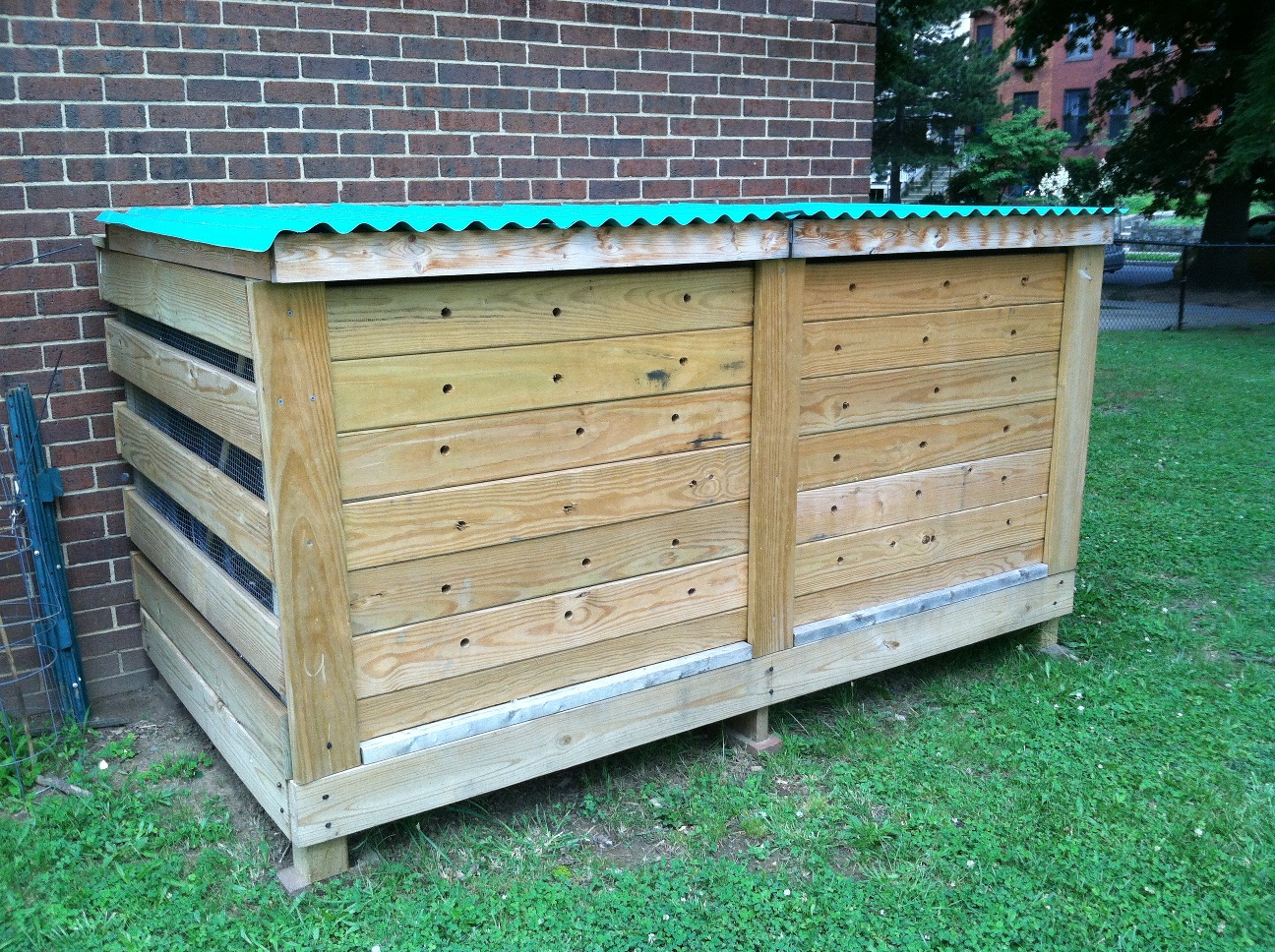
    A parent decides on reflection to take home our two bags of weeds today to then leave out for the county to collect as "spring yardwaste" and compost. I am still talking with APS school facilities about on-site composting at schools. Some Arlington Career Center students are designing composters in a new sustainable systems course. I have already offered to the Career Center teachers that Jamestown ES could pilot two of these student designed and made compost bins - one in the Courtyard and one outside by the vegetable beds. I am sure that even two of bin composters like these below will still be under-capacity for the size of the schoolyard and grounds - given the capacity of my large compost area and garden at home.
    Captionless Image
    DC Public Schools - Composter Design

    I look across the river to DC schools for rat-resistant aesthetically appealing design inspiration and also to colleagues Fairfax County Public Schools.
  • There is a large old Mantis tumbler composter at the Jamestown Elementary school, but it is no longer working. A parent is kindly arranging for repair spare parts. I've talked to custodians, parents and staff, we may be ready to start to using the compost tumbler again on a small scale. Parents and students could occasionally add in weeds and the custodians' coffee grounds that are nitrogen-rich and dried leaves that are carbon-rich to create a balanced mix. Even without taking on permaculture or a guiding framework such as Eco-Schools within the school, there is lots to learn from attitudes to composting and our "waste" management practices.

Signage and Media 
How do we best get messages out to the community?  Multi-media and incremental change is key. The staff I am working with have email, a once a week email to parents and the website, twitter and FB. I have couple of signs already for the courtyard linked by QR code to projects. We did a couple of tweets. I am using SignUp Genius to outreach to parents. I will blog garden projects here at Green STEM Learning. My goal is to add more "evidence of learning" in the garden and to use the signs to highlight students learning. A second grade class is taking on to create some signs as part of a project on habitats.

With a view to create more sustainable outdoor learning programs in Arlington, I continue conversations with other schools both in our county and elsewhere. I continue to dialog with others on EfS - Education for Sustainability - and frameworks such as Eco-Schools. Next month, our county's FitArlington Healthy Community Action Team and Superintendent's Advisory Committee on Sustainability are co-hosting a Growing Green Schools event to encourage more networking and information exchange on learning and best practices between school communities.
As far as Jamestown ES goes I list on the logic model - projects that we will do this spring - and  begin to develop a "wish-list" of others that could be done in the future.


Resources mentioned:

Logic Models: WK Kellogg Foundation, Logic Model Development Guide, 2004
Presentation: for Jamestown Elementary School, Growing Sustainability and Outdoor Learning
Tools: Trowels, Leaf Scoops
Weeds: Weed Identification for Schools by Mary Van Dyke, 2014
Native Plants in Northern Virginia: Northern Virginia Native Plant Campaign - www.plantnovanatives.org
Composting Lessons:
Permaculture Principles http://permacultureprinciples.com/
Eco- Schools USA http://www.nwf.org/eco-schools-usa.aspx
Green Schools National Network https://greenschoolsnationalnetwork.org/


Next Week: Red, White and Blue, Planting Potatoes with Montessori


Saturday, May 11, 2013

Strawberry Fields Forever.... Plans, Planting, Protection

Strawberries are fun to grow.  The early varieties cycle with the school year, fruiting in May-June.  And you can bring lots of Green STEM Learning to the art of growing strawberries.

For a lesson on growing strawberries

Let's begin with the story of how the strawberry came to be

Here in Virginia - strawberries, Fragaria virginiana are a native plant, and grow well as a groundcover in part-shade.
Violets and Wild Strawberries - at the Museum of the American Indian DC
(photo Mary Van Dyke)
There is a Cherokee story about the origin of the First Strawberries.  In the Cherokee story, the first man and woman quarrel - and the woman leaves the man in anger.  The sun sends delicious, red juicy berries down to Earth to tempt the woman.  Do you think the strawberry has the power to quell the first woman's anger and make her stay on Earth with the first man?

Find the story of The First Strawberries as a book or as an audio download (References at end of this blog entry). 


Growing Strawberries

Strawberry cultivars are bred and selected for different qualities for human-eating.
Check them out at http://strawberryplants.org/. - and select some cultivars that suit your climate, ecology, timing  and taste...


Grow strawberry plants close together to crowd out weeds.  But if you're growing for prime fruits you may space your plants further apart.  Here comes the math, engineering, technology and science....


Plans
First considerations: What shape and how big is my planting bed?  How many berry plants can I fit in? Are you growing in the ground or in a pot? 
Here I'll show my design for 2 raised beds with internal dimension about 3' 4"  x 6'
Draw out a sketch plan roughly to scale at the recommended planting distance of about one foot per plant.

Or  work the other way round...

If I have 8 strawberry plants to plant in two rows of 4:
How big an area of ground will they need at a one-foot spacing apart?

Sketch it...and make your bed to suit...
How big a planting bed do you need if you space at the recommended distance of two-feet apart?


Planting

Buy strawberry plants.  Prepare soil and plant your strawberry plants following instructions on the pot or at strawberryplants.org


Protection
From experience I know that molds, pillbugs or roly-poly's, slugs, mice, chipmunks, and birds all like to feed on strawberry fruit...
The next step in the design process is how to keep off these predators and pests that (like me) also like to feast on strawberries?

One option might be to plant lots of plants and hope for the best?
But, if you have a small number of plants you're more likely to want to protect them from birds with bird netting, while a farmer with a large crop will not net and will factor in extra plants for bird loss.

If you choose to go with bird-netting - the choice is then "Does it need a support structure - or not?"

I have two beds this year and I am experimenting:
1) In one bed I lay the lightweight bird-proof netting straight over the plants.  And I pin it down the edges of the net with some wooden 2 x 3's.  That works well at the moment.

2) On the second bed, I build a frame out of PVC piping.  This is an easy project for 5th graders and up.  It's like a construction game.  The PVC tube connectors are available in two sorts: 90 degree L's and T's.  There are no 3 way corner connections.
Can you design a cheap and strong frame to fit your bed?  How many legs is it going to have? 
Have a go and see what structure you come up with.


For this example of the 3' 4" x 6 ' bed.
I decide the frame will be rectangular and stand on four legs, and that the maximum unsupported span of PVC piping will be about 3 or 4 feet. I decide the legs will be about 6 " in the ground and 18" above ground - i.e. 24 inch length.
Here's my cutting list of 1/2 " diameter PVC pipe that is available in 12 foot lengths:
10" #4
24" #4 (legs)
36" #2
48" #2

Can you count the connector pieces I need?  How many T's and L's do I need?

That's right - 4 T's and 4 L's

Next I assemble the frame - this takes about 10 minutes and is very easy as the connectors and tubes twist and push together - no glue is needed and the frame will be demountable at the end of the season.

Put the bird netting over the frame  and secure along bottom edge with loose laid 2 x 3 timbers.


Does this netting work? Does it need a frame to function well?  Time will tell....


Topic Extension
Why do you think this farmer uses hills, black plastic and underground irrigation?
What are the pros and cons of this method of growing that is now called "Plasticulture"
What do you think the standing-pipe sprayer is for?

Picking strawberries at Mackintosh Farm, Berryville VA (Photo by Mary Van Dyke)


Think of some other ways you might grow strawberry plants if you were a farmer?
What problems would you need to solve in each case?
What issues are eliminated or added to the problem of "growing strawberries" design if you hang the strawberries in hanging baskets?  Or grow strawberries in stacked boxes?


Next steps: we look at Strawberry Science close-up, mulching and harvesting...

References:

Native Virginia Strawberries: http://www.wildflower.org/plants/result.php?id_plant=FRVI
The First Strawberries, retold by Joseph Bruchac and illustrated by Anna Vojtech
The First Strawberries, free audiodownload from Storynory
Strawberryplants.org for information on growing strawberries


Tuesday, April 9, 2013

A farm takes root in the city


Walker-Jones Education Campus - Sometimes, it’s okay to play with your food! These young sprouts are kindergarten students at Walker-Jones. The school farm’s produce is used in the classroom and goes home with the kids or is shared in the neighborhood.


‘Going green” isn’t just talk at Walker-Jones Education Campus. The D.C. school, which opened in 2009, was designed to save energy and provide a healthful environment for preschoolers through eighth-graders. But in the past three years, students, teachers and lots of volunteers have taken the school’s green commitment much further. They transformed a weedy lot across the street into a thriving farm.
“It’s a farm and not a garden,” said David Hilmy, Walker-Jones’s P.E. teacher and a trained biologist, who oversees the farm. “Our aim is to produce food.”

Link to rest of this article - Washington Post Kids Post online April 8
(Walker-Jones Education Campus) - At Walker-Jones Education Campus, students learn what it takes to make food, tending a one-acre garden that last year produced 4,200 pounds of food.