I am the "Visiting Horticulturalist" at Jamestown Elementary School in Arlington and help the school community (staff, parents, students) plan and maintain the courtyard garden and grounds for outdoor learning.
Here's the school Courtyard in October 2014
 |
Jamestown Elementary School, Courtyard
October 2014 |
Outcomes
What are the short-term outcomes that the community expects by the end of June 2015?
- A beautiful and useful garden
- Flowers in bloom
- Vegetables to harvest and taste
- To attract and sustain insects and birds while minimizing rodents
- To increase parent and teacher interest and involvement
- To increase the number of students learning outdoors
- To increase use of volunteers, such as Eagle Scouts
- To demonstrate "evidence of learning" in the garden and on various media
- Integrated "green STEM" curriculum-linked learning
I have lots of questions to work through myself and with the community.
How can we start from where the community is - and build capacity for those goals over the next few weeks?
What are projects and community-building to put on the to-do list for next year or the distant future?
How do we build time for schoolyard-based curriculum-linked gardening into the already-packed school schedule?
What resources do we have or need in terms of funding and expertise?
In the fall various projects began. The principal, lead science teacher and I met and discussed and surveyed the grounds several times. I made an inventory and site assessment. I met three key parents interested in supporting outdoor learning and I built connections to the PTA, presented to the PTA on
growing sustainability and outdoor learning. The PTA had already budgeted for an annual clean up by a landscape contractor, and also funding for Outdoor Learning and my position. An Eagle Scout undertook to gravel the pathway to the big willow oak tree. The teaching platform was repaired by facilities. I talked to custodians, and met and worked with teaching staff to discover what they were already doing, and would like to do, and to define a few projects utilizing different areas of the courtyard and grounds. I took all classes outside to learn, and I made a couple of sample signs to demonstrate potential using QR Codes and graphics.
Logic Model planning
This week in the spring, I sketched out a "logic model" starting with outcomes/outputs of various current and potential projects and worked back to our continuing assessments, and the partners and resources needed for each project. Based on my fall site and class assessments, this week I revisited designs and wrote spring plant lists.
Jamestown Courtyard
Site and Plant Assessment
Today I am out in the courtyard with a volunteer parent for our first spring maintenance session. First of all we take stock of the courtyard after the winter snow. It is windy today and I enjoy listening to the breeze in the huge willow oak tree in the center of the courtyard.
Again lots of questions: What's new since the snow? What needs doing now for a 'spring clean up' prior to planting? What can the students do when they come out in small groups to learn next week?
We decide to begin to maintain one of the flower beds inside the courtyard, and to gauge what students can do.
- There's lots of leaves from the willow oak that can be raked up and some sticks and branches to pick up - those are great jobs for a class of second graders.
- The tulips K planted in fall are coming up. A couple of crocuses are out.
- The hairy bittercress and speedwell, are already flowering in the milkweed and pollinator garden. Identifying the plants, discussing maintenance and weeding is also a great job for second graders. See link to my Weed Identification for Schools resources.
- The box bushes are yellow with winter burn. Let's have the students monitor the bushes, and see if the bushes will leaf out or need replacing?
- We need to move two lavender bushes, and prune the big buddleia shrubs back to 12 inches or so above the ground. The fall asters need clipping. Pruning and clipping is a great job too for second graders working in supervised small groups. But do we have the tools?
- The buddleia "butterfly bushes" are beloved in schoolyards but becoming an invasive in this area. Until we have built the community understanding to successfully replace the buddleias with native plants I will manage by clipping off the seedheads in the fall.
- There's lots of common milkweed growing in the courtyard and the school is devoted to raising monarch caterpillars and butterflies. We decide to focus the milkweed in two bounded beds this year rather than allowing milkweed to grow anywhere in the courtyard. And to increase diversity of plantings in the "milkweed beds" by interplanting with equally vigorous natives: We'll interplant with our local and regional native plants: goldenrod, mountain mint, rudbeckia, helianthus. Students could do the planting after spring break.
- I take quick review of sun paths, soil conditions to update my site assessment in the fall - some daffodils are now up in unexpected places.
- Over the winter I started to name and focus the beds in the courtyard - so far we have:
- Sensory Garden
- A Shade Garden
- Three B's: Birds, Bees and Butterflies Pollinator Garden
- Ms Zamora's Students Vegetable Patch
- Bird Station
- Kindergarten Tulip and Milkweed Patch
Tool Assessment
- Reassess the tools in the toolshed
- What tools work?
- What do we need and how many of each for small groups?
The school now has plenty of trowels and shovels for planting, digging and weeding, and hoses, watering cans and a big tub for watering. I will buy 4 leaf rakes, 8 pruners, and 4 leaf scoops. I will label and put the pruners in box high up in the shed, and will teach the students how to use these tools safely to trim the lavender bushes, fall asters and buddleias next week.
Processes: Yardwaste and Composting
- How do we recycle plant material currently and in the future?
If we dispose of plant material in the school dumpster the yardwaste is shipped out of the county and is likely burned for energy in our local incinerator. Perhaps it goes to a landfill?
A parent decides on reflection to take home our two bags of weeds today to then leave out for the county to collect as "spring yardwaste" and compost. I am still talking with APS school facilities about on-site composting at schools. Some Arlington Career Center students are designing composters in a new sustainable systems course. I have already offered to the Career Center teachers that Jamestown ES could pilot two of these student designed and made compost bins - one in the Courtyard and one outside by the vegetable beds. I am sure that even two of bin composters like these below will still be under-capacity for the size of the schoolyard and grounds - given the capacity of my large compost area and garden at home.
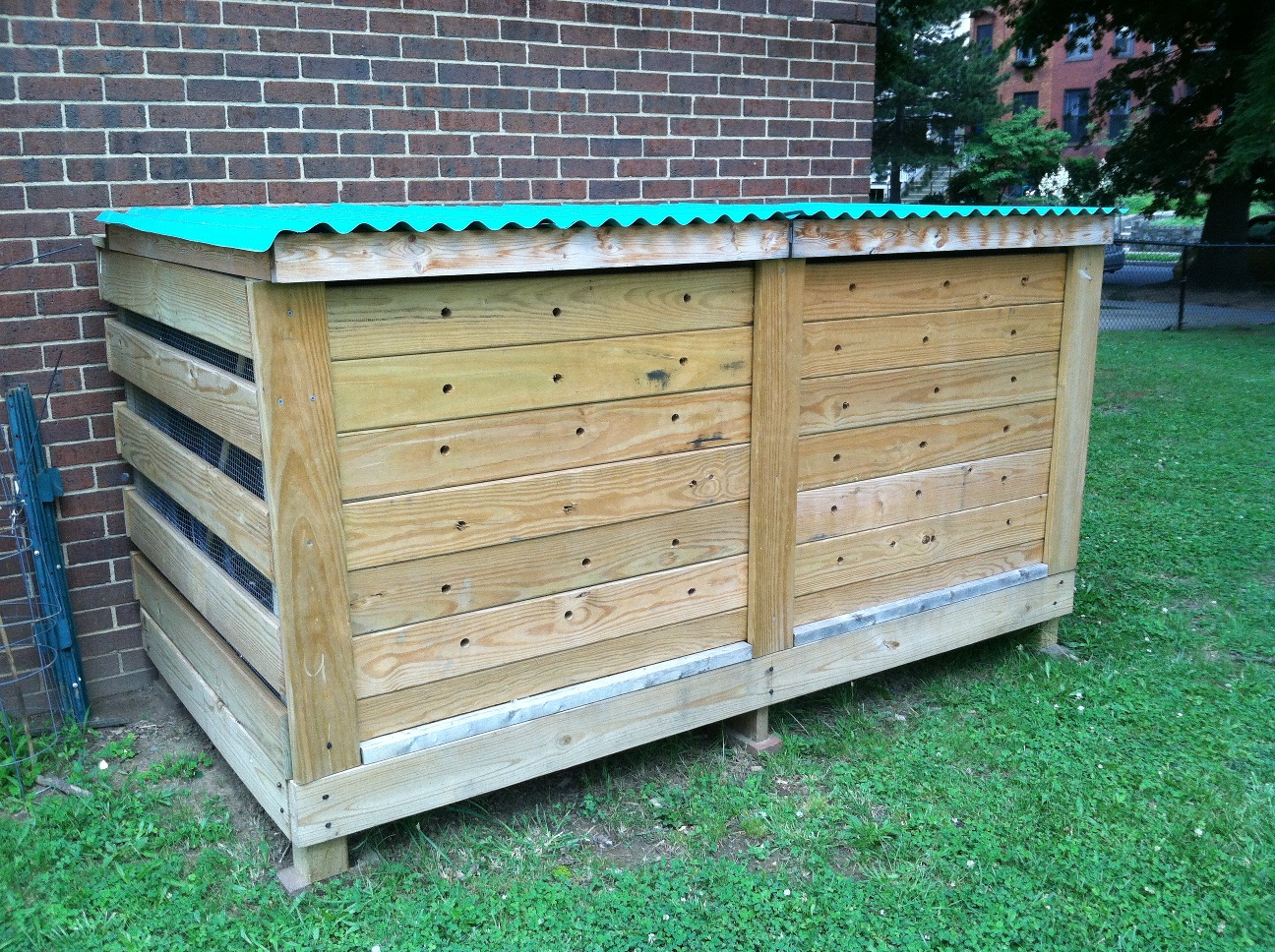 |
| DC Public Schools - Composter Design |
I look across the river to DC schools for rat-resistant aesthetically appealing design inspiration and also to colleagues Fairfax County Public Schools.
- There is a large old Mantis tumbler composter at the Jamestown Elementary school, but it is no longer working. A parent is kindly arranging for repair spare parts. I've talked to custodians, parents and staff, we may be ready to start to using the compost tumbler again on a small scale. Parents and students could occasionally add in weeds and the custodians' coffee grounds that are nitrogen-rich and dried leaves that are carbon-rich to create a balanced mix. Even without taking on permaculture or a guiding framework such as Eco-Schools within the school, there is lots to learn from attitudes to composting and our "waste" management practices.
Signage and Media
How do we best get messages out to the community? Multi-media and incremental change is key. The staff I am working with have email, a once a week email to parents and the website, twitter and FB. I have couple of signs already for the courtyard linked by QR code to projects. We did a couple of tweets. I am using SignUp Genius to outreach to parents. I will blog garden projects here at Green STEM Learning. My goal is to add more "evidence of learning" in the garden and to use the signs to highlight students learning. A second grade class is taking on to create some signs as part of a project on habitats.
With a view to create more sustainable outdoor learning programs in Arlington, I continue conversations with other schools both in our county and elsewhere. I continue to dialog with others on EfS - Education for Sustainability - and frameworks such as Eco-Schools. Next month, our county's FitArlington Healthy Community Action Team and Superintendent's Advisory Committee on Sustainability are co-hosting a Growing Green Schools event to encourage more networking and information exchange on learning and best practices between school communities.
As far as Jamestown ES goes I list on the logic model - projects that we will do this spring - and begin to develop a "wish-list" of others that could be done in the future.
Resources mentioned:
Logic Models: WK Kellogg Foundation,
Logic Model Development Guide, 2004
Presentation: for Jamestown Elementary School,
Growing Sustainability and Outdoor Learning
Tools: Trowels,
Leaf Scoops
Weeds: Weed Identification for Schools by Mary Van Dyke, 2014
Native Plants in Northern Virginia: Northern Virginia Native Plant Campaign -
www.plantnovanatives.org
Composting Lessons:
Permaculture Principles http://permacultureprinciples.com/
Eco- Schools USA http://www.nwf.org/eco-schools-usa.aspx
Green Schools National Network https://greenschoolsnationalnetwork.org/
Next Week: Red, White and Blue, Planting Potatoes with Montessori


