Friday, September 26, 2014

Count Your Sunflower Spirals - and Fibonacci and Lucas Sequences

I'm continuing research for a presentation on Seeing Math Patterns in Nature - and I am looking at growth patterns in sunflowers and other plants.

Sunflower - photo by Mary Van Dyke
Current estimates are that 90% of plants follow the Fibonacci sequence: (1 1 2 3 5 8 13 21 34 55 89... ) for optimum flow of auxin, the plant growth hormone, and evolutionary adaptation to maximize efficiency in packing seeds.

Here's Ron Knott's diagram of a 1000 seedhead sunflower with 89 and 55 spirals at the perimeter:


Some plant species, such as sunflowers, can follow both the Fibonacci and other sequences such as the Lucas sequence (1, 2 3 4 7 11...) - and other permutations of series too.

A big global citizen science experiment to study sunflowers and count their spirals has been running since 2012 in honor of mathematician Alan Turing's "enigma code breaker's" 100th anniversary of his birth - and the discovery of his unfinished work on the math of sunflowers.
See Turingsunflowers.com.


In 2012 people around the world planted sunflowers and counted their spirals - here's how from the Geeky Gardener - Anna Evangeli.


Fibonacci V Lucas: spot your sunflower's spiral › Science Features (ABC Science)

From the initial big data experiment of Turing's Sunflower Project - results came from 557 sunflowers from 7 countries as follows:
  • Fibonacci spiral sunflowers - 458
  • Lucas spiral sunflowers - 33
  • Double Fibonacci sequence numbers sunflowers - 26
  • Other spiral numbers - a small number of sunflowers with no apparent Fibonacci or Lucas number patterns
How about counting the spirals of the sunflower seedheads you planted in your garden this year?
Or do you plan to plant some sunflowers to count next year?


Collecting Sunflower Seeds - photo by Mary Van Dyke


Wednesday, September 3, 2014

Infographics - Talking Pictures

A picture speaks a thousand words, and catches your attention and appreciation.

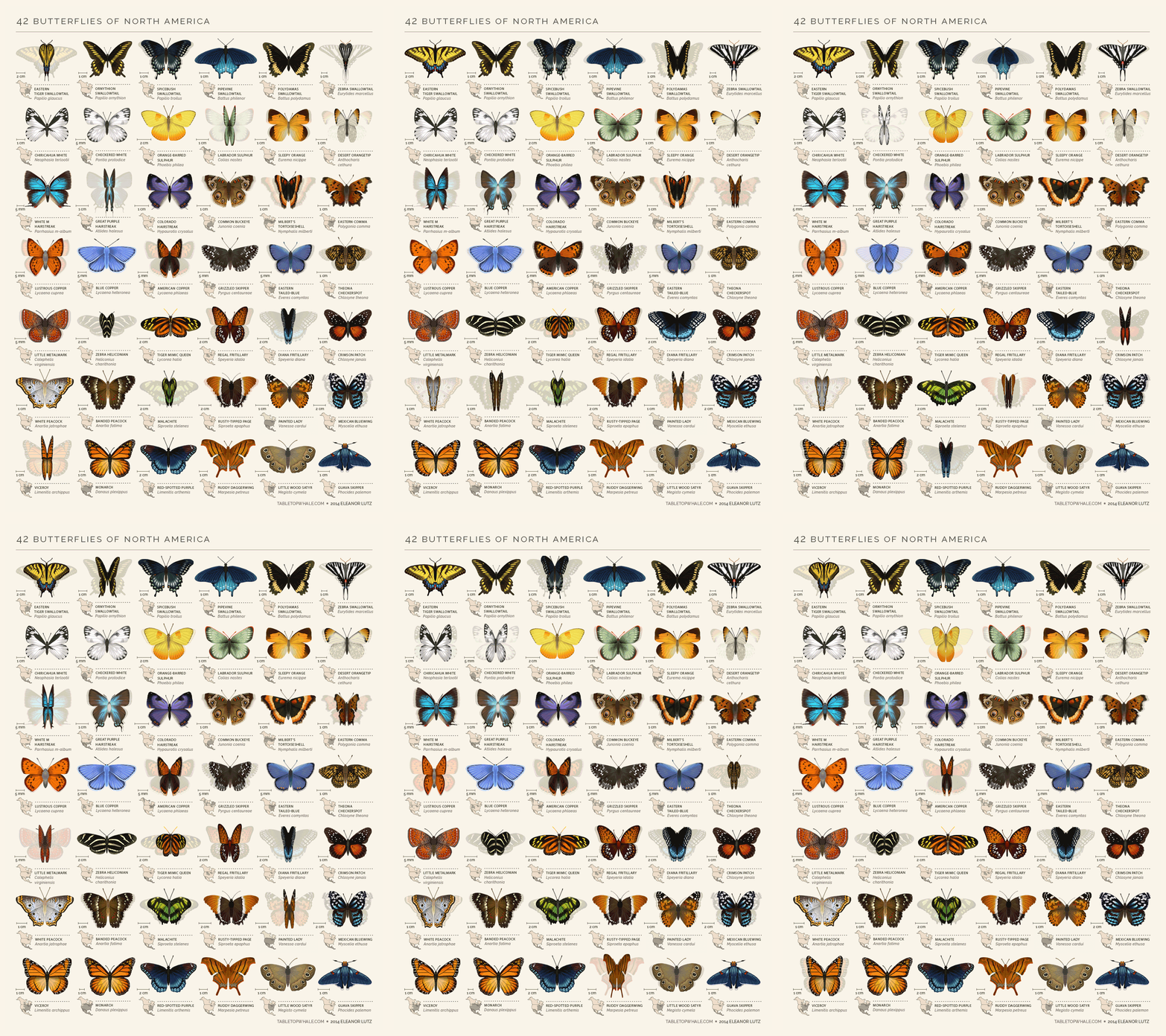
Wow your class with this fluttering butterflies infographic by Eleanor Lutz at Tabletop Whale.

http://tabletopwhale.com/2014/08/27/42-butterflies-of-north-america.html


Perhaps your students could also draw a couple of butterflies and animate them using simple gif-techniques?

Tabletop Whale publishes new infographics with science theme every two or three weeks. Check back frequently - or sign up to receive them.

Friday, August 22, 2014

Learning from Nature - Generative Design and Structural Tessellations

I am researching for my upcoming workshop on Fibonacci and Seeing Math Patterns in Nature.
I have been looking at sunflower, pinecone and branching patterns and the difference to hexagonal close-packing patterns such as in honeycombs and wasp nests.

In my google research I came across a fun blog from product designer Markus Kittner talking about "generative design and learning from nature" - and "structural tessellations and morphologies".

In the case of the Fibonacci sequence that we see in some growth patterns in nature we have a very simple input operation, that starts with the number one and simply is adding the previous number to it: i.e. the Fibonacci sequence is 1, 1+0 = 1, 1+1 = 2, 1+2 = 3, 2+3 = 5, 3+5 = 8, etc.

See more about generative design here:
http://74fdc.wordpress.com/2012/07/02/generative-design-learning-from-nature/


Find out more about the structure and economy of hexagonal honeycomb packing:

http://74fdc.wordpress.com/2012/02/10/structural-tessellations-and-morphologies/


Generative design and structural tessellations - such as seen in sunflowers, pinecones, branching patterns, and wasp nests and honeycombs, are fun applied math and design topics to explore with students K-12 both in the indoor and outdoor classroom.


Friday, August 15, 2014

Earth Force Next Steps Institute Professional Development Program in DC includes Agriculture and STEM Pathway

See http://www.earthforce.org/NSI for details of this Earth Force professional development program: Next Steps Institute, NSI, for teachers in STEM education.

Are you interested in agriscience, food and sustainability?
One of the pathways you can choose at this year's NSI is Harnessing the Power of Agriculture with STEM.


The Next Steps Institute (NSI), powered by Earth Force, is the premier professional development program that promotes hands-on, minds-on learning in STEM education. Organized by pathways that take participants on an engaging journey into critical STEM learning arenas, the Institute offers the depth and breadth of content needed to enhance effectiveness in action and advocacy around STEM.
NSI offers participants:
• Inquiry-based professional development at an affordable cost;
• Tools for effective materials management; and
• Strategies for promotion of 21st century STEM skills using an educational partnership model.

2014 Next Steps Institute: Integrating STEM Learning in Communities
Georgetown University Hotel and Conference Center
3800 Reservoir Rd NW, Washington, DC 20007
Sept. 22-23, 2014
Registration closes September 16, 2014 at 11:59 p.m. EST.
Rooms are available for $149/night. Click here to reserve your room.

   Cost:
Individual - $360
Team of 3 or more people - $330 per person


NSI_website


See http://www.earthforce.org/NSI for further details of all the pathways.
Here below is the promo for the one focused on Agriculture and STEM. 

  • Harnessing the Power of Agriculture with STEM
Building an educated workforce with the skills and expertise necessary to sustain the world’s growing population is at the core of this pathway. Responsible for our food, water, shelter, and energy, agriscience provides a compelling and relevant context to address current issues and events on global and local scales. This pathway, facilitated by faculty from Murray State University and DelCastle Technical High School, takes an issues-based approach to understanding the ways agriscience deepens student understanding of STEM content using relevant, real-world examples.
Come share and generate best practices in teaching and learning that excite students and demonstrate the relevance of agriscience now and in the future. Problem-solving and inquiry-based activities provide a structure for learning crucial content, including: biofuels, crop management, biodiversity, conservation, nutrition, and genetics. 

Tuesday, July 22, 2014

Nature: Observation, Drawing and Painting

Tiger Swallowtail - watercolor by Maya
My daughter came back from wildlife study camp today - with beautiful watercolors of butterflies she had caught and studied.  At first, she thought of making a booklet of the butterflies, but tomorrow she tells me she is going to make a mobile.

I'll post more pictures when her project is done.  It reminds of the beauty of taking time to slow down, to study and draw in the summer.

Also see the blog piece "Keen Observation" from the Junior Master Gardener's website contributor David Cain on observation and nature/plant journaling.  Maybe like you, I will be inspired, to make time and to get out some paper, the paint box and sharpen my pencils, and put the camera away for a day or two - and get outside and observe and draw!


July Flowers


These are the flowers I picked from my garden that look beautiful today.


July Flowers
All except one of these flowers are species native to our Chesapeake region or are cultivars from natives.  Being ‘native’ means these plant species co-evolved in this region to thrive with the geology, soils, climate and wildlife. While I am picking these flowers I notice bees, butterflies, moths and other pollinators feeding on the plants’ nectar and pollen and eating their leaves.
Click for links:
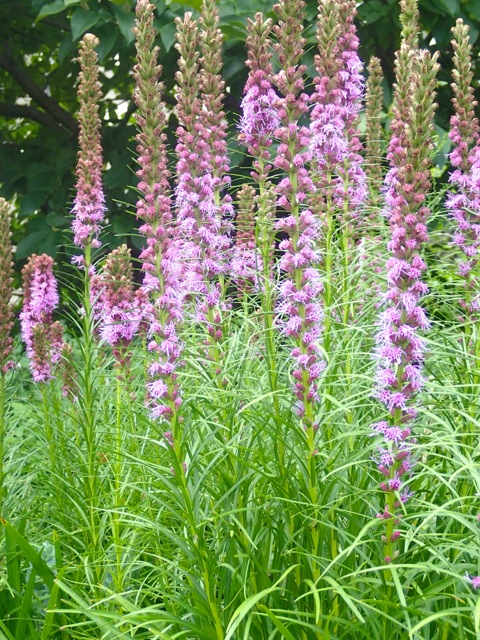
Liatris spicata
Blazing Star – Liatris spicata
Plant Liatris for its vertical emphasis and the accent of the purple starburst flower stems. Liatristhrives in sun or part-shade and is very drought tolerant once established. The flowers attract many beneficial insects and a range of pollinators including hummingbirds.  The seedheads feed our songbirds.


Pink and White Phlox
Pink and White Summer Phlox – Phlox paniculata
Summer or Garden Phlox
Phlox paniculata
Phloxes likes a moist site and can tolerate sun or part-shade, and is one of the few plants that will grow under black walnuts. Phlox has a long flowering season from mid-July to September, and the aromatic scent is more noticeable in the evenings. The pink or white flowers spotlight a shady area in the garden.  The white flowers are visible at night, and the phlox is pollinated by night-flying moths in addition to day-time butterflies, other insects and hummingbirds. Phlox is very prone to mildew on the leaves and there are many cultivars that have been bred for different colors and characteristics such as mildew resistance.  I enjoy Phlox both in the garden and in the vase.
Buttonbush
Buttonbush – Cephalanthus occidentalis
 Buttonbush
Cephalanthus occidentalis
The creamy-white spherical flowers of buttonbush are adapted to optimize their surface area for  pollinators: and this is a wonderful bush to attract pollinators to your garden: bees, moths, flies, and hummingbirds. The flower scent is a light-honey, and I like the glossy leaves and arching branches.  Buttonbush grows as a native alongside the Potomac River. If you hike to Great Falls on the Maryland side, you will see Buttonbushes growing between the rocks and cascades. You can also see a tree-form of the Buttonbush at Arlington’s Long Branch Nature Center.  Buttonbush is a great choice for a moist site in your yard or a raingarden where there is space.  With ideal conditions it can grow into a small tree (6-12+ feet high).  Buttonbush can tolerate drought and also occasional flooding. In my yard I planted the buttonbush in the sun so it flowers profusely, and where it gets occasionally flooded by rain from a downspout. I enjoy watching butterflies, bees, flies and other insects feed on nectar and pollen.
See the Fairfax Island Creekes School website for more details of the ecology of Buttonbush.
Brown-Eyed Susan
Brown-Eyed Susan – Rudbeckia triloba
I notice that this Brown-Eyed Susan, Rudbeckia triloba, plant prefers damper and a more shady locations than the extreme heat and drought tolerant Black-Eyed Susan (see below). The small flowers of Rudbeckia triloba and tall branching habit are pretty in the garden where it self-sows freely.  Rudbeckia triloba mingles well with other Rudbeckia: Black-Eyed Susan, Rudbeckia fulgida andRudbeckia hirta.


Black-Eyed Susan
Black-Eyed Susan – Rudbeckia fulgida

Black-Eyed Susan
Rudbeckia fulgida
This is the yellow and black flower you see “everywhere” in the DC metro area landscape in the summer. There are many cultivars of the native species.  The cultivar shown here is Rudbeckia fulgida ‘Goldsturm. Rudbeckia fulgidais very tolerant of sun, heat, humidity and disliked by deer.  So it is adapted well to our urban street conditions such as sunny roundabouts, medians – and yards. You might  be lucky to see Black-Eyed Susan on a hike in a open-forest or meadow too
Anise Hyssop
Anise Hyssop – Agastache foeniculum
Anise Hyssop
Agastache foeniculum
Anise Hyssop is drought, deer tolerant and from the mint family (the plant has a square-stem).  The fragrant leaves are easy to pick and make one of my favorite flavorful herbal teas.  Flowers are very attractive to bees and hummingbirds too.  It spreads freely by self-sowing. You may have seedlings to give to plant sales and neighbors!


Coneflower


Purple Coneflower
Echinacea pupurea
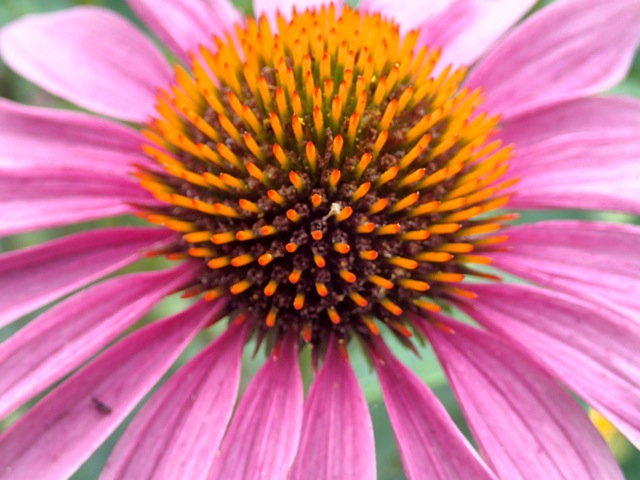
This flower’s Latin name Echinacea comes from the Greek word for hedgehog, and the cone-like seedhead and flower center may remind you of a prickly hedgehog! Purple Coneflower, Echinacea purpurea, is non-native to the Chesapeake region, and is native to the southeastern United States: moist prairies, meadows and open woods.


Purple Coneflower – 
Echinacea pupurea

The plant is very tolerant of drought, heat and humidity and poor soil; and grows very well in our urban environment. Have you tried Echinacea medications to help get over a cold? Echinacea is one of the most popular herbal remedies in North America, and you could see if it works for you. Here’s some research from the University of Maryland Medical Center about Echinacea and whether or not the plant is an effective medication.  If you leave the seedheads on the plant after they flower you will find goldfinches feeding on the seeds all winter long.
Mary Van Dyke is the Community Leader Program Coordinator for the Plant NoVA Natives campaign with the goal of encouraging Northern Virginia residents to plant more of our region’s native plants.
For June Flowers see  The Language of Flowers.
Look out for next month’s TMI Living blog on flowers to pick in Northern Virginia in August.

Contributor: Mary Van Dyke
Reposted from the TMI Living - It's a Lifestyle blog, July 22, 2014