Showing posts with label bees. Show all posts

Wednesday, February 11, 2015

The Matrix: New Curriculum Resources from Ag in the Classroom


Ag in the Classroom currently reaches 6.5 million school students in the US - and the goal is to reach more.
Here's the USDA blog on the new curriculum Matrix that helps teachers access lesson plans.

Students learn about agriculture by using materials available online through the Ag in the Classroom’s Matrix.
(iStock image- fom USDA Blog)
  • Click on the Ag in the Classroom's February Resources below - get inspired and take your students out to learn!
Honey Bees: A Pollination Simulation


  • Add agricultural literacy to your academic standards.


Wednesday, January 21, 2015

Apples for the Teachers

Apples
Apples may be on the menu for lunch or snack at school today. Chances are your school computer might also be named after one. What are the latest go-to tools for teaching about apples?

Here is the video link to Apples in the How Does It Grows series by Nicole Jolly.
This is the "first of its kind series" that follows food from farm to fork.


Watch the 5-minute video at any season. 
Then extend the learning for your students’ age group.

Study a fruit tree

Ornamental Cherry Tree
 Gunston Middle School, Arlington

  • Take your class out in the spring to study an apple tree, or visit a fruit tree from the same Rosacea (rose) family; such as a cherry, plum, almond or pear. 
  • Observe the flowers and leaves of your fruit tree. Count the petals on the flower. Look at the leaf shape and edge. Can you see how the fruit is forming?
  • Visit the same fruit tree over the following months. Study how the fruit ripens. 
  • What else do you find evidence of living on and near the tree?
  • How does a tree produce its own food, and get water and nutrients?
  • How does the tree grow in the spring, and summer and fall, and then conserve energy in the winter? 
  • How does the tree fit in our ecosystem? 


Taste a fruit


Farm to School Day
Arlington, Fall 2014

  • Feature locally grown, fresh apples as part of a Farm-to-School program.
  • Visit a local orchard or fruit farm.
  • Check out nutrition facts and some recipes.
    Why do we say, "An apple a day...keeps the doctor away"?


Link to Pollinators


The How it Grows: Apples film states that 100 hives of bees are needed to cross-pollinate the 27,500 apple trees in the Lyman’s 100-acre apple orchard. 

  • Extend your study of apple family trees to pollinators, including both native bees and honeybees too.
  • Research the latest discussions, science and politics of crop pollination. For example, discuss pollination of the almond crop in California.


Apples: history, myth and inspiration


Apples (1975) by Don Moulton
Portland ME Museum of Art

  • Research the apple in religion, myth, storytelling and history including: Adam and Eve, the Golden Apples, Newton, Johnny Appleseed, Apple Corps.  and the Apple Inc. computer brand name and logo
  • Design your own apple and name it
  • What product would you name after a fruit and why? 
  • Do you like playing Bananagrams or Appleletters


These are all questions to mull over while you munch an apple slice or two, 
or choose to reach for a banana. 

As Greek fairy tales say:

" Three apples have fallen from the sky; one is for me; one is for him who listens; and the third is for him who tells this tale."


Resources for apples as teaching tools:

How Does it Grow http://www.howgrow.org/
Red Tomato/Eco Apple http://www.redtomato.org/eco-apple/
US Apple Association http://usapple.org
Apple Activities for 4-6 grade http://usapple.org/PDF/4-6guide.pdf 
Apple Activities for PreK - 3 http://usapple.org/PDF/p-3.pdf 
How Apples Grow by Betsy Maestro (for elementary age students)
Farm to School http://www.farmtoschool.org/
Garden to Snack/Classroom e.g. in Charlottesville, VA  http://www.cityschoolyardgarden.org/2015/01/22/seasonal-snacks-from-garden-to-classroom/

Pollinators: Bee Basics An Introduction to Our Native Bees by Beatriz Moisset et al.

https://pollinator.org/PDFs/BeeBasicsBook.pdf
Intro to USDA research on pollinators http://www.ars.usda.gov/Research/docs.htm?docid=24105

Fairy Tales of Greece, Retold by Ronald Seth, 1961


Tuesday, July 22, 2014

July Flowers


These are the flowers I picked from my garden that look beautiful today.


July Flowers
All except one of these flowers are species native to our Chesapeake region or are cultivars from natives.  Being ‘native’ means these plant species co-evolved in this region to thrive with the geology, soils, climate and wildlife. While I am picking these flowers I notice bees, butterflies, moths and other pollinators feeding on the plants’ nectar and pollen and eating their leaves.
Click for links:
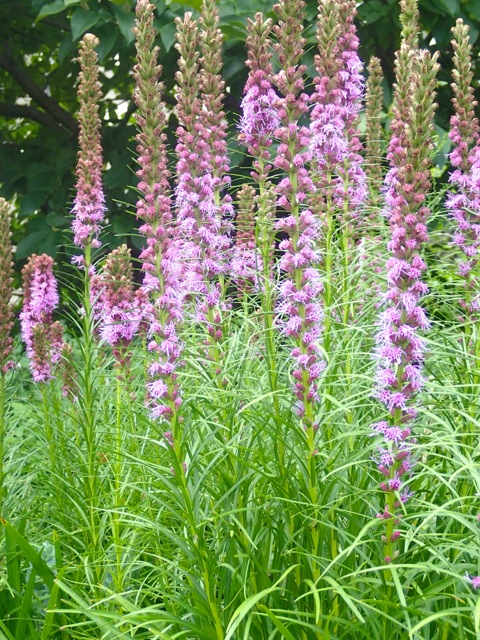
Liatris spicata
Blazing Star – Liatris spicata
Plant Liatris for its vertical emphasis and the accent of the purple starburst flower stems. Liatristhrives in sun or part-shade and is very drought tolerant once established. The flowers attract many beneficial insects and a range of pollinators including hummingbirds.  The seedheads feed our songbirds.


Pink and White Phlox
Pink and White Summer Phlox – Phlox paniculata
Summer or Garden Phlox
Phlox paniculata
Phloxes likes a moist site and can tolerate sun or part-shade, and is one of the few plants that will grow under black walnuts. Phlox has a long flowering season from mid-July to September, and the aromatic scent is more noticeable in the evenings. The pink or white flowers spotlight a shady area in the garden.  The white flowers are visible at night, and the phlox is pollinated by night-flying moths in addition to day-time butterflies, other insects and hummingbirds. Phlox is very prone to mildew on the leaves and there are many cultivars that have been bred for different colors and characteristics such as mildew resistance.  I enjoy Phlox both in the garden and in the vase.
Buttonbush
Buttonbush – Cephalanthus occidentalis
 Buttonbush
Cephalanthus occidentalis
The creamy-white spherical flowers of buttonbush are adapted to optimize their surface area for  pollinators: and this is a wonderful bush to attract pollinators to your garden: bees, moths, flies, and hummingbirds. The flower scent is a light-honey, and I like the glossy leaves and arching branches.  Buttonbush grows as a native alongside the Potomac River. If you hike to Great Falls on the Maryland side, you will see Buttonbushes growing between the rocks and cascades. You can also see a tree-form of the Buttonbush at Arlington’s Long Branch Nature Center.  Buttonbush is a great choice for a moist site in your yard or a raingarden where there is space.  With ideal conditions it can grow into a small tree (6-12+ feet high).  Buttonbush can tolerate drought and also occasional flooding. In my yard I planted the buttonbush in the sun so it flowers profusely, and where it gets occasionally flooded by rain from a downspout. I enjoy watching butterflies, bees, flies and other insects feed on nectar and pollen.
See the Fairfax Island Creekes School website for more details of the ecology of Buttonbush.
Brown-Eyed Susan
Brown-Eyed Susan – Rudbeckia triloba
I notice that this Brown-Eyed Susan, Rudbeckia triloba, plant prefers damper and a more shady locations than the extreme heat and drought tolerant Black-Eyed Susan (see below). The small flowers of Rudbeckia triloba and tall branching habit are pretty in the garden where it self-sows freely.  Rudbeckia triloba mingles well with other Rudbeckia: Black-Eyed Susan, Rudbeckia fulgida andRudbeckia hirta.


Black-Eyed Susan
Black-Eyed Susan – Rudbeckia fulgida

Black-Eyed Susan
Rudbeckia fulgida
This is the yellow and black flower you see “everywhere” in the DC metro area landscape in the summer. There are many cultivars of the native species.  The cultivar shown here is Rudbeckia fulgida ‘Goldsturm. Rudbeckia fulgidais very tolerant of sun, heat, humidity and disliked by deer.  So it is adapted well to our urban street conditions such as sunny roundabouts, medians – and yards. You might  be lucky to see Black-Eyed Susan on a hike in a open-forest or meadow too
Anise Hyssop
Anise Hyssop – Agastache foeniculum
Anise Hyssop
Agastache foeniculum
Anise Hyssop is drought, deer tolerant and from the mint family (the plant has a square-stem).  The fragrant leaves are easy to pick and make one of my favorite flavorful herbal teas.  Flowers are very attractive to bees and hummingbirds too.  It spreads freely by self-sowing. You may have seedlings to give to plant sales and neighbors!


Coneflower


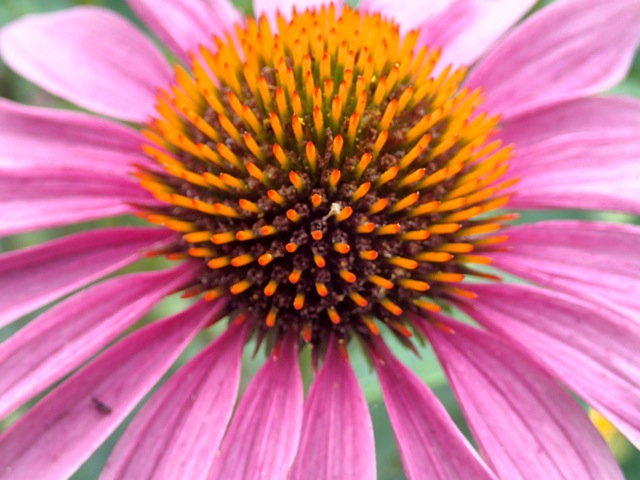
Purple Coneflower
Echinacea pupurea
This flower’s Latin name Echinacea comes from the Greek word for hedgehog, and the cone-like seedhead and flower center may remind you of a prickly hedgehog! Purple Coneflower, Echinacea purpurea, is non-native to the Chesapeake region, and is native to the southeastern United States: moist prairies, meadows and open woods.


Purple Coneflower – 
Echinacea pupurea

The plant is very tolerant of drought, heat and humidity and poor soil; and grows very well in our urban environment. Have you tried Echinacea medications to help get over a cold? Echinacea is one of the most popular herbal remedies in North America, and you could see if it works for you. Here’s some research from the University of Maryland Medical Center about Echinacea and whether or not the plant is an effective medication.  If you leave the seedheads on the plant after they flower you will find goldfinches feeding on the seeds all winter long.
Mary Van Dyke is the Community Leader Program Coordinator for the Plant NoVA Natives campaign with the goal of encouraging Northern Virginia residents to plant more of our region’s native plants.
For June Flowers see  The Language of Flowers.
Look out for next month’s TMI Living blog on flowers to pick in Northern Virginia in August.

Contributor: Mary Van Dyke
Reposted from the TMI Living - It's a Lifestyle blog, July 22, 2014

Tuesday, June 18, 2013

Get the Buzz on Pollinators.....and celebrating National Pollinator Week

Here's celebrating National Pollinator Week in the United States with an in-depth article about bee behavior  How do different kinds of bees transport pollen from flower to flower and back to their hive or nest? And why?
Photo by Mary Free


Also during National Pollinator Week, Beatriz Moisset is making her new eBook, Beginners Guide to Pollinators, available for FREE. This can be another resource in your toolkit for help with bug ID both at home, school and in the field using your iPad.
You may need to download Adobe eBook Reader too if you don't already have it. Click on the link to download