Showing posts with label schoolyard gardens. Show all posts

Saturday, August 22, 2015

Need to Claim and Tame Your Schoolyard Garden?

by Mary Van Dyke, August 22 2015
Gone away for a few weeks and come home to find your garden has turned into a jungle? Weeds are thigh-high, the herbs and flowers in pots have shriveled, and the tomatoes and pumpkins are rampant. This is the scenario when I return to my home garden after a summer vacation, and it can play out in your schoolyard garden too.


So how to "claim and tame" your schoolyard garden after the summer?
  • Do you already have parent volunteers set up a family summer-watering and weeding schedule?
  • Can you outreach to volunteers such as Master Gardeners and Master Naturalists to help “adopt a plot”?
  • Have you set up a community garden in your schoolyard?


This year at Jamestown Elementary School, we do not have family community buy-in to water or weed during the summer months. The schoolyard maintenance crew continues to visit every two weeks to mow and trim the grassy areas. The custodians in their spare time, water and harvest the vegetables: including beans, pumpkins, kale and lettuce. In late August, the PTA will hire a contractor to trim and mulch the week before school begins. The rest of the gardens will need to be reclaimed and tamed again when school begins in September.  I am planning a couple of community schoolyard maintenance sessions with Master Naturalists and the PTA for early October and in the spring. Maybe a Master Naturalist will take on to maintain a native plant meadow? These Saturday sessions will help engage some families to help on other garden learning projects too, and be part of our strategy this year to involve more staff and students in learning outdoors.


I “claim and tame” my home garden after summer vacation by: 
  1. Weeding: i.e. remove the fastest growing, most dangerous, or most prolific weeds
  2. Watering
  3. Harvesting
In a couple of hours I remove:
Poison ivy (Toxicodendron radicans) seedling

    • A dozen poison ivy seedlings
    • A dozen mulberry seedlings
    • A dozen wild grape vine seedlings
    • Several kinds of weeds, prioritizing those in the garden with lots of seeds: including lambs quarters (you can eat this one), pigweed, kochia, sow thistle, horseweed, white heath aster and crabgrass.
    • Less disruptive weeds I leave for next time!
    Mulberry seedling
    Wild grape seedling
    While in the garden, I take time to enjoy the outdoors and sunshine, and I pick green and red tomatoes to ripen indoors on a window cill.  


     I water the pots of strawberries, herbs and basil, and harvest potatoes and gourds.


    Then I pick a bunch of beautiful native flowers for the table. 


    While working I listen to the birds, see a tiger swallowtail butterfly, and get stung by a wasp!
    But now I know where wasps are nesting. I cook the potatoes with basil for supper.


    Next week I’ll start to reclaim and tame the schoolyard. 
    • What will be the main "weeds" this year?
    • What will be in flower?
    • What vegetables, fruit and herbs will be ready to harvest?
    • What animals and birds will be there?
    • Who will be interested to learn in the schoolyard?
    Reference:
    Weed Identification for Schools by Mary Van Dyke

    Next blog:
    A Guide to Nature Through the Seasons

    Wednesday, April 1, 2015

    One Small Square in the Outdoor Classroom

    Ms Rascoe’s fourth grade science classes come out to the Jamestown Courtyard "outdoor classroom" to work collaboratively in teams of four students and to practice scientific method while observing a “one-meter square plot”: a One Small Square.


    • We frame our inquiry in terms of “health”.
      • How can we begin to assess the health of the small square?
      • What is the health of the one small square plot?
      • What would we do to improve the health of this plot?
    • The lesson guides students experientially to an understanding of improving health of an ecosystem through increasing biodiversity


    Click for lesson plan details.

    Also note: although students mark out a meter square area, we will consider what is underground and also in the air above the soil surface.
    See Donald Silver's book One Small Square - Backyard for inspiration.


    Each team of four students builds a one-meter square with ½ inch plastic pipes.


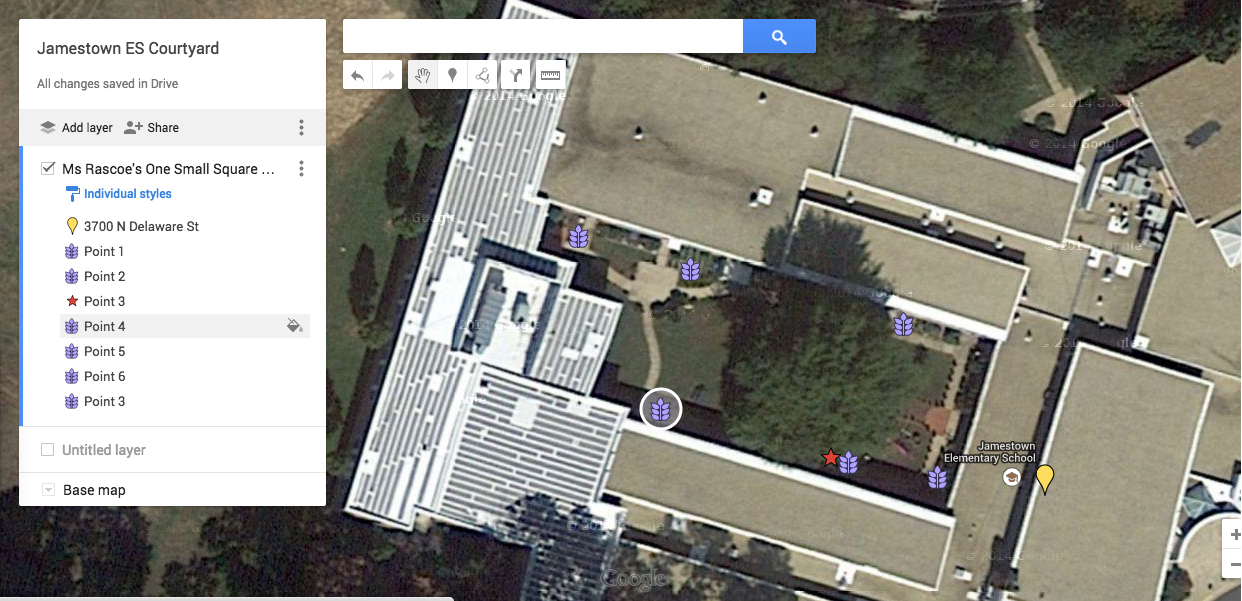
    Each student team locates their meter square within a general area of the courtyard garden. Here are the 6 areas identified on a googlemap
    JES One Small Square 0330115.jpg

    The students observe their plots using senses: look closely, listen, smell and feel too...(We're not tasting things in the garden today though!)
    • Can you draw a bird's eye view of your one-meter plot?
    • What would a cross-section look like?
    • What do you consider to be factors influencing the "health" of your plot?
      • Factors include: sun, light, soil, rock, water, air, human interactions, wildlife, plants (abiotic and biotic factors)
    • Can you find and identify the plants in the plot?
    • Are there any insects and wildlife in your plot today?
      • Can you name them?
      • Observe the insects and wildlife and describe what they are doing.
    • Can you make a hypothesis or an inference about what might be under the soil surface using some of the information on the surface or by exploring carefully?


    The students discuss together and diagram and write notes in their science journals, using pencil and colors.


    After making observations, students begin to formulate a "health assessment" of the plot and propose design improvements.
    • What do we mean by “health” of the garden? We discuss ecosystems, biodiversity, wellness...
    • What would you do to measure and improve the health your plot? Consider potential signs of health.
    • The students begin to think about introducing plants or other ways they could increase the biodiversity and improve the health of their plot.

    Here are some results and ideas for improvement:


    Plot
    Name of Plot
    Observations of Plot
    Ideas for Improvement
    of "Health" of Plot
    1
    Sensory Garden
    • Not much growing yet
    • Daffodils are out
    • Sage (smells) silvery leaves
    • Thyme (smells)
    • Strawberries
    • Sign saying second grade are going to be planting a garden here with a QR Code links to a planting list
    • Could add many more plants with different textures, feel and smell to appeal to the senses and for students to study
    • Needs pathway
    2

    End Wall
    • Name of this area is not very poetic!
    • Smells of drains from toilet inside
    • Looks like a plant died and left a big “gap”
    • After rain hear rainwater in the downpipe
    • Crocuses in flower but behind big shrubs so you can’t see them
    • Need to report potential drain leak to Principal and Custodians - it smells unhealthy in this area
    • Need to select and plant a shrub to fill the “gap”
    • Can anyone think of better name for this area?
    • Could dig up and replant crocuses in front of the big bushes so they are visible and we can enjoy them in the spring
    3

    Weather Station
    • Christmas Rose, Hellebore in flower just outside the plot
    • The weather station has a thermometer that might work, a rain gauge and an anemometer to measure wind speed. The anemometer is broken.
    • There is a birdhouse
    • Some plants here are Coneflowers, Echinacea that have seeds that provide food for birds such as goldfinches
    • A weather station is an asset to the student’s use of the courtyard. But this one is broken. Perhaps it’s time to think about getting a new one?
    • There is also room to plant more plants here
    3

    Pyramidal Frame
    • Decide the frame is for a climbing plant
    • there’s a label but no plant in sight
    • There might be a plant waiting to come up?
    • Plant a climbing plant here if one doesn’t regrow in the spring?
    4

    K Tulip/Milkweed Garden
    • Several students remember planting tulips here when they were in Kindergarten and see lots of tulip leaves
    • In addition to tulips there are crocuses and lots of other plants identified as wild garlic, mugwort, chickweed
    • It might be a good idea to weed this bed of wild garlic and mugwort so that the plants intended to be here such as the tulips and milkweed can thrive more.
    • Also the milkweed likely will overcome some of the smaller plants here.
    • If milkweed is to be here - it might be more healthy for the plot to move the other plants to where they can more easily thrive?
    5

    Second Grade Garden
    • This garden lacks a poetic name!
    • Last week it was called the bed of the “decomposing pumpkin”
    • There are a lot of plants here that look interesting including lambs ear, asters, honeysuckle, buddleia and boxwoods
    • We discuss relative impacts of the various plants.
    • Buddleia although a nectar provider for insects can now be invasive in this area, perhaps it should be taken out and replaced with native plant?
    • The students like the lambs ears - it could also be divided to plant in the Sensory Garden. It needs to be managed to not overgrow its plot.
    6

    3 B’s Bird, Bees and Butterflies, Pollinators and Milkweed Garden
    • This garden has a name - although it is long.
    • Students find a rhizome of milkweed
    • There are a lot of hairy bittercress in flower, mugwort and other plants such as mint and lavender growing here
    • May need to move lavender
      out of this bed as it will be overcome by mint
    • Could weed out
    • Could plant other plants to increase biodiversity and increase flowers from spring to summer for pollinators
    This lesson was 45 minutes long and gave students a quick overview and idea of what they could do for stewardship projects to help create a more healthy environment in the courtyard: to increase biodiversity.

    The students are excited today by observing their selected small square plots, and feel empowered by suggesting ways they could contribute to the overall well-being of the courtyard. Students offer to be included in the stewardship and maintenance process of the courtyard, and I note proposals include: to plant seeds and plants, and to weed and water. Students begin to discuss health of the ecosystem in terms of increasing biodiversity.

    Credits and Resources
    One Small Square is inspired by "Magic Spots" in The Growing Classroom, p. 238.


    Donald Silver: One Small Square - Backyard

    One Small Square adaptations
    The One Small Square lesson can be adapted for working over several class periods, and for elementary, middle school and high school students to assess for example: the health of a tree and an ecosystem, and to form an introduction to more extensive civic engagement stewardship projects.
    For example:
    • At Gunston Middle School, I developed materials in Spanish and English for 6th grade students to observe tree health, do site assessments and catalyze stewardship projects.
    • At Arlington Traditional School, second grade and fifth grade classes observed their Small Squares over a year (Sept/Oct 2011) and implemented design projects.
    • The iSchool for the Future blogs One Small Square as a family activity.
    • Use the One Small Square lesson as an introduction for more extensive site assessments and audits of your schoolyard and school such as required for the Eco-Schools USA program.

    Friday, March 27, 2015

    Second Graders: Talk About Tools and Spring Clean Up

    This afternoon is warm. The sun is shining and spring is in the air.
    Second Grade are ready to go outdoors and do a “spring clean up” in the courtyard learning lab.


    Talking about Tools
    Why use tools in the garden? Tools are extensions of our senses and body. We could dig and trim plants with our hands and feet, but technology and tools such as rakes, trowels, leaf scoops, pruners, paper bags and microscopes can help us extend our capabilities in the same way as a pencil is a useful technology or tool for the task of writing and drawing.


    We discuss tool safety.

    Spring Clean Up
    The students are in four groups assigned to different areas of the courtyard:
    • Two groups rake up willow oak leaves and pick up sticks. They have two kinds of rakes, and leaf scoops. It's interesting to take turns with the tools and see how they help us with different tasks. The yellow leaf scoops are like dinosaur paws and the kids love using them!
    • One group uses small pruners to trim buddleia bush back to 12 inches or so above soil, and to trim seedheads off asters and rosebushes, and to take dead growth off the mint and lambs ears. We "tidy up" the decomposing pumpkin. There's a lot of decisions to take when tidying up.
      • Is tidying up necessary or not? 
      • How much leaf litter do you leave for the worms? 
      • How many seedheads should stay for food for the birds and other wildlife and for the plant to reproduce?
      • Where is a good place to trim a plant?
    These are all good questions for teaching best management practices and stewardship.


    • Another group uses trowels to weed the “Three B’s: Birds, Bees and Butterflies Pollinator Garden”. Try out different kinds of trowel. Which works best? This bed is full of common milkweed that we are cultivating as a food plant for monarch caterpillars and a nectar plant for many insects and butterflies. With the goal of increasing biodiversity and lengthening the flowering season from spring to fall in this sunny bed, we’ll plant additional vigorous native flowering plants such as rudbeckia, coneflower, mountain mint and goldenrod. At the moment the bed is covered in hairy bittercress, speedwell and mugwort. These weeds very successfully reproduce and spread. The hairy bittercress can propel its seeds 10 foot from the mother plant. These “weed” plants occupy space and take light and nutrients from native plants we are choosing to cultivate. So we are deciding to weed some of them out.

    Outputs and Reflections
    In one hour the second grade students fill 9 large bags full of organic debris.

    This is an enormous amount of work done.  25 students at one hour each is 25 person hours. That would be two weeks of my part-time job here.
    • The students compare the different kinds of rake. Which one worked best with the fine willow oak leaves?
    • The students loved the extended power and aesthetics of the bright yellow “dinosaur paw” leaf scoops
    • Students learned to use pruners safely - point down and using safety catches
    • Students learned to identify plants and learned some management practices
    • Students found and identified worms, ants, and grubs
    • Students learned about waste management and composting issues
    We cannot compost on site at the moment. So we choose to throw out the waste with the school trash.  We are working towards some on-site demo composting in the courtyard.  But the reality of gardening in this large courtyard is that we will have too much organic debris each year to compost entirely within the courtyard.  My goal over the next few years is to a) demonstrate on-site composting in a small way and to b) do larger scale on-site composting in bin system and c) also to continue to take waste out of the courtyard.  At the same time we need to be careful to manage for replenishing nutrients in the soil and keep a focus on healthy soil and a healthy ecosystem.


    In addition of course there was the more extensive and unpredictable experience of discovery and outdoor learning. A hawk has caught and eaten a junco and students found some remaining feathers. Other students found milkweed seedpods and even some willow oak leaves that were sprayed gold!


    All good evidence of the rich learning environment in our courtyard and the value of time outdoors.

    The second graders made a significant contribution to the well-being of the courtyard with an hour of “service-learning”. At the same time they are fulfilling Standards of Learning (and NGSS) as we learn about scientific method, life systems, and stewardship issues. The students practice collaborative teamwork as we go too.

    Thank you to the parents helping facilitate this session with the Ms Payack’s class.

    Resources
    Leaf scoops by Gardex Pruners Trowels Weed Identification for Schools by Mary Van Dyke, Green STEM Learning, online and downloadable