Showing posts with label health. Show all posts

Wednesday, April 1, 2015

One Small Square in the Outdoor Classroom

Ms Rascoe’s fourth grade science classes come out to the Jamestown Courtyard "outdoor classroom" to work collaboratively in teams of four students and to practice scientific method while observing a “one-meter square plot”: a One Small Square.


  • We frame our inquiry in terms of “health”.
    • How can we begin to assess the health of the small square?
    • What is the health of the one small square plot?
    • What would we do to improve the health of this plot?
  • The lesson guides students experientially to an understanding of improving health of an ecosystem through increasing biodiversity


Click for lesson plan details.

Also note: although students mark out a meter square area, we will consider what is underground and also in the air above the soil surface.
See Donald Silver's book One Small Square - Backyard for inspiration.


Each team of four students builds a one-meter square with ½ inch plastic pipes.


Each student team locates their meter square within a general area of the courtyard garden. Here are the 6 areas identified on a googlemap
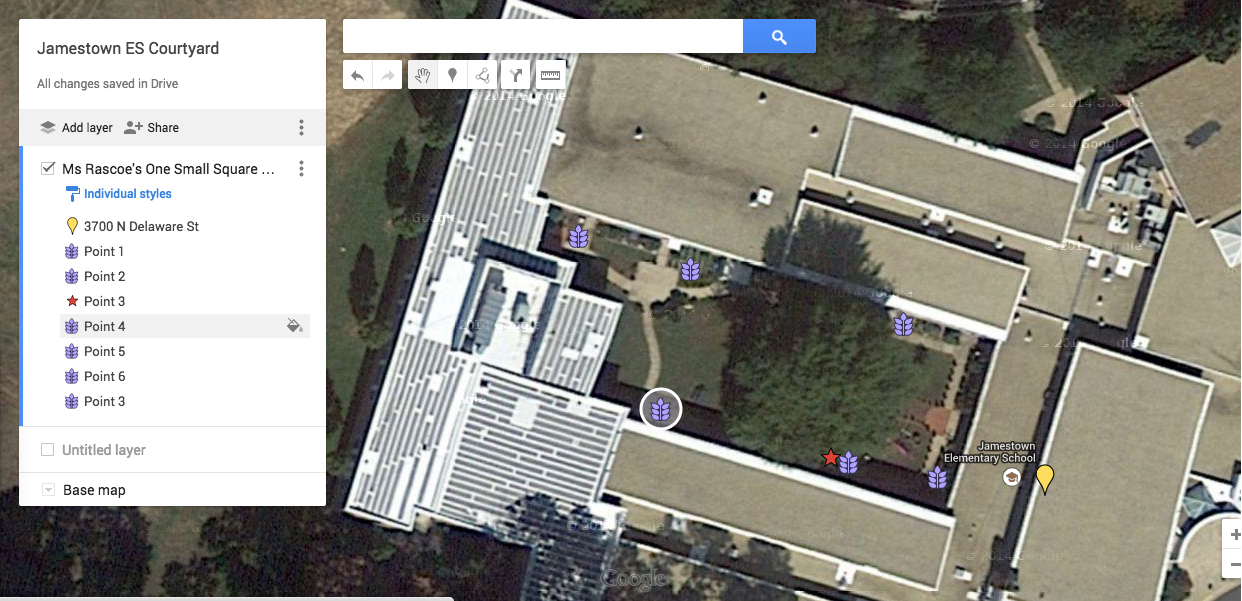
JES One Small Square 0330115.jpg

The students observe their plots using senses: look closely, listen, smell and feel too...(We're not tasting things in the garden today though!)
  • Can you draw a bird's eye view of your one-meter plot?
  • What would a cross-section look like?
  • What do you consider to be factors influencing the "health" of your plot?
    • Factors include: sun, light, soil, rock, water, air, human interactions, wildlife, plants (abiotic and biotic factors)
  • Can you find and identify the plants in the plot?
  • Are there any insects and wildlife in your plot today?
    • Can you name them?
    • Observe the insects and wildlife and describe what they are doing.
  • Can you make a hypothesis or an inference about what might be under the soil surface using some of the information on the surface or by exploring carefully?


The students discuss together and diagram and write notes in their science journals, using pencil and colors.


After making observations, students begin to formulate a "health assessment" of the plot and propose design improvements.
  • What do we mean by “health” of the garden? We discuss ecosystems, biodiversity, wellness...
  • What would you do to measure and improve the health your plot? Consider potential signs of health.
  • The students begin to think about introducing plants or other ways they could increase the biodiversity and improve the health of their plot.

Here are some results and ideas for improvement:


Plot
Name of Plot
Observations of Plot
Ideas for Improvement
of "Health" of Plot
1
Sensory Garden
  • Not much growing yet
  • Daffodils are out
  • Sage (smells) silvery leaves
  • Thyme (smells)
  • Strawberries
  • Sign saying second grade are going to be planting a garden here with a QR Code links to a planting list
  • Could add many more plants with different textures, feel and smell to appeal to the senses and for students to study
  • Needs pathway
2

End Wall
  • Name of this area is not very poetic!
  • Smells of drains from toilet inside
  • Looks like a plant died and left a big “gap”
  • After rain hear rainwater in the downpipe
  • Crocuses in flower but behind big shrubs so you can’t see them
  • Need to report potential drain leak to Principal and Custodians - it smells unhealthy in this area
  • Need to select and plant a shrub to fill the “gap”
  • Can anyone think of better name for this area?
  • Could dig up and replant crocuses in front of the big bushes so they are visible and we can enjoy them in the spring
3

Weather Station
  • Christmas Rose, Hellebore in flower just outside the plot
  • The weather station has a thermometer that might work, a rain gauge and an anemometer to measure wind speed. The anemometer is broken.
  • There is a birdhouse
  • Some plants here are Coneflowers, Echinacea that have seeds that provide food for birds such as goldfinches
  • A weather station is an asset to the student’s use of the courtyard. But this one is broken. Perhaps it’s time to think about getting a new one?
  • There is also room to plant more plants here
3

Pyramidal Frame
  • Decide the frame is for a climbing plant
  • there’s a label but no plant in sight
  • There might be a plant waiting to come up?
  • Plant a climbing plant here if one doesn’t regrow in the spring?
4

K Tulip/Milkweed Garden
  • Several students remember planting tulips here when they were in Kindergarten and see lots of tulip leaves
  • In addition to tulips there are crocuses and lots of other plants identified as wild garlic, mugwort, chickweed
  • It might be a good idea to weed this bed of wild garlic and mugwort so that the plants intended to be here such as the tulips and milkweed can thrive more.
  • Also the milkweed likely will overcome some of the smaller plants here.
  • If milkweed is to be here - it might be more healthy for the plot to move the other plants to where they can more easily thrive?
5

Second Grade Garden
  • This garden lacks a poetic name!
  • Last week it was called the bed of the “decomposing pumpkin”
  • There are a lot of plants here that look interesting including lambs ear, asters, honeysuckle, buddleia and boxwoods
  • We discuss relative impacts of the various plants.
  • Buddleia although a nectar provider for insects can now be invasive in this area, perhaps it should be taken out and replaced with native plant?
  • The students like the lambs ears - it could also be divided to plant in the Sensory Garden. It needs to be managed to not overgrow its plot.
6

3 B’s Bird, Bees and Butterflies, Pollinators and Milkweed Garden
  • This garden has a name - although it is long.
  • Students find a rhizome of milkweed
  • There are a lot of hairy bittercress in flower, mugwort and other plants such as mint and lavender growing here
  • May need to move lavender
    out of this bed as it will be overcome by mint
  • Could weed out
  • Could plant other plants to increase biodiversity and increase flowers from spring to summer for pollinators
This lesson was 45 minutes long and gave students a quick overview and idea of what they could do for stewardship projects to help create a more healthy environment in the courtyard: to increase biodiversity.

The students are excited today by observing their selected small square plots, and feel empowered by suggesting ways they could contribute to the overall well-being of the courtyard. Students offer to be included in the stewardship and maintenance process of the courtyard, and I note proposals include: to plant seeds and plants, and to weed and water. Students begin to discuss health of the ecosystem in terms of increasing biodiversity.

Credits and Resources
One Small Square is inspired by "Magic Spots" in The Growing Classroom, p. 238.


Donald Silver: One Small Square - Backyard

One Small Square adaptations
The One Small Square lesson can be adapted for working over several class periods, and for elementary, middle school and high school students to assess for example: the health of a tree and an ecosystem, and to form an introduction to more extensive civic engagement stewardship projects.
For example:
  • At Gunston Middle School, I developed materials in Spanish and English for 6th grade students to observe tree health, do site assessments and catalyze stewardship projects.
  • At Arlington Traditional School, second grade and fifth grade classes observed their Small Squares over a year (Sept/Oct 2011) and implemented design projects.
  • The iSchool for the Future blogs One Small Square as a family activity.
  • Use the One Small Square lesson as an introduction for more extensive site assessments and audits of your schoolyard and school such as required for the Eco-Schools USA program.

Wednesday, January 21, 2015

Apples for the Teachers

Apples
Apples may be on the menu for lunch or snack at school today. Chances are your school computer might also be named after one. What are the latest go-to tools for teaching about apples?

Here is the video link to Apples in the How Does It Grows series by Nicole Jolly.
This is the "first of its kind series" that follows food from farm to fork.


Watch the 5-minute video at any season. 
Then extend the learning for your students’ age group.

Study a fruit tree

Ornamental Cherry Tree
 Gunston Middle School, Arlington

  • Take your class out in the spring to study an apple tree, or visit a fruit tree from the same Rosacea (rose) family; such as a cherry, plum, almond or pear. 
  • Observe the flowers and leaves of your fruit tree. Count the petals on the flower. Look at the leaf shape and edge. Can you see how the fruit is forming?
  • Visit the same fruit tree over the following months. Study how the fruit ripens. 
  • What else do you find evidence of living on and near the tree?
  • How does a tree produce its own food, and get water and nutrients?
  • How does the tree grow in the spring, and summer and fall, and then conserve energy in the winter? 
  • How does the tree fit in our ecosystem? 


Taste a fruit


Farm to School Day
Arlington, Fall 2014

  • Feature locally grown, fresh apples as part of a Farm-to-School program.
  • Visit a local orchard or fruit farm.
  • Check out nutrition facts and some recipes.
    Why do we say, "An apple a day...keeps the doctor away"?


Link to Pollinators


The How it Grows: Apples film states that 100 hives of bees are needed to cross-pollinate the 27,500 apple trees in the Lyman’s 100-acre apple orchard. 

  • Extend your study of apple family trees to pollinators, including both native bees and honeybees too.
  • Research the latest discussions, science and politics of crop pollination. For example, discuss pollination of the almond crop in California.


Apples: history, myth and inspiration


Apples (1975) by Don Moulton
Portland ME Museum of Art

  • Research the apple in religion, myth, storytelling and history including: Adam and Eve, the Golden Apples, Newton, Johnny Appleseed, Apple Corps.  and the Apple Inc. computer brand name and logo
  • Design your own apple and name it
  • What product would you name after a fruit and why? 
  • Do you like playing Bananagrams or Appleletters


These are all questions to mull over while you munch an apple slice or two, 
or choose to reach for a banana. 

As Greek fairy tales say:

" Three apples have fallen from the sky; one is for me; one is for him who listens; and the third is for him who tells this tale."


Resources for apples as teaching tools:

How Does it Grow http://www.howgrow.org/
Red Tomato/Eco Apple http://www.redtomato.org/eco-apple/
US Apple Association http://usapple.org
Apple Activities for 4-6 grade http://usapple.org/PDF/4-6guide.pdf 
Apple Activities for PreK - 3 http://usapple.org/PDF/p-3.pdf 
How Apples Grow by Betsy Maestro (for elementary age students)
Farm to School http://www.farmtoschool.org/
Garden to Snack/Classroom e.g. in Charlottesville, VA  http://www.cityschoolyardgarden.org/2015/01/22/seasonal-snacks-from-garden-to-classroom/

Pollinators: Bee Basics An Introduction to Our Native Bees by Beatriz Moisset et al.

https://pollinator.org/PDFs/BeeBasicsBook.pdf
Intro to USDA research on pollinators http://www.ars.usda.gov/Research/docs.htm?docid=24105

Fairy Tales of Greece, Retold by Ronald Seth, 1961


Friday, October 4, 2013


Here's my two-minute movie Herbs for Life: Parsley
The movie is the first in a series about herbs, their cultivation, health benefits and cuisine.

Click on the link to view:

http://www.youtube.com/watch?v=DOQT7rWmVVc&feature=youtu.be


I am presenting my proposal on a Herbs For Life TM project at next week's INOVA Health System BrainPower Symposium on the Future of Health.

The goals of the Herbs for Life project are to bring together multi-stakeholder partnerships: consumers, growers plus education and healthcare providers to increase individual and community access to herbs and promote the health and cultural benefits.

I'll post the link to the Herbs for Life presentation in a week or two.
In the meantime enjoy the video about Parsley - and the many flavors of the herbs you eat and their health benefits!


Friday, September 27, 2013

Garden Adventures - Grow Eat and Learn in your Schoolyard - presentations at two upcoming conferences

Here is Garden Adventures, a ten-week after-school schoolyard gardening program focused on growing food and healthy eating that I co-facilitated at Arlington Traditional School Garden in 2011.

Here below is the powerpoint on Garden Adventures  I am presenting at two upcoming conferences:
Virginia Association of Environmental Educators (October 16-18)
and Virginia Association of Science Teachers (November 14-16).


Garden Adventures Grow Eat and Learn in your Schoolyard VAEE VAST 2013 reduced file size from MaryVanDyke


I based the Garden Adventures program on the session framework from Project PLANTS (from University of Kansas, fall and spring after-school food and nutrition programs) and activities from the Junior Master Gardeners curriculum.

See details on the Garden Adventures spring program at my archive blog:  ATS Gardening, March - May 2011.

Project PLANTS will soon be online!

Tuesday, August 13, 2013

Ready, Set, Learn: USDA Lessons for Our Nation’s Next Generation

Ready, Set, Learn: USDA Lessons for Our Nation’s Next Generation

Photo Courtesy of Arlington Public Schools.
In honor of back to school week, USDA offers an array of youth-focused curriculum and learning resources.
It’s that time of year! Back to school season is upon us and agencies across the U.S. Department of Agriculture (USDA) are working to ensure a stronger and healthier future for our nation’s next generation of leaders. That means providing a happy and healthy learning environment for our kids, and helping them grow up with the tools they need to succeed. 
Here we’ve assembled a few youth-focused curriculum and learning resources from USDA to help teachers, administrators and parents give kids fun tools for the classroom and beyond. Be sure to check out our USDA for Kids page as well for more resources for the classroom on link below.
Read more » 
Reposted from the USDA blog 08/13/2013 12:15 PM EDT