Friday, July 1, 2016

Flower and Leaf Pounding

Today I am testing flower pounding. I check the craft out online on Pinterest, and find Life Labs Art in the Garden pdf and their how-to YouTube (see Resources).  How does flower pounding work in practice?

Flower pounding to make bookmarks

Time of year: fall, spring, summer

Age range: 3 years - adult

Time to prep: 20 minutes
Time for activity: 20 - 40 minutes

Materials
Fresh flowers and leaves
Recommended flowers: Rose Campion, Coreopsis, Marigold, Lavender, Impatiens, Lobelia, Violets, and leaves from Parsley, Ferns, Japanese Maple
Hammers and mallets -  a selection
Wide painter’s masking tape (1 ½ inch)
Watercolor paper (140 lb), or experiment with other porous heavyweight papers

For bookmarks, in addition:
Plastic bookmark sleeves (2 ½ inch x 7 inch)
Raffia or ribbon ties
Try a selection of hammers and mallets

Preparation
  1. Get together the materials: paper, painters tape, hammers and the mallets
  2. Prepare for the class by pre-trimming the paper into trim paper into either:
    - bookmark sizes (say 2 ¼ inch x 7 inch) to fit in plastic sleeves
    - or notecard size (say 3 x 8 inch) to fit in envelopes
    Note: Each student will probably make two or three samples.

With class
  1. Go out to the garden and harvest a handful of a variety of fresh flowers and leaves each. Note that some flowers and leaves will leave more pigment on the paper.
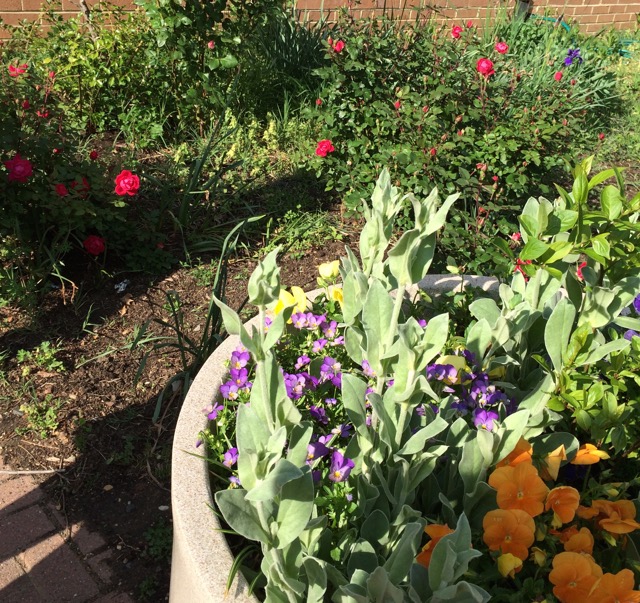
    Flowers and leaves from the garden in July
  2. Cut stems and calyx off the flowers. For large flowers, such as coneflowers, discard centers, and use only the petals.
  1. Work on the ground outdoors, or indoors on the floor or on a cutting board stabilized with a dishtowel or use a phonebook underneath as work surface.
  2. Cut pieces of painter’s tape about 7 inches long for your bookmarks (or length to fit notecards).
  3. Place the flowers and leaves face down on painters tape strip. Or put leaves and flowers onto the paper? Which works best?


  4. Then place the painter’s tape down onto the watercolor paper
  5. Now pound on top of the tape with a hammer. Make sure to hit each section of tape many times.
  6. If you need to dampen the sound, you can place a phonebook under the paper.
  7. Peel back the tape, and look at the paper to see if any area needs more pounding.
  8. Peel off all the tape. Colors from the leaves and flowers will have left a print on the paper.
  9. Remove any flower debris that is still stuck to the paper.
  10. Allow your paper to dry. Use as a notecard, or for a bookmark, or as a decoration.
  11. Laminate your bookmark or put in a plastic bookmark sleeve - and finish with a ribbon or raffia tie

Extensions
Fabric: Try flower pounding using a firm woven pale cotton fabric such as muslin instead of paper. Place the fabric over the flowers and leaves, and pound directly. Watch the color of the flowers and leaves come through the cloth.  

Mordant: Soak the cloth (or experiment with paper) in a salt or soda mordant solution overnight and then dry, before using. The salt/soda solution acts as a mordant for the pigment. Recipe for a yard of fabric is 4 T Alum, 3 T Cream of Tartar, 24 cups of very hot water, mixed together in non-reactive stainless steel or enamel bowl. Put in fabric, stir and leave for 30-40 minutes until cool. Dry in cool dryer or hang out, and iron flat before using.

In my practice
  • Parsley and Fern leaves left recognizable green images
  • Purple Japanese Maple leaves left faint reddish patterns
  • Magenta Rose Campion and purple Petunia flowers imprinted as purple
  • Lavender and pink Purple Coneflowers made brown smudges


Resources
Mallets: $3.99 from Ace Hardware

Other examples online
Life Labs - The Fine Art of Flower Pounding - pdf from Art in the Garden page 189.

Flower Pounding Note Cards

How to: Hammered flower and leaf prints

Laura C Martin, The Art and Craft of Flower Pounding

Two New Learning Labs Launch

Two powerhouse websites, both called Learning Lab, recently launched to support pre-K-12 education with digital online resources.
  • One Learning Lab provides digital resources for the Smithsonian Museums.
  • The other Learning Lab is associated with the US Green Building Center and Center for Green Schools.
  • Smithsonian’s Learning Lab is free, and USGBC’s Learning Lab is free until August 2016 and then by subscription.
  • Add both these resources to your teaching toolkits.
  • Check back as the resources grow.

Here’s my first exploration of both these new Learning Labs:

Smithsonian’s Learning Lab -  a Virtual Fieldtrip to Discover Create and Share
I view the video introduction, check out resources, and read threads related to Pandas, Hot Air Balloons and Robots.
  • How to link these and other reading resources to my K-5 outdoor lessons?
  • How can I share these resources with students, parents and teachers?
  • How about using the Smithsonian's collections of museum objects?
I click to Exploring Essential Questions With A Group of Objects, and come across a beautiful collection of tools and innovation.

I bookmark this page for a teen after-school enrichment group that I will be working with on The Food Project. From a 5-minute browse on the Smithsonian’s Learning Lab, I now know where to come back for future links to millions of Smithsonian resources, and I can plan a virtual fieldtrip!

“Not everyone can come to the Smithsonian, but they can visit the Learning Lab to inspire and design their own digital learning experiences,” said Stephanie Norby, Director of the Smithsonian Center for Learning and Digital Access.

US Green Building Center’s Learning Lab - Education for Sustainability (EfS)
After registering with USGBC’s Learning Lab, I easily access their resources.


I download a series of three lessons and films on soil science from Nature Works Everywhere designed for grades 6-8. This I can also use with my after-school enrichment groups including The Food Project. While on the Nature Works Everywhere site, I check out their resources and lesson plans on bees and pollination to add to my collection for my after-school and in-school programs!

I bookmark a module on the theme of “water” from other partners: the Sustainable Intelligence curriculum designed by EcoRise Youth Innovations and Representaciones e Inteligencia SustentableThe curriculum is mapped to current standards, and available in Spanish and English. I download the water lesson plans include songs, images and sounds of rain and a waterfall, and add these to resources for my work with a Montessori school.

I will check back often as these resources from the Smithsonian and USGBC and their Learning Lab partners grow.


Learning Lab Resources
Smithsonian’s Learning Lab - https://learninglab.si.edu/
USGBC, US Green Building Center’s Learning Lab - https://learninglab.usgbc.org/

Bookmark both for your green STEM and 'education for sustainability' (EfS) toolkits!

Add a comment below on how you are using these resources.

Thursday, June 2, 2016

Observation: Ants, Networks and Communication

By Mary Van Dyke

Interested in the everyday, networks and communication? 

This afternoon, I take about 100 3rd Grade students out to learn about soil erosion in the schoolyard. We come across small holes and miniature-hills on the playing field. The kids scuff the dust. Thinking? About the heat, soccer? Bees? Ants?
Studying schoolyard erosion and Red Maple roots
At supper this evening, I watch tiny ants carry a part of a skipper butterfly's wing 20 feet or so across the concrete patio. First one ant on its own, then another tiny ant join in. The first ant gives up at a big 1/4 inch high twig. A third ant arrives and takes over, and manages to flip the wing over the twig, and then haul the butterfly wing another 10 feet or so across the concrete. 
Ant with Skipper Wing

Meanwhile, we feed the ant colony some tiny slices of watermelon, fairly close to their walking lines. In a few minutes first 1, then 2 or 3 then, 5 or 6 and soon a dozen or so ants gather around the tiny slices of melon. 
Ants eating Watermelon
I need to read again EO Wilson and listen to Deborah Gordon on how ants communicate and whether they plan their trips? Deborah Gordon has devoted a lifetime to studying ant colonies, their networks and communication.  And I recollect a radioshow I heard a few years ago on AI, simple operations and swarm networks.

It is interesting to watch the ants for half an hour or so on the patio - and I have yet to discover the nest or where they were going. As I clear away supper, I plan to watch the ants again tomorrow.

The next day, I find the ant's nest. It's a large colony in crack in the pavement and their main nest is under a flower pot. There is another trophy wing there, but not the skipper wing, and I see a dead fly.  I am now intrigued to observe these ants over the summer!
Ant Paper Cutout Banner by Mary Van Dyke

References
EO Wilson


Deborah Gordon - interest in ants, networks, communication and AI

Thursday, May 19, 2016

Teaching Future Ranchers, Farmers and Decision Makers? Climate Change and the Water Cycle, USDA curriculum for 6th - 12th graders in the Southwest


Reposting from USDA Blog Posted by Albert Rango and Caiti Steele, Southwest Regional Climate Hub, on May 19, 2016 at 10:00 AM

Want to teach relevant, experiential projects on climate change and the water cycle to your teen future farmers, ranchers and decision makers?
Here is a new standards-aligned experiential learning curriculum for 10 hours of projects on climate change and the water cycle designed for 6th - 12th graders living in the Southwest.

"USDA has created a curriculum for teaching today’s students about climate change and educating tomorrow’s farmers, ranchers, and decision makers.  The Department’s Southwest Regional Climate Hub has partnered with the Asombro Institute for Science education to build “Climate Change and the Water Cycle,” a scientifically rigorous education unit for 6th -12th grade students.  Intended for both formal and informal educators, the unit includes 9 activities which can either stand alone or be taught over 10 instruction hours.  These hands-on activities are designed to help the students understand the scientific concepts behind different elements of the water cycle, climate change, and how to analyze data and communicate results. "


Friday, May 6, 2016

Growing Green Community: APS School Garden Meetup at Carlin Springs Elementary School

By Mary Van Dyke for Green STEM Learning
April showers bring May flowers!

Between morning showers and an evening hailstorm, on a sunny afternoon the APS School Garden Meetup gathers in the garden courtyard of Carlin Springs Elementary School.
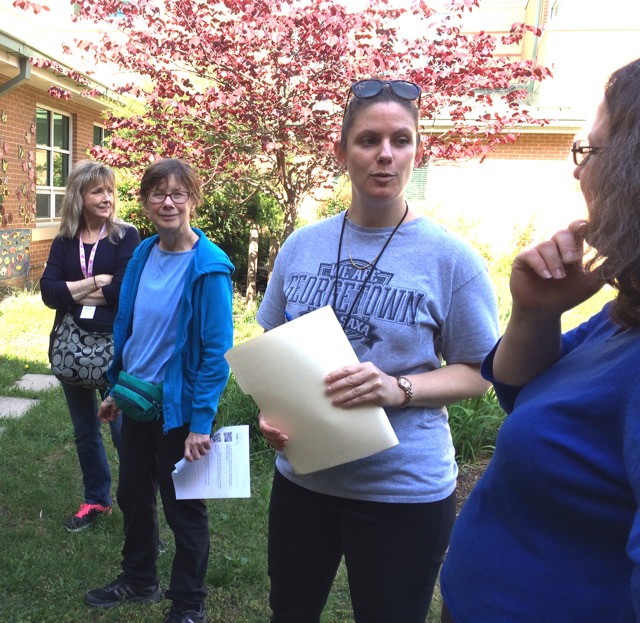
Whatever the weather, we are all here to talking about growing green communities.  Our hosts: Carol Sabatino, Community School Coordinator, and colleagues include Jeff Postell, PE staff,  and Josh Allen, 4th grade teacher, Carlin Springs’ community volunteers and other organizational partners. It takes a partnered community to successfully garden at schools and “grow greening”. Our guests are members of the APS School Garden Meetup group. We are all here to learn and exchange tips and best practices, and to grow our green networks too.

Courtyard Garden Carol introduces the courtyard habitat and goals.

IMG_0477.jpg
L to R, Robin Whitmore, Liz Macklin, Carol Sabatino, Elenor Hodges. Photo by Mary Van Dyke.
IMG_0474.jpg
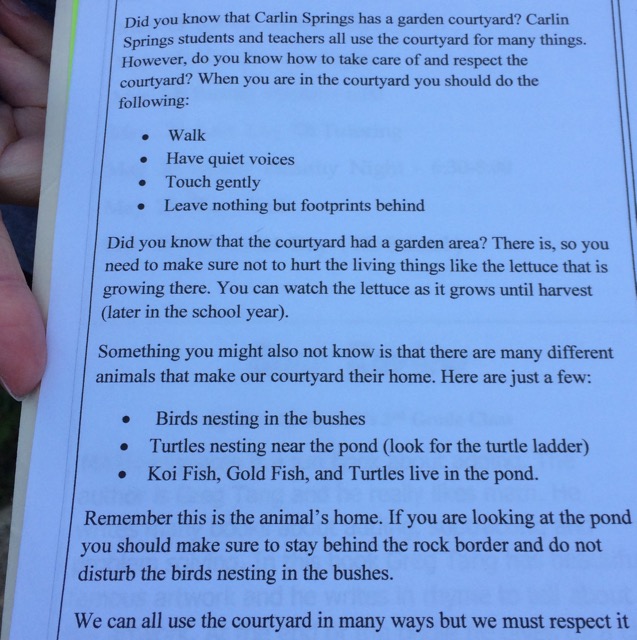
5th grader's piece on how to use the Garden Courtyard from this month’s school newsletter.

IMG_0475.jpg
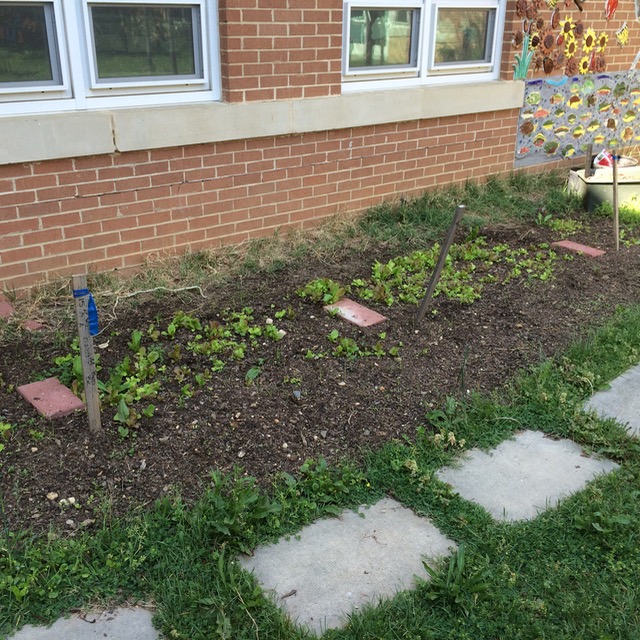
Nonprofit partner Lands and Waters grow lettuce with an after school group

Lands and Waters have partnered with Carlin Springs school for many years now. Lands and Waters first helped with habitat restoration. Growing lettuce is one of their newest projects.  Lands and Waters representatives host 10 students in a gardening club that meets weekly for 1 ½ hours after school. They are funded by a 21st Century Community Learning Centers grant.

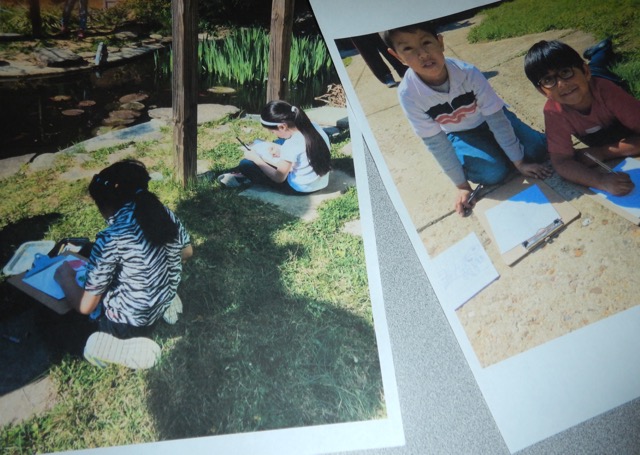
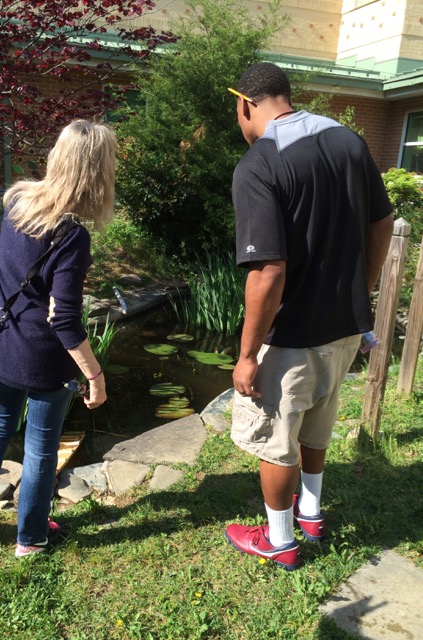
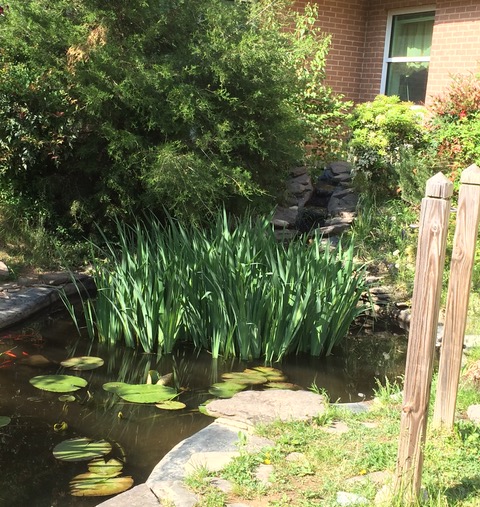
In previous years, Carol’s job was also sponsored through the 21st Century Community Learning Centers federal after school grant, although now her position is funded through Arlington Public Schools. In the courtyard we also admire the pond and learn about its history and how it is sustained. Artist, Liz Macklin, shows us some of her photos drawing in after school classes with students.

DSCN7618.jpg
We listen to the calming sound of the waterfall and birds singing. A turtle suns itself on a rock. In the corner of the courtyard, I see a birds nest on a window ledge.  
IMG_0482.jpg
Robin Whitmore discusses the pond and turtle habitat with PE teacher, Jeff Postel

IMG_0483.jpg

One of the community volunteers, Robin Whitmore, brings her expertise to care for the pond and the turtle habitat.  Robin tells us that there have been lots of toad and frog spawn this year, and sometimes on spring mornings there are frogs all over the courtyard path!
IMG_0479.jpg
Turtle habitat and bird’s nest on window cill
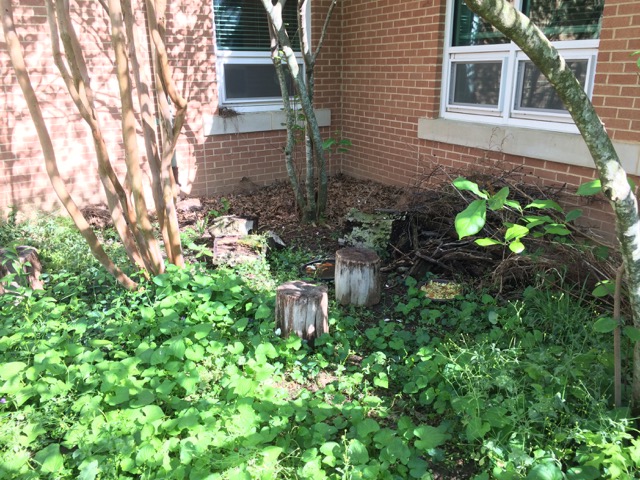
One goal in the courtyard is to increase native plantings to help create habitat for wildlife, and to reduce the amount of lawn grass so the custodians have less mowing to take care of. The courtyard is accessed from two  indoor spaces that make useful and beautiful classrooms for preparing outdoor lessons. Grow Lights as a partnered project with 4-H and Extended Day. Next on our tour, we stop by a classroom with grow lights.
DSCN7627.jpg
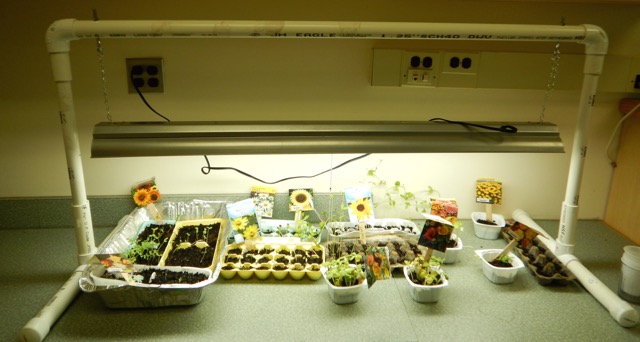
Grow lights on loan from 4-H with seedlings being cared for by Extended Day staff and students The grow lights are a simple “build your self system” from PVC pipes with “off the peg” lamps. This low-cost arrangement is on loan from partners at Arlington’s 4-H.
The big challenge was not building the grow light system, but how to care for seedlings at school? Young seedlings need attention, and maybe watering once a day. Here at Carlin Springs, Carol invited the Extended Day staff   with a group of students after school to take care of the seedlings. The students are growing quick germinating seeds including sunflowers in recycled lunch containers and egg boxes. The system is simple.  If the group wants to take it to the next level, they could perhaps get a timer to turn off the lights? Giving seedlings only 18 hours of light a day, and a  dark rest period at night would help the seedlings grow to be less leggy.  This experiment however, as it is, is already successful. The students and staff are engaged, and delighted with the learning process!
IMG_0488.jpg
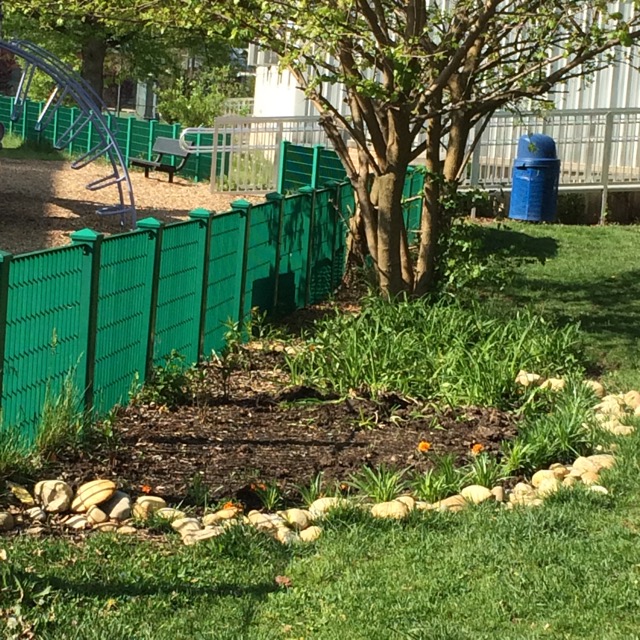
Pre-K's Garden

Pre-K Help Create Their Own GardenWe continue outside to  pre-K’s new garden. The pre-K class brought the mulch to the garden, bucket by bucket and the stones one by one from the parking lot. What a wonderful teaching in collective team work. Carol and Jeff describe other projects they have in mind for this area. Perhaps the area could be developed to include a vegetable patch and even a foraging forest? Virginia Native Wildflower Garden partnered with Master Gardeners and Master NaturalistsNext we go to see the wildflower area, in the median at the entrance of the school. This area is now being looked after by students with the guidance of Master Gardener Nancy Davis and  Master Naturalist, Joan Gottlieb. Together with students and volunteers, they have restored a VA native plant wildflower garden that was planted here several years ago by Master Gardener Judy Funderburk and others. This garden already has a long history and legacy - but  it needs many hours of work each year to keep in good health and thriving - or the weeds simply take over.  

IMG_0492.jpg
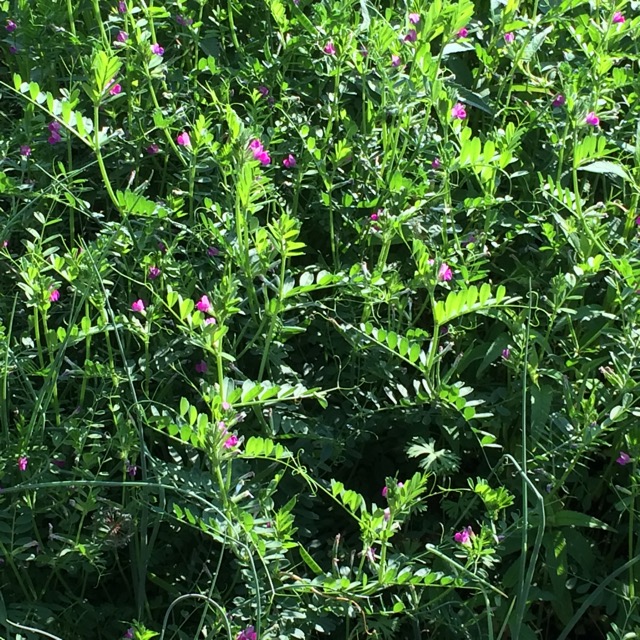
Red Vetch cover crop to suppress weeds in the wildflower garden
Weed Suppressing Techniques: Cover Crops and  Paper, Mulch, Corn GluteNancy and Joan are unable to be with us today on the tour, but share some of their weed suppressing tips and techniques. They are using cover crop of red vetch in the wildflower garden.  In one vegetable bed they are experimenting with covering the bed in the fall with layers of wet newspaper and about 5 inch of mulch and sprinkling on corn gluten. Will that help suppress crabgrass?

Gardening with students as part of PE in school and after schoolJeff Postell, PE teacher and Nancy worked to bring groups of students out here to work in the wildflower garden. During PE groups of students came out after their cardio workout for 20 minutes. But Nancy and the students felt that 20 minutes is not really long enough to do gardening, however even 20 minutes was a good start to the school community’s revitalization of interest in this wildflower garden project. Now volunteers are working on providing students with a longer time to work in this native garden as an activity or club during after school time.

IMG_0493.jpg
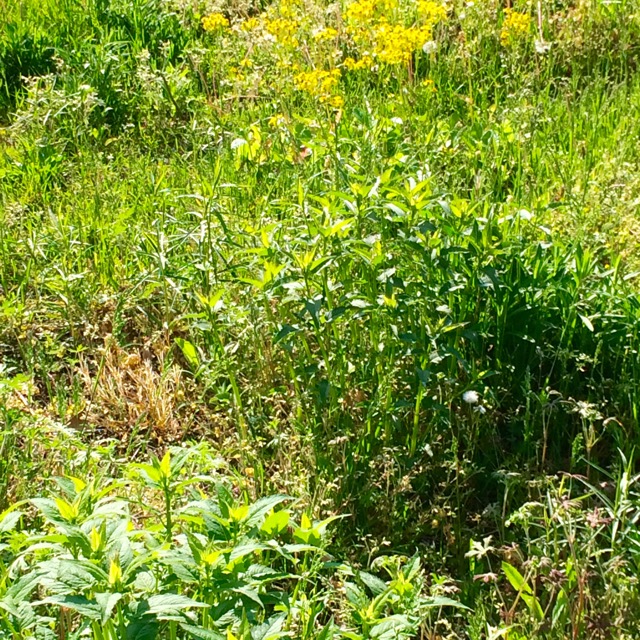
Virginia native wildflower garden in early May
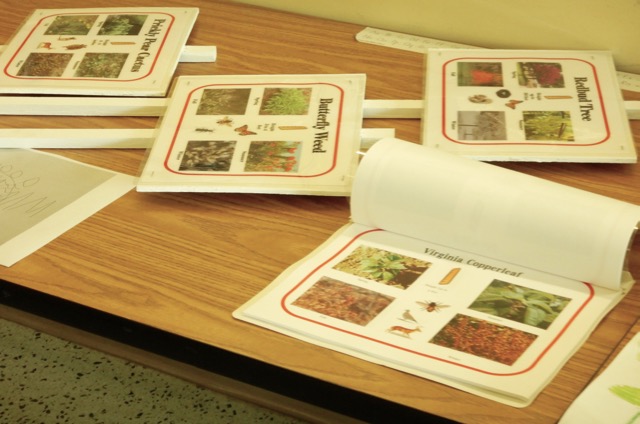
Signs to highlight ecology of some VA native plantA Master Gardener intern has made signs describing the ecology of the native plants, including the Red Bud tree, Butterfly Weed, Virginia Copperleaf and the Prickly Pear Cactus. Soon the signs will be on display in the garden
DSCN7626.jpg
Signs for the native wildflower garden showing ecological relationships and plant lifecycles
Made by Master Gardener intern as capstone project

Weekend Work Sessions with Families and VolunteersWe also discuss weekend work sessions at Carlin Spring Gardens. How frequently and how are they facilitated? Carol organizes a couple of work sessions, for families and volunteers in spring and fall on Saturdays. They usually run from 10 AM to 1 PM, then they serve refreshments. The parent organization sponsors pizza and the cost of some plants too.  Usually 35 families participate, and Master Gardeners help guide teams. Perhaps one or two teachers will be there to help too, and someone liaises in Spanish-language.

Donations to support Schoolyard GardeningChristy P, Garden Docent at neighboring Campbell Elementary School shares that some companies, including Chipotle can be invited to donate refreshments to school work parties. That is something to consider for other school and community events. Schools can also be eligible for free seeds from Seed Savers Exchange donation program and from Southern Exposure seed company. It’s late in the season for seed donations now, but it’s never too late to think ahead! We also pass along the tip that saving seed catalogs is fun for classes to use for projects. I have used images from upcycled seed catalogs to make scavenger hunts, matching games and for mod-podge decoupage projects.

IMG_0498.jpg
Front Entrance in May
Flowers include: roses, iris, pansies, Virginia sweetspire and Stachys byzantina

At the end of our guided tour, we stop by the front door and admire the vibrant roses, irises, and planters full of pansies. How about harvesting petals for pot-pourri and pressed flower crafts?

Growing Green Schools and Communities As we say goodbye, Carol reiterates that the school’s former Building and Grounds Committee was transformed into Carlin Spring’s Growing Green Committee. The goals include to:

  • improve school buildings and grounds
  • connect with and enriching academic instruction, and
  • meet the needs of the whole child.
Our tour around the gardens today show the strength of community networks needed to achieve these goals. We see projects that enhance the grounds, connect to and enrich students learning - and above all the joy of children contributing to their community.
DSCN7622.jpg
Artwork made by students Spring in the garden at Carlin Springs
I thank Carol and colleagues, and look forward to keeping in contact as we continue to network and  exchange ideas and best practices and mutually support each other to grow greener programs at schools in Arlington.

APS School Garden MeetupAPS School Garden Meetups are an initiative of the Superintendent’s Advisory Committee on Sustainability, and have been meeting monthly during 2015-16 at ten different schools. We aim to continue visiting APS schools during 2016-17. Please contact growinggreenschools@gmail.com for further information.

Photos by Mary Van Dyke unless otherwise credited.

Resources: