Friday, March 20, 2015

The Potato Project: Planting Potatoes with Montessori

It is time (and later in the season than usual) to think "potatoes". It is snowing a little, although we are already past St Patrick's Day and today is the spring equinox.


This spring, the Montessori class are taking on potato planting, care, harvest and cooking as their outdoor learning project.

In the fall, I  identified a raised bed for planting close to the students' classroom. The bed is sunny and has water nearby. I enrich the soil with compost.


I initiate "The Potato Project" with two 45-minute class sessions over two weeks, and describe here how to run for a class of twenty, 3 - 5 year olds.
Please note that this activity can be adapted easily for other groups and ages.
  • Click on resources for printable version of these two sessions and higher grade VA SOL or NGSS-linked materials.
Session One: 45 mins: Indoors (can be end of March, around St Patrick's Day)

Introduction and Planning
"One Potato, Two Potatoes, Three Potatoes, Four..."
How many of the students have eaten potatoes?  How were they prepared and cooked?


We look at different kinds of "seed potatoes" and identify eyes, tubers, sprouts. Some of the potatoes are red, others yellow, some are purple.
We discuss that "seed potatoes" are not seeds from flowers, but small potatoes that are living with stored food in the tuber and will sprout to make another plant.
Potatoes are native to Mexico and South American mountain areas.
Potatoes in a market in La Paz, Bolivia
from Vegetables, p. 135 by Roger Phillips and Martyn Rix

Rock-ledge habitat of wild potato in Mexico
from Vegetables, p. 134 by Roger Phillips and Martyn Rix

And grow well in cooler parts of North America in Maine and Idaho - and around the world.
Potatoes growing in Maine
from Vegetables, p. 141 by Roger Phillips and Martyn Rix

The students put the "seed potatoes" on the window cill to sprout.
We'll leave the seed potatoes on the window cill to sprout more, and will plant them in the garden next week - on Day 7.
I ask the teacher Ms Kipperman, if she and the students can cut the seed potatoes in half on Day 6 and leave the potatoes to "heal", to air dry for the planting session next week.

We then read Two Old Potatoes and Me by John Coy. This beautiful book sets the scene for our expectations, the "hypothesis", for our potato cultivation and celebration.

Activity: Potato Printing
Preparation:It takes about an hour for me to cut 5 lbs of potatoes into various simple designs.
I do this in the morning before the class.


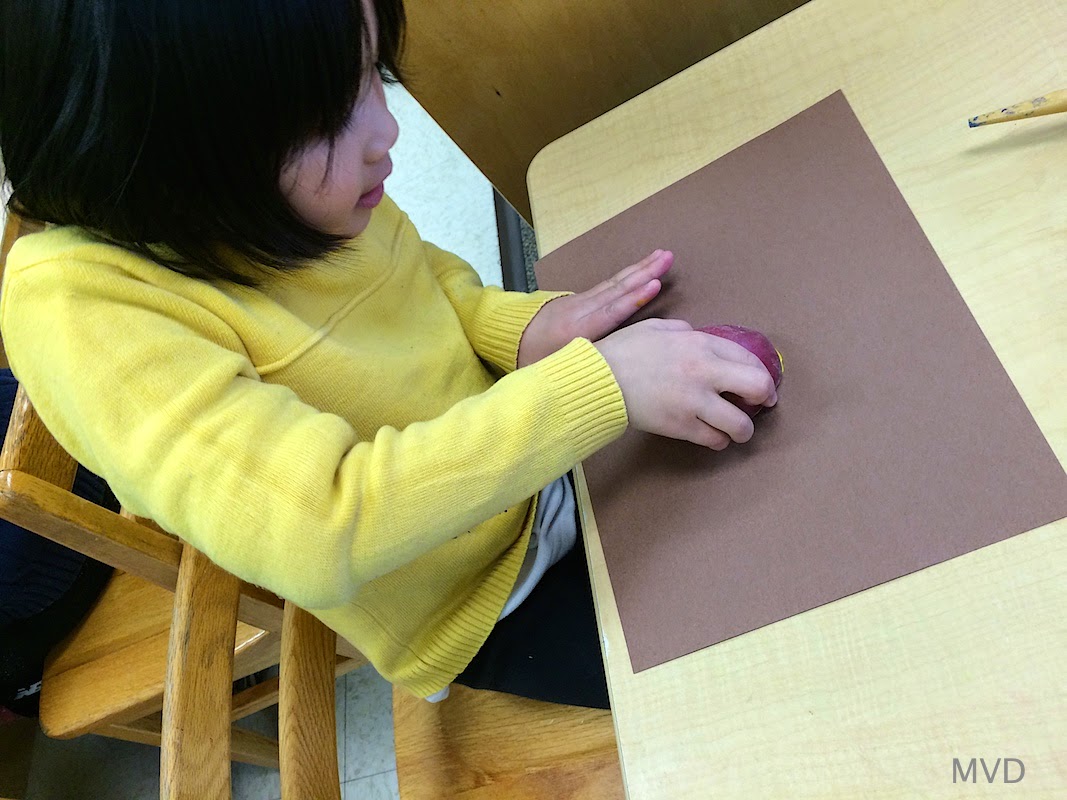
In the class, the teacher demonstrates to the students how to apply the paint thinly on the paint surface with a brush, or to dunk the potato in the paint and print. The printing with washable acrylic paints works well on ordinary construction paper.
The potato printing is a quick and fun activity for the students at the end of their school day.



This ends the Day 1, 45-minute session introducing The Potato Project.


Day 6: 
Teacher and students will take the "seed potatoes" that have been on the window sill and cut each potato in half (each half to have two or more eyes) and will leave the potatoes to dry "heal".

Next Week, Day 7,  Session Two: 45 mins: We will be mainly outdoors and
planting before spring break.

Then after spring break there will be class weekly care sessions until June:
  • Go out to potato bed, observe, journal and draw, look out for insects, and water well. 
  • Mound up earth around potato plants leaving some leaves visible. You may need to do this once a month during the growing season.
  • Adults may add compost (or fertilizer) to potatoes once or twice during growing season.
Harvest and Prepare Mashed Potatoes (June and/or September)
  • Class can harvest some or all of the potatoes in June, wash, prepare and serve "microwaved mashed potatoes" as a class celebration.
  • Or you can leave some potato plants to grow until school returns to harvest in September (as a "Legacy Garden" for next  year's class of Montessori students to harvest and enjoy!).

Resources: Link to detailed planning documents for the The Potato Project


Wednesday, March 18, 2015

Think Spring! Plan to Sustain a Teachable Schoolyard

I am the "Visiting Horticulturalist" at Jamestown Elementary School in Arlington and help the school community (staff, parents, students) plan and maintain the courtyard garden and grounds for outdoor learning.

Here's the school Courtyard in October 2014
Jamestown Elementary School, Courtyard
October 2014

Outcomes
What are the short-term outcomes that the community expects by the end of June 2015?
  • A beautiful and useful garden
  • Flowers in bloom
  • Vegetables to harvest and taste
  • To attract and sustain insects and birds while minimizing rodents
  • To increase parent and teacher interest and involvement
  • To increase the number of students learning outdoors
  • To increase use of volunteers, such as Eagle Scouts
  • To demonstrate "evidence of learning" in the garden and on various media
  • Integrated "green STEM" curriculum-linked learning

I have lots of questions to work through myself and with the community.
How can we start from where the community is - and build capacity for those goals over the next few weeks?
What are projects and community-building to put on the to-do list for next year or the distant future?
How do we build time for schoolyard-based curriculum-linked gardening into the already-packed school schedule?
What resources do we have or need in terms of funding and expertise?

In the fall various projects began. The principal, lead science teacher and I met and discussed and surveyed the grounds several times. I made an inventory and site assessment. I met three key parents interested in supporting outdoor learning and I built connections to the PTA, presented to the PTA on growing sustainability and outdoor learning. The PTA had already budgeted for an annual clean up by a landscape contractor, and also funding for Outdoor Learning and my position. An Eagle Scout undertook to gravel the pathway to the big willow oak tree. The teaching platform was repaired by facilities. I talked to custodians, and met and worked with teaching staff to discover what they were already doing, and would like to do, and to define a few projects utilizing different areas of the courtyard and grounds. I took all classes outside to learn, and I made a couple of sample signs to demonstrate potential using QR Codes and graphics.

Logic Model planning
This week in the spring, I sketched out a "logic model" starting with outcomes/outputs of various current and potential projects and worked back to our continuing assessments, and the partners and resources needed for each project. Based on my fall site and class assessments, this week I revisited designs and wrote spring plant lists.

Jamestown Courtyard
Site and Plant Assessment
Today I am out in the courtyard with a volunteer parent for our first spring maintenance session. First of all we take stock of the courtyard after the winter snow. It is windy today and I enjoy listening to the breeze in the huge willow oak tree in the center of the courtyard.
Again lots of questions: What's new since the snow? What needs doing now for a 'spring clean up' prior to planting? What can the students do when they come out in small groups to learn next week?

We decide to begin to maintain one of the flower beds inside the courtyard, and to gauge what students can do.
  • There's lots of leaves from the willow oak that can be raked up and some sticks and branches to pick up - those are great jobs for a class of second graders.
  • The tulips K planted in fall are coming up. A couple of crocuses are out. 
  • The hairy bittercress and speedwell, are already flowering in the milkweed and pollinator garden. Identifying the plants, discussing maintenance and weeding is also a great job for second graders. See link to my Weed Identification for Schools resources.
  • The box bushes are yellow with winter burn. Let's have the students monitor the bushes, and see if the bushes will leaf out or need replacing?
  • We need to move two lavender bushes, and prune the big buddleia shrubs back to 12 inches or so above the ground.  The fall asters need clipping. Pruning and clipping is a great job too for second graders working in supervised small groups. But do we have the tools?
  • The buddleia "butterfly bushes" are beloved in schoolyards but becoming an invasive in this area. Until we have built the community understanding to successfully replace the buddleias with native plants I will manage by clipping off the seedheads in the fall.
  • There's lots of common milkweed growing in the courtyard and the school is devoted to raising monarch caterpillars and butterflies. We decide to focus the milkweed in two bounded beds this year rather than allowing milkweed to grow anywhere in the courtyard. And to increase diversity of plantings in the "milkweed beds" by interplanting with equally vigorous natives: We'll interplant with our local and regional native plants: goldenrod, mountain mint, rudbeckia, helianthus. Students could do the planting after spring break.
  • I take quick review of sun paths, soil conditions to update my site assessment in the fall - some daffodils are now up in unexpected places.
  • Over the winter I started to name and focus the beds in the courtyard - so far we have:
  • Sensory Garden 
  • A Shade Garden
  • Three B's: Birds, Bees and Butterflies Pollinator Garden
  • Ms Zamora's Students Vegetable Patch
  • Bird Station
  • Kindergarten Tulip and Milkweed Patch
Tool Assessment
  • Reassess the tools in the toolshed
  • What tools work?
  • What do we need and how many of each for small groups?

    The school now has plenty of trowels and shovels for planting, digging and weeding, and hoses, watering cans and a big tub for watering. I will buy 4 leaf rakes, 8 pruners, and 4 leaf scoops. I will label and put the pruners in box high up in the shed, and will teach the students how to use these tools safely to trim the lavender bushes, fall asters and buddleias next week.
Processes: Yardwaste and Composting
  • How do we recycle plant material currently and in the future?
    If we dispose of plant material in the school dumpster the yardwaste is shipped out of the county and is likely burned for energy in our local incinerator. Perhaps it goes to a landfill?
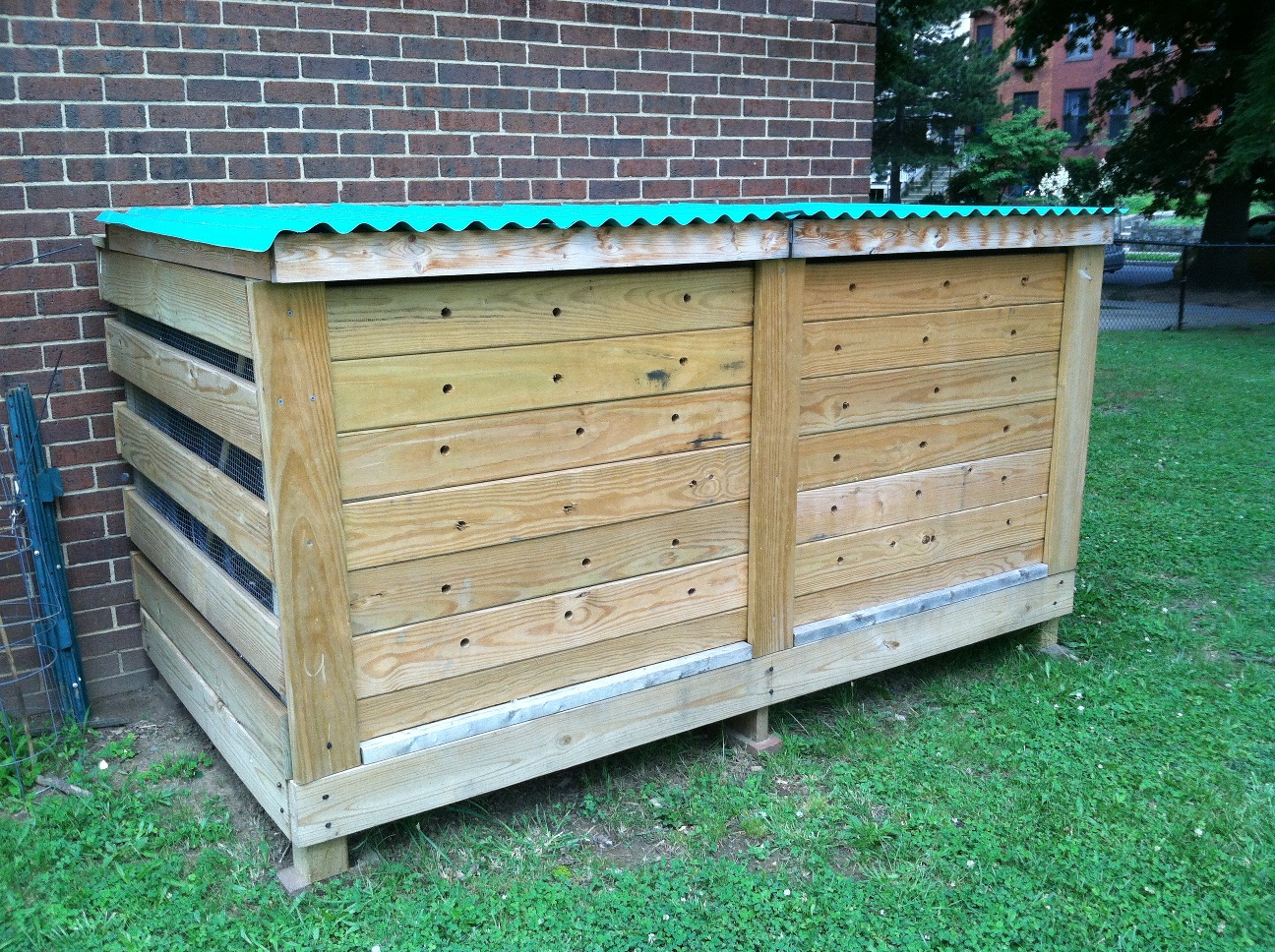
    A parent decides on reflection to take home our two bags of weeds today to then leave out for the county to collect as "spring yardwaste" and compost. I am still talking with APS school facilities about on-site composting at schools. Some Arlington Career Center students are designing composters in a new sustainable systems course. I have already offered to the Career Center teachers that Jamestown ES could pilot two of these student designed and made compost bins - one in the Courtyard and one outside by the vegetable beds. I am sure that even two of bin composters like these below will still be under-capacity for the size of the schoolyard and grounds - given the capacity of my large compost area and garden at home.
    Captionless Image
    DC Public Schools - Composter Design

    I look across the river to DC schools for rat-resistant aesthetically appealing design inspiration and also to colleagues Fairfax County Public Schools.
  • There is a large old Mantis tumbler composter at the Jamestown Elementary school, but it is no longer working. A parent is kindly arranging for repair spare parts. I've talked to custodians, parents and staff, we may be ready to start to using the compost tumbler again on a small scale. Parents and students could occasionally add in weeds and the custodians' coffee grounds that are nitrogen-rich and dried leaves that are carbon-rich to create a balanced mix. Even without taking on permaculture or a guiding framework such as Eco-Schools within the school, there is lots to learn from attitudes to composting and our "waste" management practices.

Signage and Media 
How do we best get messages out to the community?  Multi-media and incremental change is key. The staff I am working with have email, a once a week email to parents and the website, twitter and FB. I have couple of signs already for the courtyard linked by QR code to projects. We did a couple of tweets. I am using SignUp Genius to outreach to parents. I will blog garden projects here at Green STEM Learning. My goal is to add more "evidence of learning" in the garden and to use the signs to highlight students learning. A second grade class is taking on to create some signs as part of a project on habitats.

With a view to create more sustainable outdoor learning programs in Arlington, I continue conversations with other schools both in our county and elsewhere. I continue to dialog with others on EfS - Education for Sustainability - and frameworks such as Eco-Schools. Next month, our county's FitArlington Healthy Community Action Team and Superintendent's Advisory Committee on Sustainability are co-hosting a Growing Green Schools event to encourage more networking and information exchange on learning and best practices between school communities.
As far as Jamestown ES goes I list on the logic model - projects that we will do this spring - and  begin to develop a "wish-list" of others that could be done in the future.


Resources mentioned:

Logic Models: WK Kellogg Foundation, Logic Model Development Guide, 2004
Presentation: for Jamestown Elementary School, Growing Sustainability and Outdoor Learning
Tools: Trowels, Leaf Scoops
Weeds: Weed Identification for Schools by Mary Van Dyke, 2014
Native Plants in Northern Virginia: Northern Virginia Native Plant Campaign - www.plantnovanatives.org
Composting Lessons:
Permaculture Principles http://permacultureprinciples.com/
Eco- Schools USA http://www.nwf.org/eco-schools-usa.aspx
Green Schools National Network https://greenschoolsnationalnetwork.org/


Next Week: Red, White and Blue, Planting Potatoes with Montessori


Wednesday, February 18, 2015

Inspiration: The Love + Practice of STEAM

My teen daughter tells me this week that she wants to be a "neuroscientist who likes to practice music and play with clay". I listen and say, "YES!" aloud and in my heart. However, this week she had to choose between art and music at high school. Despite block scheduling and selecting options, I hope that she will continue to integrate her love of practicing the arts, sciences and languages.

On Valentine's Day I went to the Virginia Association of Science Teacher's conference on Inspiring a Love of Science with STEA*M (Science, Technology, Engineering, *the Arts and Mathematics). Keynote Speaker Margaret Hancock presented on "Thinking like Artists and Designers".  Her photos of the iconic Saarinen Womb chair and the Glasshouse by Mies Van der Rohe, reminded me of my architecture school days of thirty years ago! Then Margaret updated us to our digital ecologically-aware age with images from Patrick Dougherty's Stickwork and the architecture of Rural Studio.


Why S.T.E.A.M?
Observing and understanding nature is what Science is theoretically, but how and why? I never bought that "only observer" deal anyway. Did you? So the moment you acknowledge your active participation in systems: here comes integrating Engineering while gathering, hunting for and inventing the tools, the Technology, to help the observation, inquiry and the inevitable impetus to design and the iterative process. And whether you name it or not, you will add the Arts (and no doubt some aspects of religion or faith) to help with decision-making between various solutions and to acknowledge our basic need for symbolic references. Underlying patterns, economics and relations between all the variables there is a lot of Math, even if it is beyond your and my ability to solve for "x". So we have integrated STEAM in a nutshell. STEAM is more than just the sum of the parts:it shows emergence and synergy.

Talking of metaphors: I thought about calling this blog "Green STEAM Learning". But "Green STEAM" conjured up images of wilted lettuce and viridian clouds, so I went with the simpler "Green STEM Learning" to convey themes of integrated environmental education and sustainability.

STEAM at Home
Here is a simple example of "thinking like an artist and designer" and the synergy of STEAM in action at home.

My daughter and I spent some afternoons setting ourselves the task of making some jewelry together. We decided to go with a "cheap eats" theme and to collaborate. She decided to make Junk Food Jewelry while I made some Wearable Edible veggi brooches. And yes, we assessed plenty of social values and prejudices right there.
Junk Food Jewelry


We bought premixed polymer clay. And weighed the pros and cons and viability of alternatives such as homemade salt dough. Polymer clays are expensive, hence our decision to make small things. The color range can be enhanced by combining clays and adding pastel dust with a paintbrush. And you might experiment with some shaping tools in addition to fingers. Then you bake the objects in the oven for a few minutes to set.


Wearable Edibles


The engineering comes into play with questions such as:

  • How to create objects that work on necklaces, brooches, bracelets?
  • Do they balance well when you wear them?
  • Do they move successfully with the body, or fall off?
  • What kind of glue or fitting works best to fix a clay shape onto a metal armature?

It is a challenge to work within the budget, timeframe, technical capability and health and safety protocols that we have here at home -  or you might have in the classroom.

The creative and engineering processes are all about "having a go", experiments, analysis, feedback and iterative design. For example: the first peapod brooch toppled over on wearing. So I drew a cross-section and decided to hollow out the back and recess the brooch clip. This technique works well on the carrot and leek brooches too.


The peapods were easier to make if individual peas were baked first to harden, then clad with the pod layers and rebaked. The radish soft magenta color was achieved with pastel and water coloring - a more subtle shade than achieved by clay alone. We also used 3D modeling to good effect on the radish and chocolate chip cookies. The carrot and fronds were based on form of the pink cancer awareness ribbon brooch.


My daughter's Junk Food Jewelry and my Wearable Edibles selections both work on the symbolic artistic level, referencing well-known foods and vegetables at a miniature scale.

The result our collaborative, FUN, STEAM project-based learning.
We decided the plain chocolate chip pendant and earrings are a hit, and would sell like "hot cakes" with teens and other audiences.


Now two years on, my daughter still enjoys making and experimenting with polymer clay.  Her latest line is in "chibi" portraits as gifts to her classmates.
Emma's Chibi

Michelle's Chibi


She also takes classes at the community center to learn to throw pots, and she has chosen to study Ceramics at High School.

STEAM at Work
At this weekend's Love of Science and STEAM conference I went to other inspirational sessions. I heard George Mason Professor, Changwoo Ahn talk about his collaborative work:EcoScience + Art and current initiative: "The Rain Project - sustainable water management in an era of climate change" and his proposal for future efforts on food systems, soil and composting "The Dirt Project".

I enjoyed meeting Andrea Brothers from Micron Technology, and her multi-faceted presentation on life choices and career paths. She practices electron-microscopy to enhance yields of silicon memory products, plays violin and blends interests in art, science and technology. She played us her latest tunes, and shared her passion for innovation and design.
Andrea Brothers

STEAM at Play
I trained for many years as an architect. I also think like an architect unschooled. Here's one of my "early play dwellings", a Mouse House, or perhaps it is a model for a silicon chip?
On the Beach, Chios, April 1971

Here's to an integrated approach to education, creativity, experimenting and innovation, and to enabling holistic choices and designs. Whether or not you call it STEAM.


Thanks to Susan Bardenhagen for hosting VAST Region 8 PD Conferences, and being the VAST Region 8 Representative, and thank you to my daughter Maya, Andrea Brothers, Changwoo Ahn and Margaret Hancock for sharing their love and inspirations.


Thursday, February 12, 2015

Update on the No Child Left Inside Act


Here's an update from February 11, 2015 on the federal No Child Left Inside Act - that supports outdoor learning.
Reblogged from the Outdoors Alliance for Kids...

"Senators Jack Reed (RI-D) and Mark Kirk (IL-R) and Congressmen John Sarbanes (MD-R) and Mike Fitzpatrick (PA-R) introduced legislation aimed at improving environmental education in our nation’s public schools. Supported by the Outdoors Alliance for Kids (OAK), the No Child Left Inside Act would provide grants to school districts, support teacher training and promote the integration of outdoor learning into the regular school curriculum.
The legislation would enhance opportunities for school children and adolescents to learn about, and in, the great outdoors. Environmental education has been shown to increase academic performance across subject areas and has been linked to improvements in critical thinking skills, student motivation, civic engagement and environmental stewardship. Environmental education, particularly when practiced outdoors, can increase the amount of physical activity children and youth engage in during the school day.
“Today’s children will be asked to tackle tomorrow’s environmental challenges,” says Michael Brune, Sierra Club Executive Director. “It’s our responsibility to ensure our kids have opportunities to get outdoors and learn about the natural world. The No Child Left Inside Act will provide young people with the foundation they need to succeed and lead in a climate changing world.”
“We are hopeful that 2015 is the year that Congress acts to ensure that America’s youth have access to high-quality environmental education programs that we know help improve student achievement, connect young people to their communities, and build environmental literacy,” says Judy Braus, North American Association for Environmental Education Executive Director. “If we want our students to be competitive in a global economy, they need to be environmentally literate.”
Environmental Education

Wednesday, February 11, 2015

The Matrix: New Curriculum Resources from Ag in the Classroom


Ag in the Classroom currently reaches 6.5 million school students in the US - and the goal is to reach more.
Here's the USDA blog on the new curriculum Matrix that helps teachers access lesson plans.

Students learn about agriculture by using materials available online through the Ag in the Classroom’s Matrix.
(iStock image- fom USDA Blog)
  • Click on the Ag in the Classroom's February Resources below - get inspired and take your students out to learn!
Honey Bees: A Pollination Simulation


  • Add agricultural literacy to your academic standards.


Wednesday, February 4, 2015

Celebrating Soils! 2015 International Year of Soils

2015 is the UN’s International Year of Soils.


Key messages from the UN’s global Food and Agriculture Organization are:
  • Healthy soils are the basis for healthy food production.
  • Soils are the foundation for vegetation which is cultivated or managed for feed, fiber, fuel and medicinal products.
  • Soils support our planet's biodiversity and they host a quarter of the total biodiversity.
  • Soils help to combat and adapt to climate change by playing a key role in the carbon cycle.
  • Soils store and filter water, improving our resilience to floods and droughts.
  • Soil is a non-renewable resource; its preservation is essential for food security and our sustainable future.


Studying Soil with elementary-age students? Hit the NGSS standards relating to soils and ecosystems and begin with these 8 activities.
  1. Go dig up some soil, put in a jar, add water, shake and leave.  What do you notice after a few minutes, a day, a week?
  2. Contact your local Extension office and do a soil test for nutrients and chemical composition.
  3. Start composting: Begin with a “decomposition” experiment…
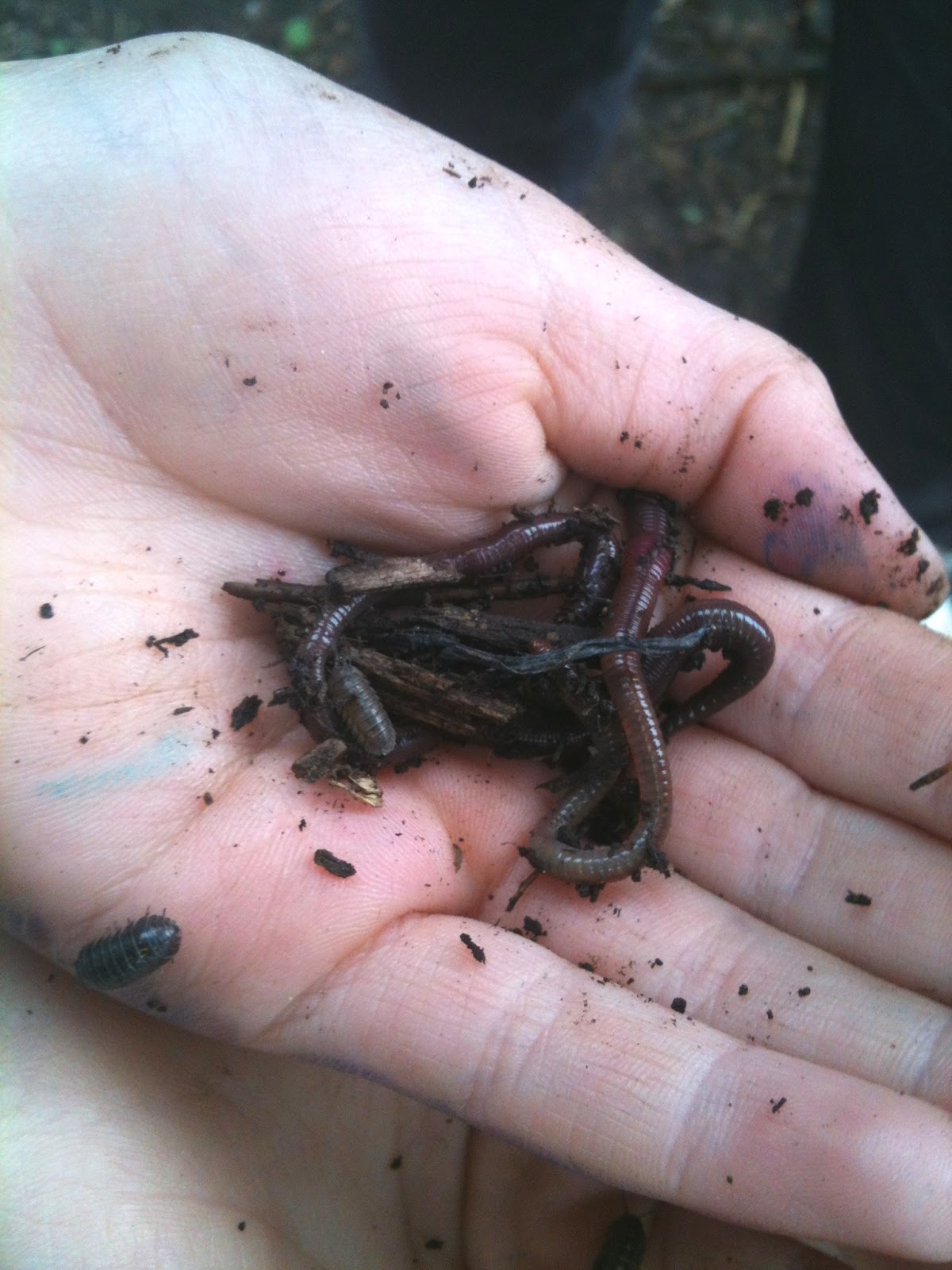
  4.  Study life in your soil...
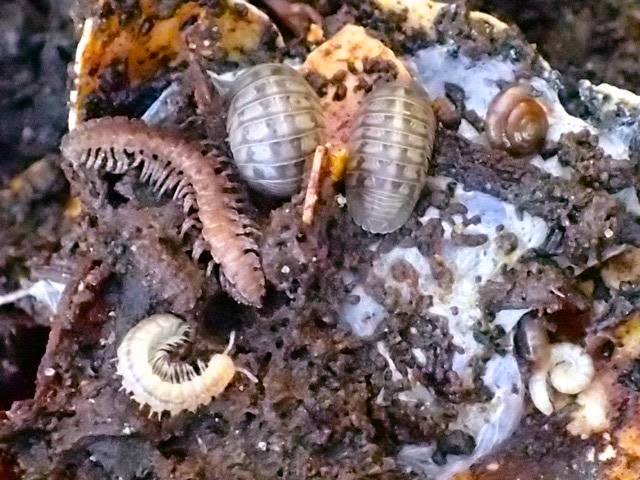
    ...and compost.


  5. Invite a soil scientist to visit with your class. See http://www.soils4teachers.org/ask or invite a soil professional from your Soil and Water Conservation District
  6. Raise awareness on soils in your locality.
    1. Here in Arlington, I am working with some residents to invite the County Board to proclaim 2015 as our local Year of Soils. Your class could outreach to your local officials and legislators. Every day is "earth day".
    2. Check out your local environmental education nonprofits, Cooperative Extension and Master Gardeners for classes on composting and soil management.
  7. Also why not work on hydroponics and aquaponics - the art and science of growing plants without soil? Here's a new starter "Aquafarm"... Product Details https://www.backtotheroots.com/shop/aquafarm
  8. Project-based learning? Identify and solve a problem such as soil erosion in your schoolyard.


Monthly Films Celebrate Soil and Diversity
These monthly two-minute films developed by the Soil Science Society of America highlight different aspects of soils and society. Each month has information on the theme, a lesson plan, and other outreach activities. Click on the month below to see the activities and films.
January - Soils Sustain Life
July - Soils are Living
February - Soils Support Urban Life
August - Soils Support Health
March - Soils Support Agriculture
September - Soils Protect the Natural Environment
April - Soils Clean and Capture Water
October - Soils and the Products We Use
May - Soils Support Buildings/Infrastructure
November - Soils and Climate
June - Soils Support Recreation
December - Soils, Culture, and People


Additional Resources
International Year of Soils Logos at


Soil Science Society of America
Resources for International Year of Soils and Soil Education


Junior Master Gardeners Teacher Leader Guide
Chapter Two is easy hands-on experiments with soils.


Example of countertop demonstration Aquaponic kit - $60
https://www.backtotheroots.com/shop/aquafarm and at other retailers

Additional movies:
Dirt! The Movie - streaming for $3, and to buy at http://www.dirtthemovie.org/the-film/
Symphony of the Soil - streaming for $5.99 at http://www.symphonyofthesoil.com/

Soil Test kits are available from your local Cooperative Extension office