Saturday, October 22, 2016

Oak Trees and Acorns as Teaching Tools

By Mary Van Dyke

Here in the DC metro area on the East Coast of the US it is often the Year of the Acorn!

On my walks around the neighborhood, I find that we have many shapes and sizes of acorns - and a large diversity of oak species (genus Quercus).
Overcup Acorns
Did you have lots of oak trees and acorns too?


So what to do with this "oak mast" and wonderful bounty of a teaching tool?


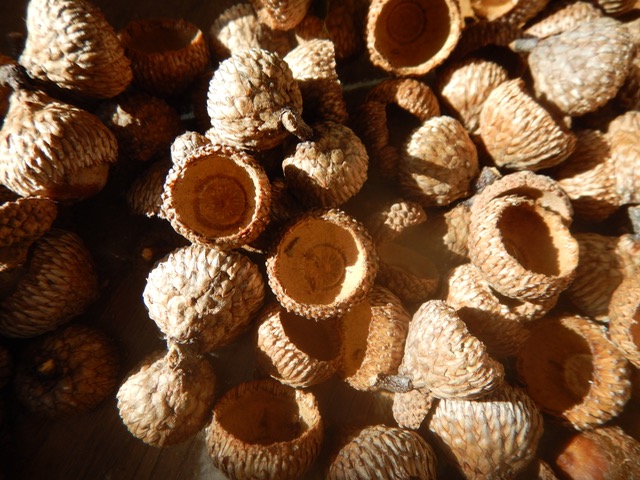
White Oak Acorn Caps

Sawtooth Oak Acorns

Red Oak Acorn Caps

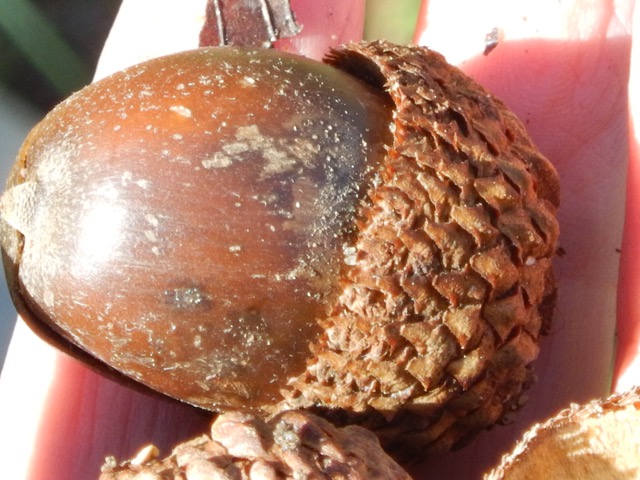
A huge Bur Oak Acorn!


The Great Red Oak, Boxerwood Gardens
Lexington VA


Here’s The Great Red Oak Tree at Boxerwood Garden at Lexington VA. The huge oak tree forms the focal gathering point of their garden and teaching for pre-K and up. Education Director, Jess Sullivan and her colleagues at Boxerwood use the Great Red Oak Tree and a squirrel puppet, Chatter, for several teaching programs.


Folkmanis Gray Squirrel Puppet from Amazon.com
Chatter's Acorn Lesson from Boxerwood


Willow Oak
Jamestown Elementary School

The Willow Oak, is the centerpiece of the courtyard at Jamestown Elementary School, and the focal heart of the school. Many students spent time learning in the canopy of the beautiful Willow Oak, enjoying the shade in the heat of the summer and the structure in the winter.


At elementary schools I enjoy teaching Goods from the Woods for 4th grade standards on Natural Resources, and Health Assessment of a Tree lesson I developed for 5th Grade standards.
I teach about Ecosystem Services of Trees using i-Tree Design or i-Tree Canopy (suitable for 4th - 8th Grade outdoor learning) with focus on the Oak, Maples, Pines and other trees in the schoolyard.

For any tree, with a simple tape measure and using a laptop or tablet with i-Tree Design, it is easy to calculate the dollar value of some major ecosystem contributions of the tree: stormwater/runoff mitigation, contribution to air quality, CO2 uptake of any tree, and the energy impact on nearby buildings. That's cool to know, and fun to compare different trees. It is good to appreciate the living value of trees and their contribution in ecosystem services, in addition to their timber value, aesthetic value or commercial value for products.


Insect-Oak Relationships
Oak leaves often have an array of insect eggs, scale and galls on them.  Pick a few leaves and see what you can find.
Galls are under-researched and an interesting insect/plant symbiosis. This year we found several scale insects on a young Willow Oak and fun pink woolly gall that looked like a bit of pipecleaner.


Dr.Doug Tallamy (Professor in Entomology and Wildlife Ecology at University of Delaware and author of bestseller Bringing Nature Home) tells us that a single oak tree can support 534 kinds of lepidoptera (moths and butterflies). You usually will be lucky too finding evidence of insects living on your native oak trees!

Raking Leaves
I compost the oak leaves we rake up in the school courtyard and teach 1st, 2nd and 3rd grade students about decomposers.


First graders rake up oak leaves as a service learning project to clear their garden bed - and make a huge leaf pile for the Pre-K classes to have fun jumping into!

Collecting Acorns and Acorn Viability Testing
Will your acorn grow into a mighty oak tree? Has your acorn been chewed by a mouse, or drilled into by a weevil? Testing acorns for viability is a fun experiment for elementary and middle school students. Gather lots of acorns. Set up an aquarium full of water, tip in the acorns. Do they sink or float?
  • The acorns that sink are likely to be viable (as they have seed still inside). 
  • The acorns that float, will have been eaten by an animal or our otherwise decayed. 
  • Count how many acorns floated? How many sank? 
  • How many acorns are viable? What percentage of the whole collection of acorns are viable seeds?  
  • Are any of your acorns already sprouting? Can you see a root and shoot?

Acorn as Seeds and Sprouting
Study sprouting acorns as part of your plant classification studies and introduction to dicots/monocots. By destructive testing you can split apart an acorn and find: the seed coat, root, shoot and the two food parts (cotyledons). Oaks are classified as large flowering plants, and are dicots.

Acorn Planting
Plant an acorn. Choose a viable acorn and plant it in a gallon pot, keep outdoors and moist over the winter. Keep animals away from digging in your pot and eating the acorn! Do you see the oak seedling sprout? Find a good place to plant your small oak tree in the spring.

Identify Your Acorn Caps
Look at photos of 12 different kinds of common acorn caps in the East Coast: on this LINK sourced from the USDA-NRCS plants database

Noticing Patterns
As I am teaching I highlight differences in patterns between the two major families of red oaks and white oaks. Red oaks have pointed leaves usually and white oaks are rounded. Note: acorn caps have spirals similar to pinecones, pineapples and sunflowers: the familiar Fibonacci-like spirals are a familiar pattern of how plants grow.

Resources for teaching about oaks


Next blog
There are plenty of potential for crafts beyond teaching the oak and acorn lifecycle and acorn biology. Next blog we’ll look at some crafts that use oak tree leaves and acorn caps.

Friday, July 1, 2016

Flower and Leaf Pounding

Today I am testing flower pounding. I check the craft out online on Pinterest, and find Life Labs Art in the Garden pdf and their how-to YouTube (see Resources).  How does flower pounding work in practice?

Flower pounding to make bookmarks

Time of year: fall, spring, summer

Age range: 3 years - adult

Time to prep: 20 minutes
Time for activity: 20 - 40 minutes

Materials
Fresh flowers and leaves
Recommended flowers: Rose Campion, Coreopsis, Marigold, Lavender, Impatiens, Lobelia, Violets, and leaves from Parsley, Ferns, Japanese Maple
Hammers and mallets -  a selection
Wide painter’s masking tape (1 ½ inch)
Watercolor paper (140 lb), or experiment with other porous heavyweight papers

For bookmarks, in addition:
Plastic bookmark sleeves (2 ½ inch x 7 inch)
Raffia or ribbon ties
Try a selection of hammers and mallets

Preparation
  1. Get together the materials: paper, painters tape, hammers and the mallets
  2. Prepare for the class by pre-trimming the paper into trim paper into either:
    - bookmark sizes (say 2 ¼ inch x 7 inch) to fit in plastic sleeves
    - or notecard size (say 3 x 8 inch) to fit in envelopes
    Note: Each student will probably make two or three samples.

With class
  1. Go out to the garden and harvest a handful of a variety of fresh flowers and leaves each. Note that some flowers and leaves will leave more pigment on the paper.
    Flowers and leaves from the garden in July
  2. Cut stems and calyx off the flowers. For large flowers, such as coneflowers, discard centers, and use only the petals.
  1. Work on the ground outdoors, or indoors on the floor or on a cutting board stabilized with a dishtowel or use a phonebook underneath as work surface.
  2. Cut pieces of painter’s tape about 7 inches long for your bookmarks (or length to fit notecards).
  3. Place the flowers and leaves face down on painters tape strip. Or put leaves and flowers onto the paper? Which works best?


  4. Then place the painter’s tape down onto the watercolor paper
  5. Now pound on top of the tape with a hammer. Make sure to hit each section of tape many times.
  6. If you need to dampen the sound, you can place a phonebook under the paper.
  7. Peel back the tape, and look at the paper to see if any area needs more pounding.
  8. Peel off all the tape. Colors from the leaves and flowers will have left a print on the paper.
  9. Remove any flower debris that is still stuck to the paper.
  10. Allow your paper to dry. Use as a notecard, or for a bookmark, or as a decoration.
  11. Laminate your bookmark or put in a plastic bookmark sleeve - and finish with a ribbon or raffia tie

Extensions
Fabric: Try flower pounding using a firm woven pale cotton fabric such as muslin instead of paper. Place the fabric over the flowers and leaves, and pound directly. Watch the color of the flowers and leaves come through the cloth.  

Mordant: Soak the cloth (or experiment with paper) in a salt or soda mordant solution overnight and then dry, before using. The salt/soda solution acts as a mordant for the pigment. Recipe for a yard of fabric is 4 T Alum, 3 T Cream of Tartar, 24 cups of very hot water, mixed together in non-reactive stainless steel or enamel bowl. Put in fabric, stir and leave for 30-40 minutes until cool. Dry in cool dryer or hang out, and iron flat before using.

In my practice
  • Parsley and Fern leaves left recognizable green images
  • Purple Japanese Maple leaves left faint reddish patterns
  • Magenta Rose Campion and purple Petunia flowers imprinted as purple
  • Lavender and pink Purple Coneflowers made brown smudges


Resources
Mallets: $3.99 from Ace Hardware

Other examples online
Life Labs - The Fine Art of Flower Pounding - pdf from Art in the Garden page 189.

Flower Pounding Note Cards

How to: Hammered flower and leaf prints

Laura C Martin, The Art and Craft of Flower Pounding

Two New Learning Labs Launch

Two powerhouse websites, both called Learning Lab, recently launched to support pre-K-12 education with digital online resources.
  • One Learning Lab provides digital resources for the Smithsonian Museums.
  • The other Learning Lab is associated with the US Green Building Center and Center for Green Schools.
  • Smithsonian’s Learning Lab is free, and USGBC’s Learning Lab is free until August 2016 and then by subscription.
  • Add both these resources to your teaching toolkits.
  • Check back as the resources grow.

Here’s my first exploration of both these new Learning Labs:

Smithsonian’s Learning Lab -  a Virtual Fieldtrip to Discover Create and Share
I view the video introduction, check out resources, and read threads related to Pandas, Hot Air Balloons and Robots.
  • How to link these and other reading resources to my K-5 outdoor lessons?
  • How can I share these resources with students, parents and teachers?
  • How about using the Smithsonian's collections of museum objects?
I click to Exploring Essential Questions With A Group of Objects, and come across a beautiful collection of tools and innovation.

I bookmark this page for a teen after-school enrichment group that I will be working with on The Food Project. From a 5-minute browse on the Smithsonian’s Learning Lab, I now know where to come back for future links to millions of Smithsonian resources, and I can plan a virtual fieldtrip!

“Not everyone can come to the Smithsonian, but they can visit the Learning Lab to inspire and design their own digital learning experiences,” said Stephanie Norby, Director of the Smithsonian Center for Learning and Digital Access.

US Green Building Center’s Learning Lab - Education for Sustainability (EfS)
After registering with USGBC’s Learning Lab, I easily access their resources.


I download a series of three lessons and films on soil science from Nature Works Everywhere designed for grades 6-8. This I can also use with my after-school enrichment groups including The Food Project. While on the Nature Works Everywhere site, I check out their resources and lesson plans on bees and pollination to add to my collection for my after-school and in-school programs!

I bookmark a module on the theme of “water” from other partners: the Sustainable Intelligence curriculum designed by EcoRise Youth Innovations and Representaciones e Inteligencia SustentableThe curriculum is mapped to current standards, and available in Spanish and English. I download the water lesson plans include songs, images and sounds of rain and a waterfall, and add these to resources for my work with a Montessori school.

I will check back often as these resources from the Smithsonian and USGBC and their Learning Lab partners grow.


Learning Lab Resources
Smithsonian’s Learning Lab - https://learninglab.si.edu/
USGBC, US Green Building Center’s Learning Lab - https://learninglab.usgbc.org/

Bookmark both for your green STEM and 'education for sustainability' (EfS) toolkits!

Add a comment below on how you are using these resources.

Thursday, June 2, 2016

Observation: Ants, Networks and Communication

By Mary Van Dyke

Interested in the everyday, networks and communication? 

This afternoon, I take about 100 3rd Grade students out to learn about soil erosion in the schoolyard. We come across small holes and miniature-hills on the playing field. The kids scuff the dust. Thinking? About the heat, soccer? Bees? Ants?
Studying schoolyard erosion and Red Maple roots
At supper this evening, I watch tiny ants carry a part of a skipper butterfly's wing 20 feet or so across the concrete patio. First one ant on its own, then another tiny ant join in. The first ant gives up at a big 1/4 inch high twig. A third ant arrives and takes over, and manages to flip the wing over the twig, and then haul the butterfly wing another 10 feet or so across the concrete. 
Ant with Skipper Wing

Meanwhile, we feed the ant colony some tiny slices of watermelon, fairly close to their walking lines. In a few minutes first 1, then 2 or 3 then, 5 or 6 and soon a dozen or so ants gather around the tiny slices of melon. 
Ants eating Watermelon
I need to read again EO Wilson and listen to Deborah Gordon on how ants communicate and whether they plan their trips? Deborah Gordon has devoted a lifetime to studying ant colonies, their networks and communication.  And I recollect a radioshow I heard a few years ago on AI, simple operations and swarm networks.

It is interesting to watch the ants for half an hour or so on the patio - and I have yet to discover the nest or where they were going. As I clear away supper, I plan to watch the ants again tomorrow.

The next day, I find the ant's nest. It's a large colony in crack in the pavement and their main nest is under a flower pot. There is another trophy wing there, but not the skipper wing, and I see a dead fly.  I am now intrigued to observe these ants over the summer!
Ant Paper Cutout Banner by Mary Van Dyke

References
EO Wilson


Deborah Gordon - interest in ants, networks, communication and AI