Wednesday, May 13, 2015

Plan and Plant a Three or Four Sisters and Brothers Garden

First Grade are ready to go outside and plant, but first we need to plan our garden.

It's going to be a Three or Four Sisters and Brothers Garden.
Sunflowers at Jamestown Elementary School
August 2014

by Mary Van Dyke

Who or what are the Three or Four Sisters  - and Brothers?
I have a basket with food items from the grocery store: popcorn, maize, beans, pumpkin seeds, and sunflower seeds to discuss with the students. 
Popcorn, sunflower seeds, pumpkin seeds, cowpeas

Today I had pumpkin seeds in my granola. I might have sunflower seeds as a snack and popcorn when I get home from school, and make bean soup for supper. Corn, beans and squash (pumpkins and gourds) are the classic Three Sisters crops. Add sunflower seeds, and you have the Four Sisters crops. Native American traditionally planted these three or four crops together in a garden as they support each other like sisters and brothers.

Gourd Seedlings

The corn is usually planted in the middle of the garden, and then the beans grow up and vine around the corn. The squash: pumpkins and gourds grow on hills in the corners of the garden, and the sunflowers can be planted around the edge of the garden. Beans have nodules on their roots that are able to fix nitrogen from the air and provide other plants nutrients. The squash have big leaves that crowd out weeds.  The sunflowers are tall and might protect the garden from wildlife or provide wildlife food and act as a decoy for the other crops. Sunflowers also produce chemicals that suppress other plants, so can help keep down weeds too.

Planning
Outside we have two long thin beds (12 foot x 4 foot) for our garden space and three classes of 24+ students.

I sketch and discuss a couple of plans and design options on paper, and include the first graders in the design process.

Design #1 we make one garden, with the two beds, all working together in stages. Here's corn in the middle, the sunflowers around the edge, the hills for squash, and the beans...


Design #1 for one garden over two beds

Design #2 with 6 small gardens in the two beds

Design #2 we could make 6 gardens, with the two beds...

We decide to go with Design #1 and work together as one big team.

I've pre-soaked giant sunflower, assorted gourd, cowpea and heritage red corn seeds to show the class and for us to plant.

The students are going to plant a seed each and make a popsicle stick label for the seed.


Planting
The students were very excited to be outside working in the soil and found worms and grubs. We also weeded as well as planting.
With 25 students in a class the planting works best with small groups of 2 - 4 students.

Care
Here's my sign for the garden that will link to the project progress.


Sign with QR Code link to the project photos


This garden is outside the school building: factors affecting growth will include wildlife and passersby. The earth too I notice is mostly a deep layer of leaf mulch and may need additional digging. I will monitor the project over the next few weeks. The classes will set up a watering schedule.

I also plant some seedlings at home and bring to school to show germination and also in case we need to replant.


After a week or two the seedlings in the tray are growing and I transplant them outdoors and give some away to another school. 
The Three or Four Sisters Garden needs weeding as the mugwort is growing too! And the seedlings need regular watering if it is not raining.


This Three or Four Sisters and Brothers Garden is a "legacy garden".  These First graders will come back as Second graders in the fall to observe the development of the garden over the fall, and hand it on to the new classes of incoming First graders.


Tuesday, May 12, 2015

You’re invited to a School Garden Meetup, Jamestown Elementary School - June 8, 4 -5 PM

Interested to share and learn more about outdoor learning and gardening in Arlington schools? 

Parents, staff and community are warmly invited to drop by for a first School Garden Meetup on Monday, June 8, 4 -5 PM at Jamestown Elementary School

Details and RSVP at http://goo.gl/forms/980LWWTkIk


Saturday, May 9, 2015

Spring Garden Adventures #1 - Introductions

Today I teach the first session of a Garden Adventures program with two groups of Homeschool Club students, 5 - 8 years old.  We introduce ourselves and the Garden Adventures program. 
Students settle in, experimenting with microscopes to observe seed heads and insects.
Here's a butterfly wing!  You can even see the scales.

We then color butterflies exotic designs too.


Then we take time to make beautiful journal covers, by cutting and pasting photos from flower and vegetable catalogs.


We will use the journals for drawing, diagrams and reflection each week.

We read together the "I Like Bugs" poem by Margaret Wise Brown.
I love this poem.


Bugs! by Margaret Wise Brown
Illustrated by Carolyn Thomas

The simple rap appeals from pre-K to 5th grade, and sets the tone for respecting worms, pillbugs, grubs and other wildlife we'll find outside. 
We discuss "rules n' tools", other expectations for going outside as a class.

We go out to explore the Garden. It's a small courtyard garden managed by Master Gardeners with raised beds. Several students identify the Kale or Broccoli growing in the Vegetable Bed... 
...and take a photo of a raindrop on a leaf.

One student from each group identifies the Dogwood in bud - and tells me where another Dogwood like this grows in their neighborhood. We talk about the patterns of the Dogwood bud and flower.  Next week the Dogwood might be in flower?


On the way back to class, Ms Harrison from Parks and Recreation invites us to view the chicken eggs incubating! They will be hatching in 21 days or so...


Resources
Microscopes - Magiscopes

Next week's theme for Garden Adventures #2 is Soils

Friday, April 24, 2015

Beauty and Science: Design with Hummingbirds in Mind


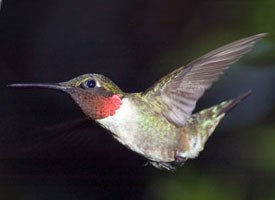
A glimpse of green and red?

Ruby-throated Hummingbird Photo
Ruby-throated Hummingbird
www.allaboutbirds.org
Your first sighted hummingbird?


Turn Your Yard into a Hummingbird Spectacular
Selasphorus Hummingbird, SP. Photo: Roger Levien/Audubon Photography Awards


15 species of hummingbird are common in the US and Canada. The ruby-throated hummingbird is our local visitor to the Mid-Atlantic region. But aren't ruby-throated hummingbirds too small and too shy to observe in schoolyards here?

Hummingbirds will come to schoolyards as well as home gardens.
The key factor to attract ruby-throated hummingbirds is that they need their preferred food sources: tubular, mostly red-flowered nectar-producing plants.

Plant these native plants to attract and feed hummingbirds in our area throughout the season:
Red Columbine, Coral or Trumpet Honeysuckle, Scarlet Beebalm, Cardinal Flower.
Red Columbine
Aquilegia canadensis
Thriving in dry-shade, Arlington Traditional School

Red Columbine
Aquilegia canadensis
April 2015


Red Columbine - Aquilegia canadensis
Adaptable to soil conditions and thrives in sun and part-shade
Flowers from April
Three-season appeal
Freely self-sows and is a great plant for spring school or club plant sales
Coral or Trumpet Honeysuckle
Lonicera sempervirens
Taylor Elementary School, Arlington

Coral or Trumpet Honeysuckle
Green Spring Gardens, Fairfax County

Coral or Trumpet Honeysuckle - Lonicera sempervirens
Sun to part-shade
Needs to climb, so train on trellis
Reproduce by layered-cuttings
Coral honeysuckle flowers spring to fall
Scarlet Beebalm
Monarda didyma
Flowering in Shenadoah National Park, VA

Scarlet Beebalm
Monarda didyma
Flowering in my yard Arlington, VA

Scarlet Beebalm - Monarda didyma
Prefers fairly damp sites
Contain the planting borders as Beebalm spreads by roots as well as seeding
Flowers late in summer, July to September
Attracts hummingbirds, butterflies and native bees and honeybees
Red Cardinal Flower
Arlington Science Focus School

Red Cardinal Flower
Green Spring Gardens, Fairfax County, VA

Red Cardinal Flower - Lobelia cardinalis
and Blue Cardinal Flower - Lobelia siphilitica
For sale at Watermark Woods Nursery, VA

If you have a courtyard or area protected from rabbits and deer, also try
Red Cardinal Flower - Lobelia cardinalis

You will notice all these plants have the red tubular flowers that the hummingbirds enjoy feeding from. I've also seen hummingbirds in my yard feeding from the eye-catching yellow early spring-flowering Carolina Jessamine, orange Turk's-cap Lilies (Lilium superbum) and coral-colored Agastache rupestris.
Turk's Cap Lily
Lilium superbum
in my garden, Arlington, VA

Agastache rupestris
Licorice Mint
in flower, Arlington, VA
and native to South-Western US

For native plant resources local to Northern Virginia consult Plant NoVA Natives.
Toni Genberg, Arlington Regional Master Naturalist and partner author of the inspirational and informational blog ChooseNatives.org, lists resources for native plants in the Mid-Atlantic region. Toni, in  addition to native plantings, recommends an easy-to-clean hummingbird feeder such as the Dr JB's feeder.

Dr. JB's 16 oz Clean Feeder for Hummingbirds


For school students:
Study hummingbirds and recording observations, and arrival and departure of visiting migrant hummingbirds as part of a citizen science program such as Journey North's Hummingbirds or Audubon Society's Celebrate Hummingbirds.
The datasets compiled over years contribute to our understanding of climate change.

Reflect on the moment of delight and wonder.
Here's my poem about a hummingbird I saw and heard last year.

Chance

I hear a soft call
And turn to see the hummingbird:
Hover, glance and fly away


Resources:
nest
Image: Dorothy Edgington
 Journey North - Hummingbirds

ruby hummer
Image: Laura Erickson


Journey North - Hummingbirds
https://www.learner.org/jnorth/humm/index.html
Program with maps and apps, and learning resources to observe and record the migration of hummingbirds in your area of the United States.
Your school can contribute data and record their arrival and departure in your area.


Project Budburst
http://budburst.org/

A national citizen science program focussed on the timing of plant cycles (phenology).
Observe and record the time of the budding, flowering and seeding of flowers such as Aquilegia canadensis in your schoolyard.
This year the Aquilegia is out in my yard one week prior to my hummingbird first sighting.

Audubon Society - Celebrate Hummingbirds
National program.
Download the Hummingbird app to record your sightings and contribute to citizen science.

Cornell Lab of Ornithology - Life Cycle, History, Bird Songs
http://www.allaboutbirds.org/guide/Ruby-throated_Hummingbird/id

Native Plants for Northern Virginia - www.plantnovanatives.org for further information on native plants in Northern Virginia, demonstration native plant gardens and local resources.

ChooseNatives.org - for further information on selecting native plants for the Mid-Atlantic region

Credits:
Thanks to Toni Genberg (ChooseNatives.org) for inspiration and insight.


Wednesday, April 22, 2015

Kindergarten Learn About Seeds and Plant Beans

How to plant beans with 25 kindergartner students?
There's lots of ways to group the students for optimal learning.  Today with Ms Zamora's Spanish classes we are indoors, and will plant a couple of bean seeds in plastic bags.
The students are learning to practice awareness, appreciation and stewardship...

First we recap plant parts: flor, hoja, raiz, semilla, tallo. 

Then I show some crop seedlings that have been given us by Arlington Food Assistance Center. One or two students recognize the salad as lettuce, some others recognize the blue-green cabbage family seedlings as kale. We identify the collard seedlings. Students mention spinach and carrots and I describe those too.


I also show a mini-greenhouse with beans, squash, corn and sunflowers planted three days ago.

The beans are sprouting, and pushing up a shoot and roots as the seed splits.  The sprouts have grown since breakfast time!
Look at the three different kinds of seeds on the plates: here are cornbeets and cucumber.


We also pass around living seed potatoes  and see the green shoots beginning to grow out of the eyes.

Ms Zamora runs through what plant needs to grow - sun or light, water, air, a place to grow and for roots to anchor.  Ms Zamora's diagrams are on the whiteboard.

Planting Beans Activity
The individual student activity is to:
a) Label/name your quart plastic bag with Sharpie
b) Add a scoop of soil to the quart bag (the place). The soil is damp from the rain last night, so we don't need to add more water
c) Add dos frijoles - two beans
d) Leave in the light to grow for a few days and observe


I find a very large grub and a white pebble in the soil sample.  This is an excellent opportunity to discuss non-living and living things which is on the K curriculum.  The grub has six legs and will change (through metamorphosis) into a beetle. Some students find worms in the soil. We discuss that the soil has many other animals in it, and bacteria and fungi, some too small to see. It looks and smells like pretty healthy soil!

Ms Zamora's classes will observe the beans germinating over the next few days.
This is part of an extended and successful project growing vegetables outdoors. It is very much a partnered project with the school custodians helping students and Ms Zamora to plant, water and look after the vegetables.

Today also Jose, one of the custodians, planted red onions in the vegetable patch outside Ms Zamora's class.

Ms Zamora will then use the onions and other vegetables planted here as a teaching tool later on with many classes. Classes will also sample salads and other vegetables. Over the summer tomatoes will be growing and Ms Zamora will add photos of the ripening vegetables on her website for students and families to see.

Thank you to Ms Zamora and the generosity of the school custodians and families for enabling this learning about growing food and nutrition in both Spanish and English for many students at Jamestown!
Thank you to Arlington Food Assistance Center for donations of seeds and seedlings.


Signs of Life: Second Grade labeling project

This is the second lesson in a project with a second grade class to label plants and the worm bin in the school courtyard.
In the fall I introduced the idea of labelling to the students and we looked at some examples of signs. Students visited the courtyard and reported in sketches and notes on Post-It's what they think a school audience would be interested to know more about on a sign.

This next lesson, students select a plant to label. The format of the label is a 5 x 7 inch Google Slide with a photo image, a sentence or two, and a QR-code to some more information.
Examples of 11 x 7 Garden Plot QR Code Signs using Google Slide format
Printed in color laser on polyester paper
by Mary Van Dyke for Jamestown ES

Draft examples in black/white of formats for 5 x 7 and 5 x 3 plant labels
by Mary Van Dyke

In this second lesson we work in small groups over two hours. I take six groups of four students out.
We tour the courtyard, highlighting the ecosystem value of the plants or plants with interest. Each student has pencil and paper clipped to a whiteboard.  Students can choose whether or not to diagram, sketch and annotate as we tour.

At the end of the tour we convene in the new popup greenhouse dubbed "the White House".

Students group into pairs, each pair decides which plant they would like to label. Some students - as an extension activity - choose to also diagram their selected plant.
After the class I tabulate the choices for the teacher - names of students, selected plant to label, whether or not it is native to northern VA,  and links to information resources on each plant.

The plants chosen today include:

The big native Willow Oak in the center of the courtyard that provides shade for us, and feeds the squirrels and provides shelter and habitat for other animals, and soaks up lots of rain too!

The flowering native Redbud tree where we notice lots of different kinds of native bees drinking nectar and pollinating the flowers.


The spectacular red and white Tulips that kindergartners plant each year.

Apple trees, where we see a ladybug.

Lavender - as its crushed leaves smell amazing.


The exotic rose-flowered Camellia

And beautiful native blue Bluebells


The Boxwoods that remind several students of Colonial Williamsburg.


Students also chose to study and label the beautiful flowering strawberries.


And the native Common Milkweed that is about to sprout in this bed.

Some students will label the worm bin - where today we observe worms, decomposing oak leaves, pillbugs and a spider.

This was a beautiful morning for this lesson.


I notice that given a choice, most second graders did chose to draw and diagram.
Some students though chose to only listen, rather than draw and annotate.
It will be interesting to see if the students who only listened, will design labels and signs as clear as the students that opted to diagram?

Next steps on this "Signs of Life" project over two weeks.
  • Students work on writing a sentence or two about their chosen plant and develop a 7 inch wide x 5 inch high Google Slide with image, text and QR-code
  • Print with color laser on to Xerox Never Tear water-resistant paper
  • Metal sign holders, 7 x 5" horizontal available from SATO retailers, e.g. Speciality Tag and Label
Resources
See my recent blog on labelling and QR Codes