Saturday, October 18, 2014

Numbers in Nature at the Chicago Museum of Science and Industry


In Chicago with kids? Then take time to check out the Numbers in Nature exhibition at the Museum of Science and Industry.

"Your kids will never look at the world around them the same way after seeing the stunning new exhibit Numbers in Nature at the Museum of Science & Industry. This new permanent exhibit aims to make math fun and relevant for kids by illustrating how mathematical concepts are all around us in our everyday lives."

More at

Wednesday, October 1, 2014

Seeing Math Patterns in Nature - For Kids of All Ages

Here's a preview of my presentation for a workshop on Seeing Math Patterns in Nature for the National Science Teachers' Association, NSTA Conference in Richmond, VA, 16 - 18 October.  This is timely, as the October 2014 issue of the NSTAs Science and Children e-Journal is on "Patterns" too.

In my workshop, we'll take a look at plant growing patterns that you see in pinecones, pineapples, sunflowers and other plants that are easy to find in your garden, schoolyard and grocery store - and we check out Fibonacci and non-Fibonacci sequences.

Here's my powerpoint:


Seeing Math Patterns in Nature from MaryVanDyke

As Vi Hart might say,  "Are you still feeling spirally today?"
If so, give yourself 20 minutes and check out her YouTubes:
Doodling in Math: Spirals, Fibonacci, and Being a Plant Part 1: http://youtu.be/ahXIMUkSXX0

Part 2: http://youtu.be/lOIP_Z_-0Hs
Part 3: http://youtu.be/14-NdQwKz9w

And also spend a minute or two playing with Wolfram Mathematica's interactive models.
My favorites are:

Fibonacci Tree by Sandor Kabal

3D Spirals by Stephen Wolfram

On the Fundamental Theory of Phyllotaxis by Dmitry Weise


Enjoy the math.
It's as easy as one plus one...and then some.

Friday, September 26, 2014

Count Your Sunflower Spirals - and Fibonacci and Lucas Sequences

I'm continuing research for a presentation on Seeing Math Patterns in Nature - and I am looking at growth patterns in sunflowers and other plants.

Sunflower - photo by Mary Van Dyke
Current estimates are that 90% of plants follow the Fibonacci sequence: (1 1 2 3 5 8 13 21 34 55 89... ) for optimum flow of auxin, the plant growth hormone, and evolutionary adaptation to maximize efficiency in packing seeds.

Here's Ron Knott's diagram of a 1000 seedhead sunflower with 89 and 55 spirals at the perimeter:


Some plant species, such as sunflowers, can follow both the Fibonacci and other sequences such as the Lucas sequence (1, 2 3 4 7 11...) - and other permutations of series too.

A big global citizen science experiment to study sunflowers and count their spirals has been running since 2012 in honor of mathematician Alan Turing's "enigma code breaker's" 100th anniversary of his birth - and the discovery of his unfinished work on the math of sunflowers.
See Turingsunflowers.com.


In 2012 people around the world planted sunflowers and counted their spirals - here's how from the Geeky Gardener - Anna Evangeli.


Fibonacci V Lucas: spot your sunflower's spiral › Science Features (ABC Science)

From the initial big data experiment of Turing's Sunflower Project - results came from 557 sunflowers from 7 countries as follows:
  • Fibonacci spiral sunflowers - 458
  • Lucas spiral sunflowers - 33
  • Double Fibonacci sequence numbers sunflowers - 26
  • Other spiral numbers - a small number of sunflowers with no apparent Fibonacci or Lucas number patterns
How about counting the spirals of the sunflower seedheads you planted in your garden this year?
Or do you plan to plant some sunflowers to count next year?


Collecting Sunflower Seeds - photo by Mary Van Dyke


Wednesday, September 3, 2014

Infographics - Talking Pictures

A picture speaks a thousand words, and catches your attention and appreciation.

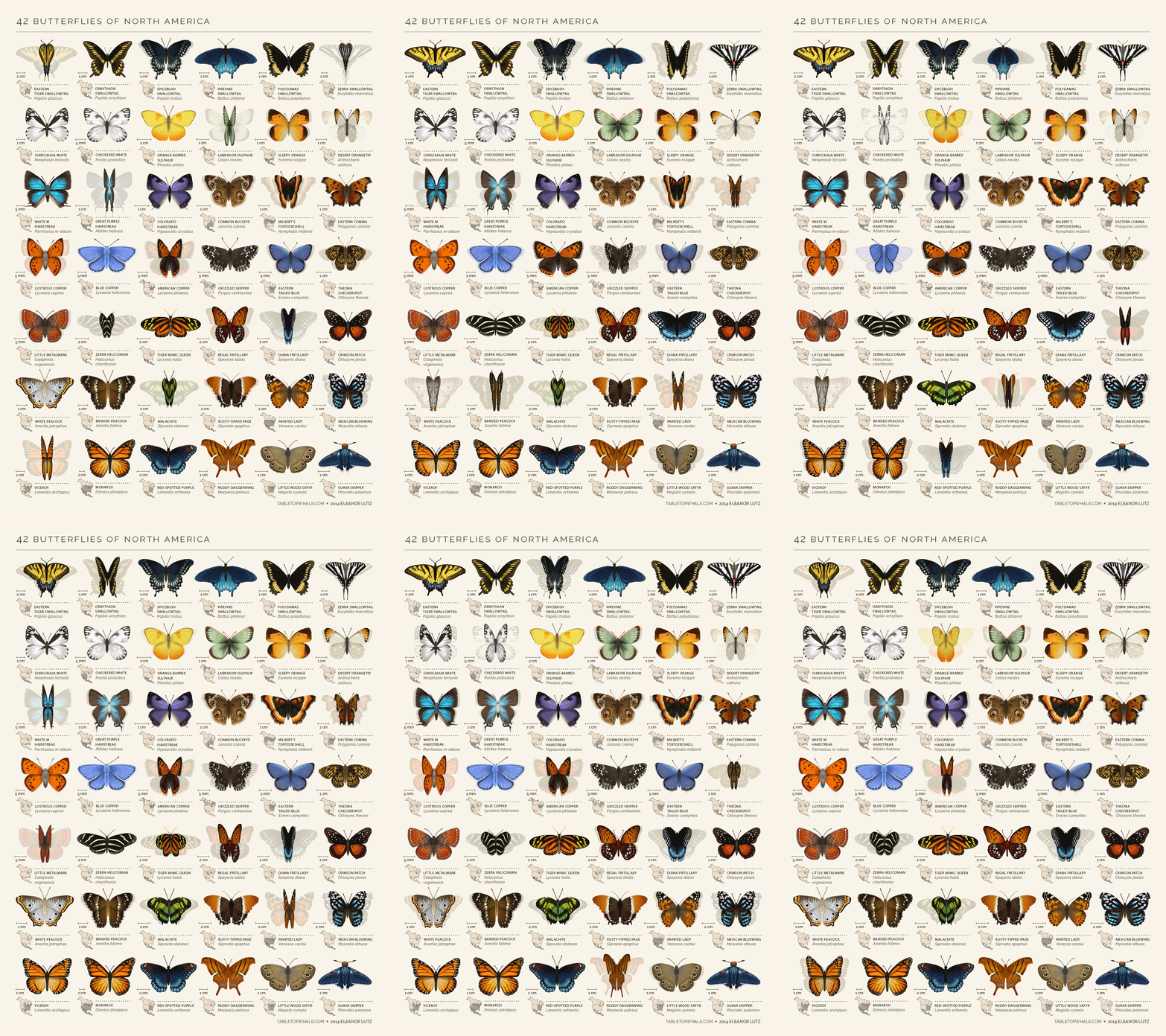
Wow your class with this fluttering butterflies infographic by Eleanor Lutz at Tabletop Whale.

http://tabletopwhale.com/2014/08/27/42-butterflies-of-north-america.html


Perhaps your students could also draw a couple of butterflies and animate them using simple gif-techniques?

Tabletop Whale publishes new infographics with science theme every two or three weeks. Check back frequently - or sign up to receive them.

Friday, August 22, 2014

Learning from Nature - Generative Design and Structural Tessellations

I am researching for my upcoming workshop on Fibonacci and Seeing Math Patterns in Nature.
I have been looking at sunflower, pinecone and branching patterns and the difference to hexagonal close-packing patterns such as in honeycombs and wasp nests.

In my google research I came across a fun blog from product designer Markus Kittner talking about "generative design and learning from nature" - and "structural tessellations and morphologies".

In the case of the Fibonacci sequence that we see in some growth patterns in nature we have a very simple input operation, that starts with the number one and simply is adding the previous number to it: i.e. the Fibonacci sequence is 1, 1+0 = 1, 1+1 = 2, 1+2 = 3, 2+3 = 5, 3+5 = 8, etc.

See more about generative design here:
http://74fdc.wordpress.com/2012/07/02/generative-design-learning-from-nature/


Find out more about the structure and economy of hexagonal honeycomb packing:

http://74fdc.wordpress.com/2012/02/10/structural-tessellations-and-morphologies/


Generative design and structural tessellations - such as seen in sunflowers, pinecones, branching patterns, and wasp nests and honeycombs, are fun applied math and design topics to explore with students K-12 both in the indoor and outdoor classroom.


Friday, August 15, 2014

Earth Force Next Steps Institute Professional Development Program in DC includes Agriculture and STEM Pathway

See http://www.earthforce.org/NSI for details of this Earth Force professional development program: Next Steps Institute, NSI, for teachers in STEM education.

Are you interested in agriscience, food and sustainability?
One of the pathways you can choose at this year's NSI is Harnessing the Power of Agriculture with STEM.


The Next Steps Institute (NSI), powered by Earth Force, is the premier professional development program that promotes hands-on, minds-on learning in STEM education. Organized by pathways that take participants on an engaging journey into critical STEM learning arenas, the Institute offers the depth and breadth of content needed to enhance effectiveness in action and advocacy around STEM.
NSI offers participants:
• Inquiry-based professional development at an affordable cost;
• Tools for effective materials management; and
• Strategies for promotion of 21st century STEM skills using an educational partnership model.

2014 Next Steps Institute: Integrating STEM Learning in Communities
Georgetown University Hotel and Conference Center
3800 Reservoir Rd NW, Washington, DC 20007
Sept. 22-23, 2014
Registration closes September 16, 2014 at 11:59 p.m. EST.
Rooms are available for $149/night. Click here to reserve your room.

   Cost:
Individual - $360
Team of 3 or more people - $330 per person


NSI_website


See http://www.earthforce.org/NSI for further details of all the pathways.
Here below is the promo for the one focused on Agriculture and STEM. 

  • Harnessing the Power of Agriculture with STEM
Building an educated workforce with the skills and expertise necessary to sustain the world’s growing population is at the core of this pathway. Responsible for our food, water, shelter, and energy, agriscience provides a compelling and relevant context to address current issues and events on global and local scales. This pathway, facilitated by faculty from Murray State University and DelCastle Technical High School, takes an issues-based approach to understanding the ways agriscience deepens student understanding of STEM content using relevant, real-world examples.
Come share and generate best practices in teaching and learning that excite students and demonstrate the relevance of agriscience now and in the future. Problem-solving and inquiry-based activities provide a structure for learning crucial content, including: biofuels, crop management, biodiversity, conservation, nutrition, and genetics.