Saturday, November 28, 2015

Here Today, Gone Tomorrow: Ephemeral Nature-Based Art

By Mary Van Dyke

Andy Goldsworthy, the British sculptor and photographer, is famous for his meditative focus on the ephemeral in nature-based art. Think photos capturing instants in a process: melting snow circles in arctic light; leaves in spectral colors placed in a streamflow; rocks balancing.
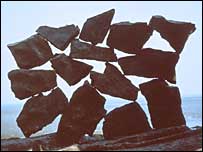
Balanced Rocks - Andy Goldsworthy
Andy Goldsworthy
Nature-based art is a great fall activity for school students of all ages, embracing change, decay, creativity and the delight of being “in the flow”! Here are examples of Backyard Art inspired by Goldsworthy, arranged and photographed on iPads by 3rd and 4th Graders at Jamestown Elementary School, in a project taught by art teacher, Mary Gaynor.

Backyard Art by 3rd and 4th grade students at Jamestown Elementary School
inspired by Andy Goldsworthy
Project facilitated by art teacher Mary Gaynor
NOVA Outside, Northern Virginia’s regional alliance of environmental educators, recently hosted a workshop with Amy Perlman Gura, artist, teacher and parent who "strives to integrate her passions for the creative processes of art and nature." The result was an afternoon of teamwork creating ephemeral collaborative art and some very inspired Early Childhood Educators.
Voices from the Land (Voices) has created a school-based industry on creating poetry and art books and hosts teacher workshops integrating language and the landscape, art and culture. Inspiration comes from Andy Goldsworthy and a growing tradition of eco-art.
Find out more at the Voices website http://www.sharingvoices.org/ and collate your students visual and language arts into a poster, calendar or a album book as a more permanent record. If you’d like to know more - you can sign up for a Voices workshop near you or in a place you’d like to visit. This year Voices held a workshop in Ireland.
Voices from the Land Album from the Readingzone Blog
Voices from the Land, 2011, 2012
by Second Graders at Daniels Run Elementary School, Fairfax VA
Displayed at NoVA Outside's School Environmental Action Showcase
April 9, 2015
Photo by Mary Van Dyke
Next time you’re outside, collect and arrange some pinecones, acorns, sticks, leaves, flowers, stones and pebbles - and access your own creativity - even for a moment! Just go outside and do it! As Goldsworthy says, "A lot of my work is like picking potatoes; you have to get into the rhythm of it."

Mary Van Dyke is Visiting Horticulturalist at Jamestown Elementary School and serves on the Advisory Committee of NoVA Outside, a regional alliance of environmental educators in Northern Virginia.


Resources

Amy Perlman Gura

Andy Goldsworthy
NoVA Outside - a regional alliance of environmental educators in Northern Virginia
NSTA Early Childhood Blog


Voices from the Land (Voices)


Tuesday, November 3, 2015

Green STEM Ed: Learning and Teaching

Reposting of Green STEM: STEM as It's Meant to Be by Laura Arndt and Anne Tweed

"Roland Quitugua, a leading scientist in the U.S. territory of Guam, stood before a room of 60 public school teachers, describing his tireless efforts to eradicate a devastating problem on the tiny island in the Western Pacific: the Coconut Rhinoceros Beetle....

See full article at http://ow.ly/U0UbR

Reposting from: http://www.advanc-ed.org/source/green-stem-stem-its-meant-be

Sunday, October 18, 2015

Green Apple Day of Service - at Jamestown Elementary School

Green Apple Day of Service
Today is a beautiful crisp fall morning for our Green Apple Day of Service at Jamestown Elementary School!

Green Apple Day of Service is an initiative run by the Center for Green Schools at the US Green Building Council to help promote service learning in schools here in the US and around the world. Green Apple Day of Service - like Earth Day is on a specific day - but you can schedule your event to suit your community. The Green Apple website has plenty of how-to’s on organizing service events: flyer templates, web advertising, media toolkits, email signatures and yes, merchandizing too. We use the website and flyer to advertise our event - as a native plant habitat restoration in the front entrance area of the school. I look at the checklist to make sure our event planning is on track.
Downloadable Resources from greenapple.org
include banners, badges, email signatures

Landscape issues

There’s already some native and ornamental plants in Jamestown’s front entrance garden - but I notice there are also lots of fast growing weeds and many large areas of bare brown mulch. First, we identify the weeds. Alan digs some weed samples up - roots and all - and we identify and label them: dandelion, crabgrass and mugwort.
  • Dandelions grow deep and need to be dug out.
  • Crabgrass spreads by rhizomes, underground stem
  • Mugwort re-grows from tiny parts of broken underground stem


Why are these weeds thriving in this garden area? We dig deeper into the mulch.
Tom finds the crabgrass roots are layered like a cake and are over a foot deep!  Yu-hsin and Wendy find a tangled network of bindweed roots under the top layer of mulch. 


What’s happening? Once or twice a year, this garden bed is weed-whacked and mulched over by a maintenance crew. The intentions are admirable, and the routine of weed-whacking and over-mulching is the norm for maintenance crews here. But this ground maintenance method actually worsens our weed problem. Only 8 weeks after being mown to the ground and mulched by the crew the weeds are back in force. The crabgrass, mugwort and the bindweed all re-grow new plants and sprout easily from the tiny parts of broken underground stems. These weeds grow a new mat of roots up into the new layer of mulch and then sprout up above ground.  The weeds outcompete the ornamental and native plants we are trying to cultivate.  
Mugwort

Plant Native Plants to Enhance Biodiversity

With 30 or so people here today we accomplish a lot of work and have time to play. We plant native plants that are not yet in the schoolyard that will help increase the biodiversity in this garden area.
Watering newly planted Fothergilla

Planting Aster


I select the native plants from Plant NOVA Natives to be tolerant of the extreme conditions in our school garden and for beauty in the fall and spring as well as summer.  We also plant purple and yellow pansies for instant effect and beauty. Some plants I bought at a market, most are donated native seedlings. Let’s hope these new plants will take root, and we and our native wildlife can enjoy their flowers and foliage over the next year or two.
Visit PlantNOVANatives.org for more information


Conversations and Community in Action

We chat while we work: this is community politics in action and at the heart of service learning and sustainability. We talk about longer term needs. Should we consider alternative management practices?  If weed whacking and mulching doesn’t work - what will?  How do we lessen the “weed bank”?
Options we bandy around include:
  • annual “weed-whacking and mulch” maintenance with the landscape crew as usual, augmented by another Green Apple Day, or
  • apply chemical weed-killers, or
  • mechanically remove the entire soil structure and redesign the whole front area to include a playground, or
  • pave over this entire area too if the school is ever rebuilt
These are only some of the options to consider: each comes with environmental and social pros and cons and issues. For example, we need to remember that chemical weed-killers are not allowed on school grounds. Inevitably each option comes with a price tag. While we work today we are visited by John, videographer from Arlington Public Schools Green Scene. John interviews many of the people here today about the event. Here is the link to his Green Scene film compiling three schools Green Apple Days of Service - including Jamestown's. I enjoy chatting and meeting people too, and I come away with many impressions, including a Pennsylvania Dutch recipe for eating dandelions with bacon dressing.
Planting Rudbeckia - Black-eyed Susan

Collective Impact and Green Apple Days

Several people tell me they enjoy the morning, and ask me if we could arrange more outdoor Green Apple Days over the year. To me that’s a sure sign of success. Although this garden area at the front entrance of the school needs ongoing maintenance, we have to consider what other projects could use collective attention and time. There are plenty of other places in the schoolyard for service projects and that might attract community to join in. Maybe at our next Green Apple Day of Service we could pull invasive vines off the trees and shrubs in our wood area near the school?  Or we could beautify the native plantings on the other side of the school or we could look after the vegetable patch? All of these jobs can be done easily by groups. Together we can accomplish far more than any one of us could do alone - and we help our school look beautiful, be a more healthy community and we learn while we work. This is collective impact, and service learning and a reason to have another Green Apple Day!


Thank you!

With thanks to many for enabling our first Jamestown Green Apple Day of Service including:


Alan, Anisa, Barbara, Bethany, Carl, Chris, Clementina,  David, Elizabeth, Eric, Jason, Jade, Jenn, Jerome, John, Jose, Kenwyn, Phil, Susan, Tom, Wendy, William, Yu-hsin, the Navigators families and all the Jamestown community families helping today!


Resource Links


Article by Mary Van Dyke
Mary Van Dyke is Visiting Horticulturalist at Jamestown Elementary School, Arlington, VA, where she facilitates outdoor learning and the outdoor classrooms. Mary was recently recognized by The Center for Green Schools with their Good Apple award for her work promoting healthy, safe and sustainable learning environments.

Monday, October 5, 2015

Join us for "first Monday" monthly APS School Garden Meetups - today's is at Campbell Elementary School, Arlington, VA

Please join us for today's Arlington Public Schools - APS School Garden Meetup!

Monday, October 5, 4 – 5 PM
At Campbell Elementary School, 737 S Carlin Springs Road, Arlington, VA, 22204
Hosted by Christy Przystawik and Jessica Haney
Come and see the Campbell Wetlands Learning Lab, learn about Campbell’s Expeditionary Learning Community, see the Hugelkultur beds and other gardens and more!
All are welcome, including accompanied children. Rain Plan: We will meet indoors
Sign in at the school front office and follow directions to where we’ll be meeting, in the courtyard, weather permitting. Please RSVP:  http://goo.gl/forms/c19jMx2hO3
outdoor drawing - hopscotch
  • Network with parents & staff
  • Learn about Campbell’s Expeditionary Learning Community
  • Discover Campbell’s Wetlands Learning Lab, Hügelkultur Gardens, food growing programs and more!
  • Learn about our volunteers and community connections
  • Connect and get inspired
  • Share best practices and curriculum ideas
  • Brainstorm solutions
journaling in wetlands on bench

This is the second APS School Garden Meetup, following up on the April 2015 APS Growing Green Schools event. 
Read about the first APS School Garden Meetup at Jamestown Elementary in June 2015.

SAVE THE DATE: for the next School Garden Meetup at Patrick Henry ES School Garden, Monday 
November 2, 2015, 4- 5 PM 
Come to network, exchange best practices and learn about Patrick Henry ES’s Habitat and focus on Service Learning “Helping Hands”
Host Susan Spranger
on Monday, November 2, 4 – 5 PM
RSVP to Patrick Henry School Garden Meetup http://goo.gl/forms/mDIFweZykD

Please join us for School Garden Meetups 
at other schools in Arlington over the year.
We are meeting most months on first Mondays.
Please contact GrowingGreenSchools@gmail.com to host a School Garden Meetup or for further info.

APS
 School Garden Meetup organizers:
Jessica Haney, Mindful Healthy Life
Mary Van Dyke, Green STEM Learning

Reposting from Mindful Health Life and the APSGreenSchools listserve

To join the APSGreenSchools listserve to receive future notices about the APS Garden Meetups and other area events and to share green schools information in the Arlington VA community - please send an e-mail to: 
APSGreenSchools-subscribe@yahoogroups.com with the name of your Arlington Public School (APS) or affiliation/interest group

Monday, September 14, 2015

Use All the Senses: Observation 101

Back-to-school and introducing the basics of inquiry-based science.
How to build students' skills of awareness and observation using the senses whether you are indoors or out?

Introduce the senses, including the five senses: sight, hearing, taste, touch, smell and others such as the ability to sense electro-magnetic fields and non-visible light and radiation. Talk about the anatomical adaptations that allow us and other animals to sense our environment and various types of energy.


Here’s some ideas for easy sensory activities for pre-K through 4th grade.

Sight

  • Look around the class, look for specific colors
  • What do you see indoors?
  • What can you see outside through the window?

Hearing

  • Read a "sound" poem e.g. Summer Song in A First Book of Nature by Nicola Davies
  • Play some notes and music
  • Listen to sounds in the classroom. What do you hear: air conditioning, cars, people chatting?

Taste

  • Discuss taste and flavor and link to tongue and nose receptors
  • If you can, bring in some washed herbs, such as parsley, thyme, sage, mint and rosemary for students to taste

Touch


Materials
Cloth bags or paper lunch bags - to share one bag per child or one bag between two students

Tactile objects one per bag
Preparation
Fill each bag with a tactile object: include some natural found objects such as seashell, pebble, feather, grass seedhead, pinecone. Also add some small treasures such as a piece of textured cloth or a small basket.


Activity

  • Give each student a bag and ask them to not look inside
  • Invite students to put a hand carefully inside their bag and feel the object and try to guess what’s inside, and describe to the class.
  • After everyone has taken a turn, then students take out their object to share other features such as color.

Smell


Materials
10 ½ pint preserving jars with lids
10 cottonwool makeup pads
10 different scents e.g. cinnamon, vanilla essence, lavender flowers, tea tree oil, lemon essence, orange essence, coconut essence, ginger root, peppermint essence.
Stickers numbered 1 to 10


Preparation:
Make sure jars are clean and dry.
Put a small amount of a spice or few drops of  an essence on a cottonwool pad and place in jar.
Put numbered sticker on jar lid and make list to key, e.g. #1 is cinnamon, #2 is vanilla.


Activity
  • Put jars 1 through 10 on tables in front of students, with lids off and with numbered stickers up for reference
  • Have students list numbers 1 through 10 on a sheet of paper and walk around gallery-style to sniff the jars and describe and guess what is the scent they can smell in each jar
  • Which smells are familiar? Which smells do you prefer?
  • Refer to your keyed list of the jars and scents if need be


Outdoor Extension for Using All the Senses
How do you feel outside? Is it warm or cold today?
Play a sensory scavenger hunt to look for, see, observe and identify animals and plants in the schoolyard
Shut your eyes and listen - what do you hear now we’re outside? A plane, the wind rustling leaves, people chatting, crickets, squirrels, birds?
Smell the roses or other flowers. Dig up some earth and smell it.
Pick some edible herbs, fruit or vegetables. Remember to wash before you taste or when you return to the classroom.

  • Embellish your conversation about the senses with some amazing animal facts from the Neuroscience for Kids website.


This week I facilitated a lesson on Using the Senses with two groups of homeschool students. The students enjoyed the tactile and scent activities, and listening to the sounds inside the classroom and outdoors. Out in the playground we also found several spiders and several vines. The students learned to identify and distinguish between English ivy, Poison ivy, Wild Grape and Porcelainberry and had lots of fun finding acorns.

Next week we’ll study ants!


Resources:


Gardening With and For Kids: Use All the Senses from Mary Van Dyke


  • A First Book of Nature by Nicola Davies
  • Sensory Scavenger Hunt by Arlington Regional Master Naturalists
  • Amazing Animal Senses on the Neuroscience for Kids website https://faculty.washington.edu/chudler/amaze.html